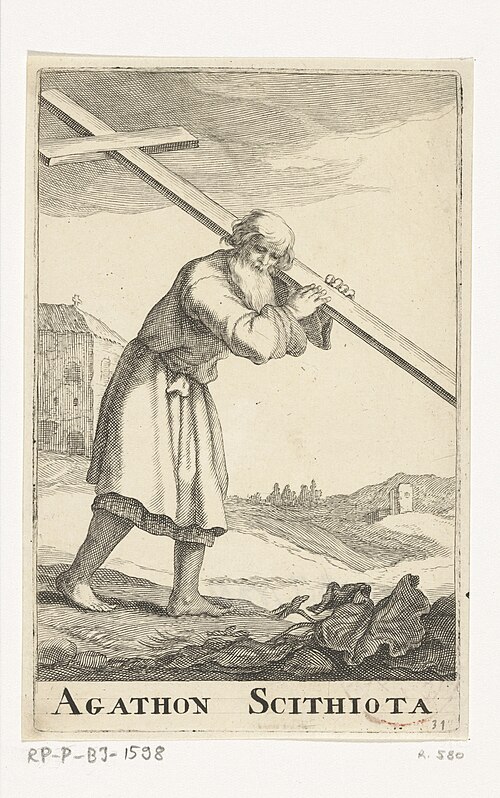
Venerable
Agathon of Egypt
Desert Father
Monk of Scetis in Egypt, known for meekness and discernment, one of the Desert Fathers.
- Feast
- March 2old style March 15
- Reposed
- 4355th century
- Place
- Tinnis
- Order
- Venerables
Life
Venerable Agathon of Egypt was an Egyptian monk of Scetis, one of the Desert Fathers, known for his meekness and discernment. He lived in the fourth and fifth centuries and fell asleep around the year 435. He is remembered on 2 March (15 March on the new calendar).
Apprenticeship
Abba Agathon was trained in the Thebaid by Poemen when he was a young man. According to the Sayings of the Desert Fathers, Poemen held him in such regard that he called him “Abba” (father) although Agathon was still young. He was also a disciple of Abba Lot and a contemporary of great fathers of the desert, such as Amun, Macarius, Joseph and Peter. He lived in Scetis with Alexander and Zoilus, who were later disciples of Arsenius. After the destruction of Scetis he moved near Troe, close to the Nile, with his disciple Abraham. A Russian source says that he lived forty years with his parents, then ten years in the desert, then fifty years more as a stylite.
Struggle and examples
It is said that he often travelled taking nothing but the knife he used to make wicker baskets. Even in old age he provided everything he needed by manual labour. He is even said to have lived three consecutive years with a stone in his mouth, to learn silence and restraint of speech. He accounted himself the most sinful of all men.
Once certain monks came to test him and falsely accused him of being a fornicator, a speaker of nonsense, proud and a heretic. He accepted all the accusations as true except that he was a heretic. When they asked why, he said: “The other sins I must ascribe to myself, for every man is liable to err and all of us, by our corrupt nature, are drawn unwillingly by passions, but heresy is separation from God, a willing renunciation of the Truth of God.” Amazed by his humility, they left edified. He once admonished a brother who wished to take a single green pea discarded at the roadside, and told him never to take anything that was not his; likewise he commanded another brother who had brought a piece of nitre from a tree to return it. He charged his disciples to sell their goods in the market at the first price the buyer asked and likewise to buy at the first price named, without bargaining. Once he met a sick man on the road to the market, took him to a cell and paid the rent four months, until he was well. Another time he saw a paralytic by the roadside; the man asked to be carried to the market, and the abba carried him, spent all the proceeds of his sale on the things the man asked for and then brought him back to where he had found him; suddenly the man told him that he had divine virtues and vanished: it was not a paralytic but an angel who had come to test him. In the Prologue of Ohrid it is told that a monk complimented him on a small knife he used to cut brushwood, and the abba immediately gave it to him as a gift. He also said: “It would please me to take the body of a leper and give him mine.” Asked which labours are more important for salvation, the outward or the inward, he answered: “Man is like a tree; outward or bodily labour gives leaves, and labour of the soul bears fruit. But as Scripture says that ‘every tree that does not bear good fruit is cut down and thrown into the fire,’ it is clear that the greatest care should be on the fruit. The tree also needs leaves, to keep its sap and so that their shade protects it and the fruit from drying heat.”
Repose
At his death Abba Agathon remained three days with his eyes open, not speaking, gazing intently at something. The brothers asked him where he was, and he said that he was at the Judgement Seat of God. The disciples asked him if he was afraid; he said: “Until this moment I have done my utmost to keep the commandments of God; but I am a man; how should I know if my deeds are acceptable to God?” When they asked further: “Do you not hope in your good deeds?” he answered: “I do not hope until I see God. The judgement of God is not that of man.” Immediately after these words he passed to the Lord. Dorotheus of Gaza twice quotes the last words of Abba Agathon in his exhortations to his monks. His death is placed around 435, according to some sources at the age of a hundred.
Commemorated the same day March 2
 Pelagius I of RomeSaint · Bishop of RomeMar 2
 Chad of LichfieldSaint · Bishop of LichfieldMar 2
 Non of WalesSaint · Mother of Saint DavidMar 2
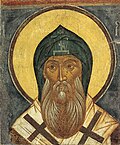 Arsenius of TverSaint · Bishop of TverMar 2
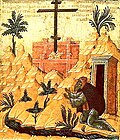 Sabbatius of TverVenerable · Founder of Sabbatius HermitageMar 2
- Theodotus of CyreniaSaint · Bishop of CyreniaMar 2
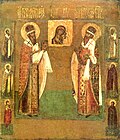 Savva of TverVenerable · Abbot of the Presentation MonasteryMar 2
- Barsanuphius of TverVenerable · Abbot near TverMar 2
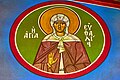 EuthaliaMartyrMar 2
- Joachim of IthacaVenerable · Monk of VatopediMar 2
- Nicholas PlanasRighteous · Priest of AthensMar 2
- Quintus of PhrygiaConfessor · The Wonderworker of PhrygiaMar 2