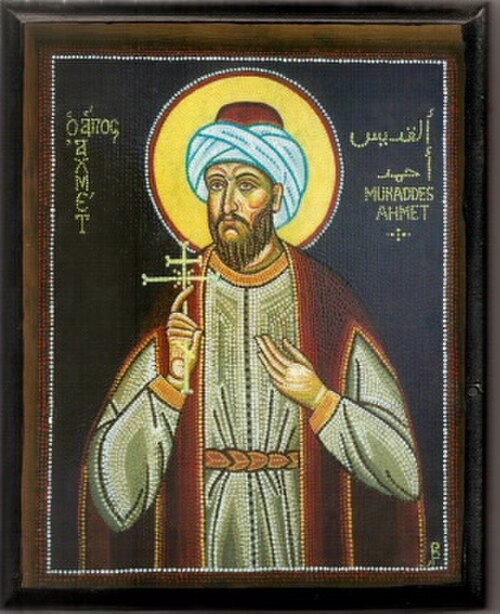
New Martyr
Ahmed the Calligrapher
Ottoman official of Constantinople
Ottoman official of Constantinople who converted to Christianity and was martyred on May 3, 1682.
Life
Saint Ahmed the Calligrapher, the New Martyr (also called Christodoulos), was a Turkish official of Constantinople in the seventeenth century who was baptized in secret and beheaded for his faith in Christ on 3 May 1682. Only Christian hagiographical sources speak of him. The Church commemorates him on 3 May and on 24 December (6 January by the new calendar), under his baptismal name, Christodoulos.
Ahmed's household
Ahmed was born into a Muslim family of Constantinople, in the seventeenth century, and worked as a secretary and calligrapher in the sultan's chancery, in the service of the empire's chief scribe. He was a man of influence. Being unmarried, by the law and custom of the time he took as his concubine a Christian slave, an Orthodox Russian woman. Being very devout, she received from Ahmed permission to confess her faith freely and to go to church, together with another, older slave. The two went to church on feast days, and the old woman brought the young one antidoron and holy water.
In time Ahmed began to take an interest in their faith. He was struck above all that, when the young woman returned from church, a pleasant fragrance came from her mouth. One day he asked what she ate at church that smelled so. She answered that she ate only blessed bread, antidoron, and drank holy water. Ahmed grew intrigued and asked a priest to keep him a hidden place in the church from which he could watch the Liturgy served by the Ecumenical Patriarch. The priest allowed it. Ahmed laid aside his clothes and the white turban, the sign of Muslims, and put on Christian clothes and the blue turban worn by Christians. According to some sources he stayed hidden in the church for several days.
The vision and baptism
Christian tradition says that Ahmed then saw the Patriarch walking without touching the ground, with the chalice in his hand. When the Patriarch blessed the people, rays of light burst from the chalice and fell on the heads of all the Christians present, but not on his own. By another account, he saw the priest shining high above at the Great Entrance, and from the Patriarch's hands rays of light came upon the heads of the faithful, except on his own. Moved, Ahmed asked a priest to baptize him in secret and received baptism. From then he confessed his faith in Christ in hiding, because he would have lost not only his property but his life: by Ottoman law he would have been an apostate and faced the death penalty.
Confession and martyrdom
In time the Turks began to doubt his loyalty to Islam. One day a group of officials who were quarrelling asked him his opinion. He answered that there is nothing better than the Christian faith and that the God of the Christians is the greatest thing in the world, all others being pale beside Him. Those present began to beat him and handed him over to the authorities. For this he was brought before Sultan Mehmed IV and the judge.
Brought before the chief judge, Ahmed confessed that he had received the Orthodox faith after a revelation and that he hoped with all his heart that they too would come to know the truth. The angry judge threw him into prison and ordered him left without food or water for six whole days. When he appeared a second time, Ahmed said that the fast had purified him and that Jesus Christ had revealed to him the deepest mysteries of the faith. His conviction was so unshaken that, the Life says, it would have been easier for the judge to crush stones or make fire with his hands than to change his mind. He was then brought to the sultan, who threatened him with beheading. Ahmed answered that such a punishment would be for him the greatest joy. The sultan pronounced the sentence and Ahmed was beheaded on 3 May 1682. He was entered on the list of saints under the name Christodoulos.
His body was thrown on the shore of the Bosphorus, and according to the Life, the place where it was thrown shone for a long time with a supernatural light. The Serbian Orthodox Church commemorates him on 24 December by the old calendar (6 January by the new).
Commemorated the same day May 3
 James the LessApostle · The ApostleMay 3
 Theodosius of the CavesVenerable · Abbot of the Kiev Caves LavraMay 3
 Juvenal of NarniHieromartyr · First Bishop of NarniMay 3
 Peter of ArgosSaint · Bishop of ArgosMay 3
- Oecumenius of TriccaSaint · Bishop of TriccaMay 3
 Xenia of KalamataGreat MartyrMay 3
 Primianus of LarinoMartyrMay 3
- Gabriel the New MartyrNew MartyrMay 3
- 27 MartyrsHoly MartyrsMay 3
- AdalsindisVenerableMay 3
- Aethelwine of LindseySaint · Bishop of LindseyMay 3
- Aldwyn of PartneyVenerableMay 3