Saint
Oecumenius of Tricca
Bishop of Tricca
Bishop of Tricca in Thessaly, to whom Greek commentaries on the New Testament are attributed, in the 10th century.
Life
Oecumenius of Tricca (in Greek Οἰκουμένιος) is the name under which several Greek commentaries on the New Testament have been preserved. For a long time he was held to be bishop of Tricca (today Trikala) in Thessaly, writing around 990. Present research shows the matter is more tangled: not all these commentaries are by the same author or from the same time, and the oldest of them dates from about 600. The Church commemorates him on 3 May (16 May by the new calendar), and his memory is honoured above all in the diocese of Trikala in Greece.
What is known
Almost nothing certain is known of the life of Oecumenius. The name "Oecumenius of Tricca" appeared only in 1715, when Bernard de Montfaucon published in the "Bibliotheca Coisliniana" the summary of a commentary on the Apocalypse found in the Coislin codex 224. Its first sentence attributes it to "the blessed Oecumenius, bishop of Tricca in Thessaly". Tricca is the old name of the town of Trikala. Nothing else is known of this bishop. Archbishop Filaret (Gumilevsky) took him to be the same as the author of the Commentary on the Apocalypse. According to Sixtus of Siena, Oecumenius also wrote a commentary on the first eight books of the Old Testament, but it has not survived.
The writings
Under his name there have survived interpretations of the epistles of the holy Apostle Paul, of the catholic epistles, of the Acts of the Apostles and of the Apocalypse. As an interpreter, Oecumenius follows chiefly Saint John Chrysostom and other holy Fathers, and often includes in his works long quotations from their writings. His commentaries can be counted as catenae, that is, collections of the interpretations of several Fathers.
In February 1532 the Veronese Hellenist Bernardino Donato published a volume dedicated to Pope Clement VII, with collections of commentaries on the New Testament. Those on the Acts of the Apostles, the Pauline epistles and the catholic epistles were attributed to "Oecumenius", and those on the Apocalypse to Arethas of Caesarea. Several Latin translations soon appeared, among them that of the Dominican Jean Henten. A bilingual edition of the commentaries of Oecumenius and Arethas appeared at Paris in 1631, by Frédéric Morel, and was reprinted in Migne's Patrologia Graeca. The Commentary on the Apocalypse was first edited by John Antony Cramer in 1840 to 1844, and the most recent edition is that of Marc De Groote in 1999. An English translation was made by John Suggit in 2006.
The commentaries on Acts and on the catholic epistles are almost identical with those attributed to Theophylact of Ohrid, with small additions, omissions or transpositions. But manuscripts older than Theophylact survive, which excludes the idea of a simple copying of his work. The commentary on Paul's epistles also resembles Theophylact's work but has a distinct form, a step between the chain of interpretations and a commentary proper. Most interpretations are unsigned, but others quote several authors, among them Patriarch Photius and Oecumenius himself. The attribution of all three sets to the same author is arbitrary, since they were assembled by unknown compilers around the tenth century. Otto Bardenhewer doubted the authorship, and Ehrhard wrote that the name Oecumenius is, in the present state of research, a riddle that can be solved only by a thorough critical study of the manuscripts.
The Commentary on the Apocalypse
In 1901 the German theologian Franz Diekamp discovered at the university library of Messina the original commentary of Oecumenius on the Apocalypse, written not in the tenth century but in the sixth. It is in the codex Messina S. Salvatore 99, from the old monastery of the Holy Saviour in the city, a manuscript of 139 leaves in two columns containing the commentary alone, with the title "Interpretation of the Apocalypse of the divine evangelist and theologian John, written by Oecumenius". Much more incomplete copies are in the Vatican codex 1426 and in the Turin codex gr. 84. The text was edited in 1928 by Herman C. Hoskier and in 1999 by Marc De Groote.
It is the oldest surviving commentary in Greek on the Apocalypse. In one place the author writes that a very long time has passed, over five hundred years, since those events, and places the writing of the book toward the end of Domitian's reign, about 95, which puts the author around 600. But he is older than Andrew of Caesarea, who uses him. On the other hand, two letters of Severus of Antioch (died 538) are known, addressed to a "Count Oecumenius". It seems the recipient is identified with the author of the commentary by a note in a Monophysite chain of interpretations, which says Oecumenius was a wise man, very "orthodox" in their sense, as the letters sent by Severus show. If the author was a contemporary of Severus, then the phrase "over five hundred years" is not very exact, or refers to the time of the crucifixion rather than the writing of the Apocalypse.
If the author of the commentary is indeed Severus's correspondent, he was a simple layman, with the title of count, later a high military post, living in Isauria, in the south-east of Asia Minor, interested in theology without having penetrated the finer points of Christological and Trinitarian doctrine. Then he could not have been bishop of Tricca. On the other hand, he praises the high theological ability of Evagrius Ponticus, condemned with Origen by the Second Council of Constantinople in 553, which may show that the text is older than 553. For these reasons the name "Pseudo-Oecumenius" is sometimes used because of the uncertainty.
Teaching
Oecumenius is known as an early supporter of the sinlessness of the Virgin Mary. He is also credited with the teaching that Christ filled all things according to His flesh.
Commemorated the same day May 3
 James the LessApostle · The ApostleMay 3
 Theodosius of the CavesVenerable · Abbot of the Kiev Caves LavraMay 3
 Juvenal of NarniHieromartyr · First Bishop of NarniMay 3
 Ahmed the CalligrapherNew Martyr · Ottoman official of ConstantinopleMay 3
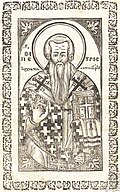 Peter of ArgosSaint · Bishop of ArgosMay 3
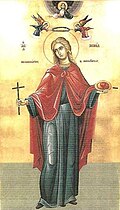 Xenia of KalamataGreat MartyrMay 3
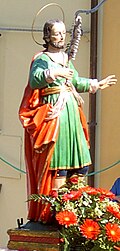 Primianus of LarinoMartyrMay 3
- Gabriel the New MartyrNew MartyrMay 3
- 27 MartyrsHoly MartyrsMay 3
- AdalsindisVenerableMay 3
- Aethelwine of LindseySaint · Bishop of LindseyMay 3
- Aldwyn of PartneyVenerableMay 3