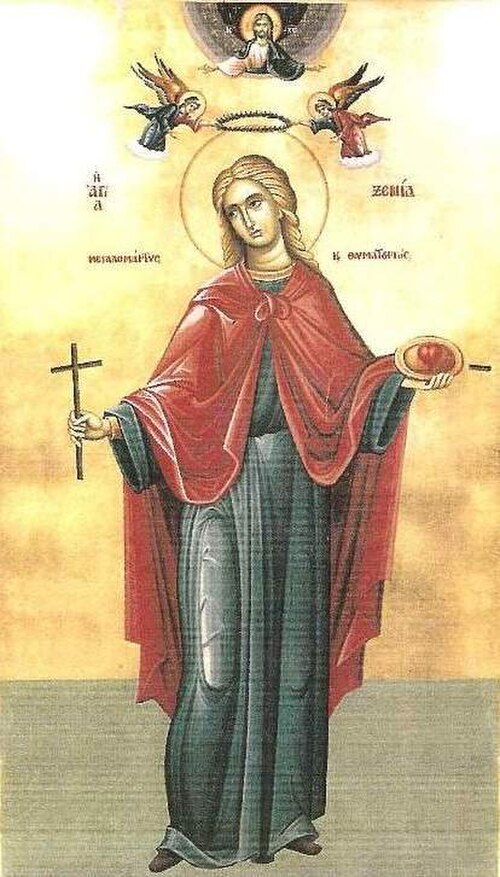
Great Martyr
Xenia of Kalamata
Born at Kalamata in 291 to parents from eastern Italy, honored as a great martyr; died in 318.
- Feast
- May 3old style May 16
- Era
- unknown
- Place
- Kalamata
- Order
- Great Martyrs
Life
Saint Xenia of Kalamata (Xenia of the Peloponnese), Great Martyr, is a saint venerated in the Greek Orthodox Church, said to have lived between 291 and 318 and to have died a martyr because she refused to marry a pagan governor. Her commemoration is on 3 (16) May. Her veneration is recent. Our sources show that it began in the twentieth century, on the basis of a priest's vision and a manuscript of uncertain origin, and they give no formal act of canonization.
Life according to the manuscript
According to the life published in 1946, she was born in the third century at Kalamata in the Peloponnese, in the family of Nicholas and Despina, who had come from eastern Italy. The parents, Christians, moved to Kalamata fleeing persecution and settled on a farm outside the city, since her father was a farmer. From childhood Xenia longed for God, loved prayer and preferred to help her family rather than play. Grown, she stood out for unusual beauty, tall, with a beautiful face, blue eyes and long golden hair. She did not wish to marry, resolved to keep virginity and give herself to God.
Once, while she was working in the field, the pagan governor Domitian, a harsh and cruel man, saw her and wanted by all means to make her his wife, but she refused again and again. Domitian went to magicians to bewitch her, but the saint drove off the spells by prayer and the sign of the Cross. Seeing that he did not succeed, he ordered her thrown into prison and tortured. She was tied to a post, her body was burned and scraped, but in the morning she was found whole and healthy. Enraged, Domitian ordered her tied by the feet to a horse and dragged through the city, but the horse did not move. She was led to a pagan temple to offer sacrifice to the gods, but at her prayer an earthquake occurred that destroyed the temple. Remaining unmoved after long torments and glorifying Christ, the eparch ordered her beheaded and her heart brought to him. Xenia accepted death with joy, saying a prayer of thanks. The soldiers took out her heart and put it on a dish, and the body they cut into pieces and burned. A beautiful fragrance came from it. The Christians gathered the ashes, from which miracles began to flow. Domitian was soon struck by lightning while hunting. Through prayer to her, the possessed, the paralysed and those with diseases of the eyes, heart, skin and nerves were healed. She is depicted as a fair-haired girl with a cross in her hand and her heart on a dish.
Veneration
The veneration of Great Martyr Xenia long had only a local character in the Peloponnese, and the saint was not known to a wide circle of the faithful. At the beginning of the twentieth century, in the United States, the Greek priest George Nassis saw in prayer a girl with long golden hair and blue eyes, who introduced herself as the martyr Xenia and commanded him to paint her icon. After searches a manuscript by Constantine Byzantios of Constantinople was found, with her life. Father George copied it and published it in 1946, with a service and a paraklesis he composed. In 1993 a church in her name was built at Kalamata. She is depicted on the icon of the Synaxis of the Saints of Messenia, beside Venerable Hierotheos the Iberian.
Commemorated the same day May 3
 James the LessApostle · The ApostleMay 3
 Theodosius of the CavesVenerable · Abbot of the Kiev Caves LavraMay 3
 Juvenal of NarniHieromartyr · First Bishop of NarniMay 3
 Ahmed the CalligrapherNew Martyr · Ottoman official of ConstantinopleMay 3
 Peter of ArgosSaint · Bishop of ArgosMay 3
- Oecumenius of TriccaSaint · Bishop of TriccaMay 3
 Primianus of LarinoMartyrMay 3
- Gabriel the New MartyrNew MartyrMay 3
- 27 MartyrsHoly MartyrsMay 3
- AdalsindisVenerableMay 3
- Aethelwine of LindseySaint · Bishop of LindseyMay 3
- Aldwyn of PartneyVenerableMay 3