
Venerable
Theodosius of the Caves
Abbot of the Kiev Caves Lavra
Monk who brought cenobitic life to Kievan Rus, abbot of the Kiev Caves Lavra, who died in 1074.
- Feast
- May 3old style May 16
- Reposed
- 107411th century
- Place
- Kyiv
- Order
- Venerables
Life
Venerable Theodosius of the Caves was a monk and abbot of the Kiev Caves Lavra in the eleventh century. Together with Venerable Anthony of the Caves he is counted the founder of Russian monasticism. He brought to Kievan Rus the rule of communal life, after the rule of Saint Theodore the Studite, from where it spread to the Slavic monasteries. He fell asleep in the Lord on 3 May 1074.
Childhood and calling
Theodosius was born at Vasiliv, near Kiev, in a well-to-do family. The year of his birth is uncertain: the older sources give 1029, more recent scholars place it between 1008 and 1038. His father, a man of arms, was transferred by order of the prince to Kursk, where the saint's childhood and youth were spent. There he learned Holy Scripture, reading and church singing, and his father died when he was thirteen.
He loved prayer and wore chains on his body. His mother, described in his Life as God-fearing but harsh and domineering, opposed his wish to give himself to God and beat him. A first attempt to set out for Jerusalem with pilgrims failed. For three years he baked prosphora for the church at Kursk and gave to the poor what he earned from selling them.
Around 1055 he left home for Kiev. The monasteries turned him away because of his youth, and he went to Venerable Anthony. He was tonsured a monk, according to some sources by Anthony himself, according to others by Nikon, and settled with them in the cave. According to tradition, his mother sought him out and called him home, and he advised her to enter a convent herself.
Abbot
Theodosius was ordained hieromonk, and around 1062 (the sources also give 1057) he was chosen abbot of the monastery, after Varlaam. He raised a wooden building into which all the monks moved, about a hundred of them. Around 1068 he asked Constantinople for the Studite rule, on which the first rule of the Lavra was drawn up. In his time the great church of the Dormition was begun, finished in 1078, and one of the first church libraries in Rus was founded.
The saint shepherded not only monks but also laypeople. Among his spiritual children was Prince Iziaslav, and when Sviatoslav overthrew his brother in 1073, Theodosius, a man of great humility, resolutely opposed him. His Life tells of many miracles. Dressed in old, ragged clothes, which Nestor says shone on him like imperial purple, he spent every Great Lent shut in the cave with little bread. The door was blocked with earth, and the brethren spoke with him only through a small window and only in need.
Repose and relics
He fell asleep in 1074 after a short illness, asking to be buried at night in the cave where he shut himself in Great Lent. On 14 August 1091 his body was taken up, as Nestor the Chronicler relates; it was found incorrupt and was moved to the church of the Dormition. In 1108 his name was entered in the synodikon and his veneration became general. His Life, written by Nestor, is the oldest Russian hagiographic work and belongs to the Paterikon of the Caves.
His main feast is on 3 May, and a second, for the finding of his relics, on 14 August. The Far Caves of the Lavra and a spring in the Lavra bear his name.
Commemorated the same day May 3
 James the LessApostle · The ApostleMay 3
 Juvenal of NarniHieromartyr · First Bishop of NarniMay 3
 Ahmed the CalligrapherNew Martyr · Ottoman official of ConstantinopleMay 3
 Peter of ArgosSaint · Bishop of ArgosMay 3
- Oecumenius of TriccaSaint · Bishop of TriccaMay 3
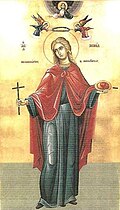 Xenia of KalamataGreat MartyrMay 3
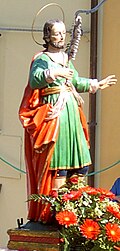 Primianus of LarinoMartyrMay 3
- Gabriel the New MartyrNew MartyrMay 3
- 27 MartyrsHoly MartyrsMay 3
- AdalsindisVenerableMay 3
- Aethelwine of LindseySaint · Bishop of LindseyMay 3
- Aldwyn of PartneyVenerableMay 3