Hieromartyr
Alexander Krylov
A Russian priest who died a martyr for his faith in Christ during the communist persecution.
- Feast
- December 26old style January 8
- Reposed
- 193820th century
- Order
- Martyrs
Life
Saint Hieromartyr Alexander Krylov (1892 to 1938) was an archpriest in the Ivanovo region and was shot on 8 January 1938. He is commemorated on 8 January, on 7 February with the synaxis of the new martyrs and confessors of the Russian Church, on 20 June with the saints of the Ivanovo metropolis, and on 6 July with the saints of Vladimir.
The priest Alexander Ivanovich Krylov was born on 14 August 1892 in the village of Ryakhovo, Kovrov district, Vladimir province. His father, Ivan Alexeevich, was from a peasant family, had studied at Tver and was a teacher at the school in Ryakhovo; his mother, Maria Afanasievna, was from a merchant family and died early. His stepmother, Elizabeth, was gentle and devout, and he loved her as his own mother. She taught him prayers. From early years he felt drawn to God; his father locked him in the house, but he ran out through the window to the church to pray. He told his father that he would study for the priesthood, though his father was firmly against it; his stepmother supported him and sold her dowry to pay for his schooling at the seminary. In 1907 he finished the church school in Vladimir, and in 1913 the Vladimir seminary. He then served as psalm-reader and taught religion in various parishes of the Vladimir province. From 1915 he served at the church in the village of Smerdovo, where he met Catherine, daughter of the local priest Basil Orlov, whom he married that same year; soon he was ordained priest and served at Smerdovo, because Father Basil, being ill, had been retired.
The persecutions begin
After the October Revolution the persecutions against the Church began, and Father Alexander had to change his parish often. Especially hard was the year 1920. At that time he lived in the village of Eltesunovo. The summer was hot, and a fire broke out in a house on the edge of the village; wind and heat made the fire seize a third of the buildings, and the local firemen could not put it out. Father Alexander carried out of the church the icon of the Mother of God "The Unburnt Bush" and, with prayers, went around with the clergy the houses untouched by fire. Suddenly the fire stopped and the blaze died down, so that a large part of the village was saved. Later, in December, a man with amputated hands came to him and, weeping bitterly, confessed that he had set fire to the house in the village; afterwards, drunk, he had lain long in the snow and been frostbitten, especially in the hands. Father Alexander received him in a Christian way, forgave him and heard his confession, and the priest's wife and her sister fed him. In July 1920 his father-in-law, the priest Basil Orlov, died, whom he had tended in his illness, carried in his arms when needed, anointed with the Mystery of Unction and buried himself. Besides serving in the church Father Alexander kept the household: he had a garden, an apiary, a horse and a cow, and was skilled at everything. He loved his wife and children (Maria, Lyudmila, Zoya, Zinaida and Sergius) tenderly, taught them to pray and took them to church.
The arrest of 1929
From 1929 the repressions touched him too. First the people's court of the Stavrovo district fined him fifty rubles for late payment of the self-taxation levy. In the autumn of that year the grain delivery campaign was held in the village; although by the commission's count the family of Father Alexander lacked thirty poods of bread, the village soviet ordered him to hand over as "surplus" fifteen poods of rye and eighty of oats. The family, already deprived of the cow, began to weep. Distressed by the tears of the family doomed to poverty, on 4 October he went to the village soviet and said in a raised voice to the chairman that they had no surplus and that he was being asked for the tax of a priest, not surplus; thinking of the danger of seeing his five small children, aged two to thirteen, die of hunger (and his wife was expecting another child), he even said: "If you want to hang us, hang us." He refused to hand over the grain of his own will and to sign the notice.
The camp
On 6 October he was arrested by the people's judge on a charge of "agitation against delivery of grain". On 9 October he was imprisoned at the Vladimir isolator; his wife, pregnant, walked to Vladimir to see him. On 29 January 1930 the Special Council of the OGPU Collegium decided to shut him in a camp for three years. On 22 February 1930 he arrived at Pinyug station in the Komi Republic, at the northern camps, where he worked as a digger, probably on the railway. In the camp he was respected, showed himself capable and practical, and was even made an assistant foreman. His superiors urged him to give up the priesthood and take up secular work after his release, and his brothers and sisters advised the same; he refused. Even in the camp he secretly performed services, heard confessions and buried the dead; once two prisoners who were to be shot in the morning asked him to sing the burial service, and he fulfilled their request. He returned from the camp in 1932, aged, though he was only forty, with teeth lost to scurvy.
Martyrdom
The local authorities kept persecuting him and threatening to imprison him again; he sought a new place of service and in 1935 moved with his family to the Gorky diocese, to the village of Yazykovo. After a year and a half he moved to the Ivanovo region, to the village of Ilinskoe, then in April 1937 to the village of Strelki, where the priest's place had fallen vacant; at Strelki he served and worked at the collective farm. In 1937 and 1938 the repressions against "enemies of the people" were carried out with special ferocity. Father sensed that his turn would come. Before the arrest he said to his wife: "Katya, they will soon take me. I am sorry for the children." According to his son's recollections, at home he was greatly upset over the destruction of the Cathedral of Christ the Saviour in Moscow.
On 9 December 1937, on the denunciation of some members of the community, he was arrested by the Vichuga section of the NKVD and imprisoned at Kineshma. His wife fainted; the small children wept; Nicholas ran barefoot through the snow after the departing "black raven", crying: "Father, do not go." He was accused of active counter-revolutionary agitation and of "counter-revolutionary illegal gatherings of church people" being held on his initiative. He admitted guilt only in having re-elected a passive church council in June 1937 without permission of the district executive committee. Though he admitted guilt only in part, the testimony of witnesses was considered sufficient proof. On 27 December 1937 the NKVD troika decided: "Alexander Ivanovich Krylov to be shot; his personal property to be confiscated." On 8 January 1938 Archpriest Alexander Krylov received the death of a martyr: he was shot at Ivanovo and buried at the town cemetery of Balino.
Commemorated the same day December 26
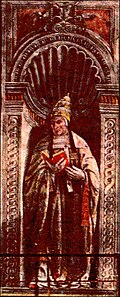 Dionysius of RomeSaint · Bishop of RomeDec 26
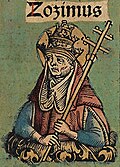 Zosimus of RomeSaint · Bishop of RomeDec 26
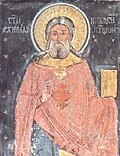 Nicodemus of TismanaVenerable · Founder of Tismana MonasteryDec 26
 Euthymius of SardisHieromartyr · Metropolitan of SardisDec 26
 Leonid AntoshchenkoHieromartyr · Bishop of MariDec 26
- Augusta ZashchukVenerable Martyr · Abbess and schemanunDec 26
- Isaac Bobrakov of OptinaVenerable Martyr · Last abbot of old OptinaDec 26
 Michael CheltsovHieromartyr · Archpriest and theologianDec 26
- Constantine of SynadaVenerableDec 26
- Constantine the RussianVenerable Martyr · HieromonkDec 26
- AbadiuHieromartyr · Bishop of AntinoeDec 26
- Agrippina LesinaMartyrDec 26