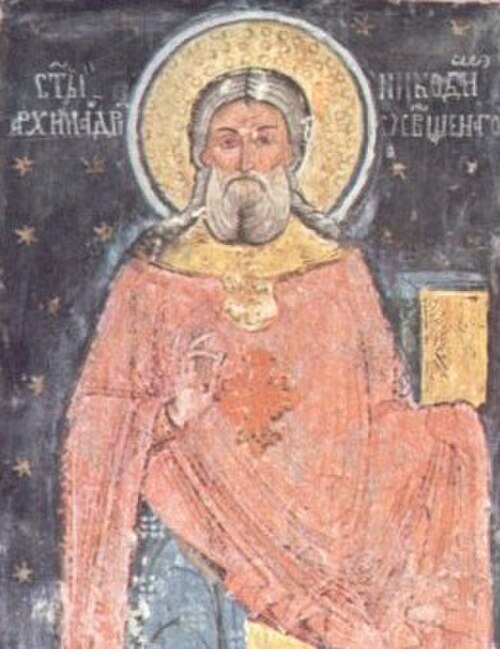
Venerable
Nicodemus of Tismana
Founder of Tismana Monastery
Monk and scribe born at Prilep, founder of Tismana Monastery in Wallachia; died in 1406.
- Feast
- December 26old style January 8
- Reposed
- 140615th century
- Place
- Tismana Monastery
- Order
- Venerables
Life
Venerable Nicodemus of Tismana was a monk, scribe and translator, born around 1320 at Prilep, founder of the monasteries of Vodița and Tismana in Oltenia and of the monastery of Manastirica in Serbia, patron of Oltenia. He fell asleep on 26 December 1406. The Orthodox Church numbered him among the saints in 1767 (in the Romanian Church the official glorification took place in 1955) and remembers him on 26 December.
Origins and youth
As to his birthplace and ancestry the sources disagree. Most probably he was born at Prilep, in today's North Macedonia, to a Greek father from Kastoria and a Serbian mother; other scholars speak of an Aromanian father and a Bulgarian mother, and the Serbian historian Đorđe Radojičić thinks he was born at Prilepac, near Novo Brdo, the birthplace of Prince Lazar, to whom he was related. Metropolitan Nestor Vornicescu held him to be a Serb, fluent in Serbian, Slavonic and Greek. The date of his birth is uncertain: the monks of Tismana say he died at a hundred and nine, which would make him born in 1297, other sources give 1310 or 1320.
Raised in piety and honesty, as a youth he met in Serbia some travelling monks from the monastery of Hilandar and went with them to Mount Athos, where he studied and laboured patiently. After the death of the abbot of Hilandar at that time, the monks chose the young Nicodemus in his place. He was a friend of many figures of his day: Prince Lazar of Serbia, the monk Isaiah, the Anonymous Athonite (Isaiah's biographer), Patriarch Euthymius of Tarnovo, the Serbian archbishop Danilo II and many others. He was one of the followers of Saint Gregory of Sinai, that is, one of the hesychasts, who struggled by the prayer of the mind.
Founder on the Danube
Prince Lazar wished to appoint him to a high spiritual office, but he refused and settled in the eastern parts of the country, near Kladovo on the Danube. Hearing of his pure life, monks gathered around him and there, at Manastirica, they founded a monastery dedicated to the Holy Trinity, in which he established the hesychast rule learned on Athos. In 1364-1365, after the Hungarians took the kingdom of Vidin and imposed Catholicism, he crossed to Wallachia. According to the Romanian sources, in 1369 he swam across the Danube opposite Orșova and founded his first monastery in Oltenia, Vodița, dedicated to Saint Anthony the Great, the founder of Christian monasticism.
When Prince Lazar sent a delegation to Constantinople for dialogue with Patriarch Philotheus, he took care that Nicodemus went with the monk Isaiah, who led the mission. In 1375 the mission succeeded in reconciling the Serbian Church with the Patriarchate of Constantinople, after the Serbian patriarchate had been anathematized in 1350. On his return Nicodemus began, in 1377, the building of the Tismana monastery, dedicated to the Most Holy Mother of God. The monastery received help from the princes Radu I, Dan I and Mircea the Elder of Wallachia, from Stefan Lazarević and from the emperor Sigismund, whose confessor the venerable Nicodemus was when Sigismund was king of Hungary. He also rebuilt the monasteries of Vișina and Prislop. Between 1399 and 1405 he withdrew to Prislop, in Transylvania, where in 1405 he copied a Tetraevangelion in Slavonic, held to be the oldest dated book of Wallachia. In 1406 he returned to Wallachia. Mircea the Elder, meeting him at Tismana, called him “our prayerful father Nicodemus,” and in November he took part at Severin in the meeting with King Sigismund, whom he impressed with his gift of working miracles. He corresponded with Patriarch Euthymius of Tarnovo, for the defence of the true faith against the Bogomil heresy.
Repose and veneration
Venerable Nicodemus fell asleep on 26 December 1406 and was buried in the narthex of the church of the Tismana monastery. Serbs, Romanians and Bulgarians each claim him as their own; he is renowned above all as patron of Oltenia and for the link he made between the hesychast tradition of Athos and the lands on the Danube. His life, written from the oral tradition of the monastery, was reworked in Romanian at the beginning of the nineteenth century by the hieromonk Stefan of Tismana.
Commemorated the same day December 26
 Dionysius of RomeSaint · Bishop of RomeDec 26
 Zosimus of RomeSaint · Bishop of RomeDec 26
 Euthymius of SardisHieromartyr · Metropolitan of SardisDec 26
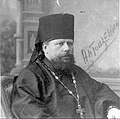 Leonid AntoshchenkoHieromartyr · Bishop of MariDec 26
- Augusta ZashchukVenerable Martyr · Abbess and schemanunDec 26
- Isaac Bobrakov of OptinaVenerable Martyr · Last abbot of old OptinaDec 26
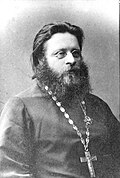 Michael CheltsovHieromartyr · Archpriest and theologianDec 26
- Constantine of SynadaVenerableDec 26
- Constantine the RussianVenerable Martyr · HieromonkDec 26
- AbadiuHieromartyr · Bishop of AntinoeDec 26
- Agrippina LesinaMartyrDec 26
- Alexander KrylovHieromartyrDec 26