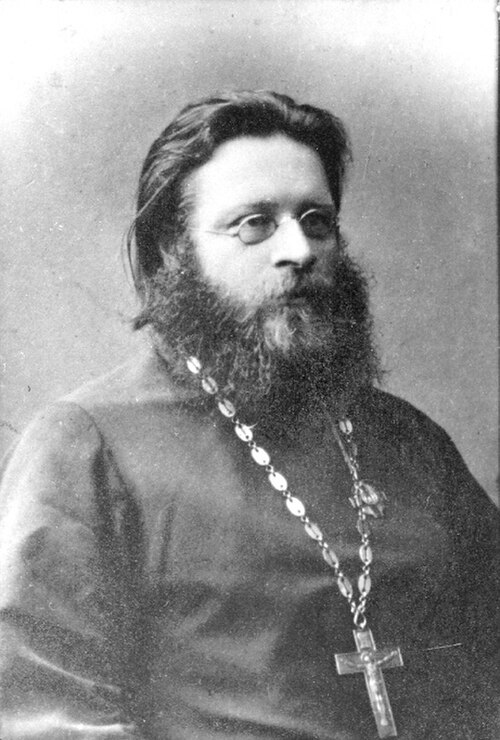
Hieromartyr
Michael Cheltsov
Archpriest and theologian
Archpriest and theologian born at Kikino into a priest's family, who died in 1931 and was canonized in 2005.
- Feast
- December 26old style January 8
- Reposed
- 193120th century
- Place
- Saint Petersburg
- Order
- Martyrs
Life
Saint Michael Cheltsov (1870-1931) the hieromartyr was an archpriest of the Russian Orthodox Church and a theologian, a teacher of religion and the author of the memoir "Recollections of a Man Condemned to Death". He was shot at Leningrad in January 1931 and numbered among the saints by the Russian Church in 2005. He is commemorated on 26 December (8 January in the new style).
Youth and studies
He was born on 27 May 1870 in the village of Kikino, Ryazhsk district, Ryazan governorate, in the family of the priest Pavel Mikhailovich Cheltsov and Agrippina Sergeevna (née Polyanskaya). His grandfather had been a deacon and his great-grandfather a priest. He graduated in 1890 from the theological seminary of Ryazan and in 1894 from the Kazan Theological Academy, with the degree of candidate of theology, with the right to teach at a seminary and to seek the degree of master without a new oral examination. From November 1894 he was a teacher at the Kaluga seminary and did missionary work. In 1898 he defended the dissertation "The Church of the Kingdom of Serbia since Its Attaining Autocephaly, 1879-1896" for the degree of master of theology.
From 1898 he was a missionary of the diocese of Saint Petersburg, author of works on missionary questions and of many articles in "Missionary Review" and other journals, and for a time worked in the chancery of the chief procurator of the Synod, Konstantin Pobedonostsev. In September 1903 he was ordained priest. From 1903 to 1905 he was co-editor and co-publisher of the monthly "Orthodox Guide". From 1903 to 1918 he was a teacher of theology at the Institute of Civil Engineers and rector of the church of Saint Simeon at this institute. His course was popular for the liveliness and clarity of its exposition. The collection of lectures "The Christian Worldview" analyses in accessible form weighty theological questions: the origin of sin, the relation of science and religion, the rift between Christianity and culture. He often spoke at religious-philosophical and church gatherings. On 6 May 1914 he was raised to archpriest.
The years of persecution
In January 1918 his home was searched at night. In March 1918 he was elected a member of the Narva district Duma on the list of the Kadet party, although he did not belong to it. At the first extraordinary assembly of the Petrograd diocese, in July 1918, he was elected a member of the diocesan council, and at its first meeting, on 15 July 1918, its chairman. In autumn 1920, when the diocesan council was dissolved by order of the NKVD, he moved to the chancery of Metropolitan Benjamin (of Kazan) of Petrograd. At the beginning of September 1918 he was arrested with other representatives of the clergy in connection with the murder of Moisei Uritsky, taken to the Cheka prison on Gorokhovaya, then to the Deryabin prison. On 2 November 1918 he was arrested again, taken to the Vyborg police station, then to the former Vyborg military prison, and released on 12 November. From November 1919 to May 1922 he was rector of the Trinity-Izmailovsky Cathedral in Petrograd.
On 31 May 1922 he was arrested in the case of "resistance to the confiscation of church valuables". He was tried in the Petrograd trial, in which, with Metropolitan Benjamin and others, he was sentenced to death by shooting. Later the sentence was commuted, as for some others, to five years of imprisonment. He spent forty days in the death cell. About his arrests, prison and trial he left the memoir "Recollections of a Man Condemned to Death about What He Lived Through", a sincere confession of a priest who prepared himself spiritually for death, overcame doubts, remembered his loved ones and waited every night to be taken. He tells that he knew from many that the shooting is done at night: in winter from evening, in summer at dawn, and that the short July nights were a great blessing; he tried not to sleep by day and, after dawn came, fell asleep calmly, because if they had left him on the cot in the evening, they would not shoot him in the morning. Once he thought his hour had come, when he heard the key in his own cell door; he sat up, crossed himself and prepared to go, with a calm soul and a kind of resolve, but the door opened, shut quickly, and he heard only: "Excuse us, we made a mistake." He spent two years in prison, then was released.
From April 1924 to September 1930 he was rector of the church of the Archangel Michael (Malokolomenskaya) in Leningrad. In 1926 he taught dogmatic theology and the New Testament at the Higher Theological Courses.
His death
He was arrested on 2 September 1930 in the case of Countess Zarnekau. In summer 1929 two émigré officers had managed to come illegally to Leningrad and take Countess Zarnekau, a daughter of the Prince of Oldenburg, abroad. The OGPU learned of the circumstances of her escape when the countess described them in the émigré press and published the names of persons she had had ties with in Petrograd. About forty persons from her circle were arrested, among them Father Michael. Shortly before his death he told a cellmate that he had lived a life not always easy, that his children had grown up, and that he should rejoice that the Lord gave him this end, and not the infirmity of old age and years of suffering on a sickbed, and that the Lord was calling him to Himself by such a blessed way. On 2 January 1931 he was sentenced to death and, a few days later, was shot.
On 16 July 2005 the Holy Synod of the Russian Church decided to include the name of Archpriest Michael Cheltsov in the Synaxis of the New Martyrs and Confessors of Russia of the twentieth century.
Family and writings
His father was the priest Pavel Mikhailovich Cheltsov. He had sons Pavel (1905-1943, arrested in 1922 in the church valuables case, acquitted, died at the front), Vasily (1908-1988, expelled in 1933 from the Leningrad Chemical-Technological Institute), Semyon (1915-1942, arrested in 1939, sentenced to ten years in camps, died in prison in the Arkhangelsk region) and Georgy (1917-2001, chief engineer, arrested in 1945, sentenced in 1946 to fifteen years in camps, released in 1955, in the 1990s a member of the society "Memorial"). Among his writings are: "The Church of the Kingdom of Serbia" (1899), "Edinoverie in Its Hundred Years of Existence in the Russian Church" (1900), "Christianity and Politics" (1906), "The Essence of Church Renewal" (1907), "On Faith and Unbelief" (1910), "Orthodox Christian Doctrine", a manual of religion (seven editions between 1911 and 1917), "Contemporary Religious Quests: Theosophy" (1914) and "The Christian Worldview" (1917), as well as "What Is the Cause of the Church Collapse of 1920-1930" and "Recollections of a Man Condemned to Death", published posthumously.
Commemorated the same day December 26
 Dionysius of RomeSaint · Bishop of RomeDec 26
 Zosimus of RomeSaint · Bishop of RomeDec 26
 Nicodemus of TismanaVenerable · Founder of Tismana MonasteryDec 26
 Euthymius of SardisHieromartyr · Metropolitan of SardisDec 26
 Leonid AntoshchenkoHieromartyr · Bishop of MariDec 26
- Augusta ZashchukVenerable Martyr · Abbess and schemanunDec 26
- Isaac Bobrakov of OptinaVenerable Martyr · Last abbot of old OptinaDec 26
- Constantine of SynadaVenerableDec 26
- Constantine the RussianVenerable Martyr · HieromonkDec 26
- AbadiuHieromartyr · Bishop of AntinoeDec 26
- Agrippina LesinaMartyrDec 26
- Alexander KrylovHieromartyrDec 26