Hieromartyr
Alexander Malinovsky
A Russian priest who died a martyr for his faith in Christ during the communist persecution.
Life
Saint Hieromartyr Alexander Malinovsky (1892 to 1918) was a priest in the village of Verkh-Suksunskoe, in the Perm province, and was tortured and shot at Krasnoufimsk on 2 September 1918, together with the priest Lev Yershov, for preaching in defence of the faith. He is commemorated on 2 September, on 7 February with the synaxis of the new martyrs, on 11 February with the saints of Yekaterinburg, and on 14 February with the saints of the Perm metropolis. He was canonized in the year 2000, and in 2002 his relics were found.
Youth and ministry
He was born on 12 April 1892 in the city of Petrovsk, in the Saratov province, into the family of the priest John Malinovsky; his grandfather too had been a priest. He studied at the two-class town school, then, after the family moved to Volsk, at the church school, and then at the Perm seminary. There he met Vera, daughter of the priest Demetrius Alexandrovich Zatoplaev, whom he married; they had two sons, Michael and Valerian. In 1913 he finished the seminary with first rank and was ordained priest, then sent to the church of the Transfiguration in the village of Gamovo. He ran the church schools of Gamovo and Kostarevo and taught religion. He was chairman of the parish board of trustees and of the society "Sobriety", with which he fought drunkenness, a common affliction in the village; in 1914 he received the priest's hip-cloth. In the war years he strove to support the front with money, in 1915 he received the skufia, and in 1916 the bishop's blessing. He was tall, sturdy, with noble features and thick curly hair. A good preacher, he guided and strengthened, in the hard time before the revolution, not only his own parishioners but also the people of Perm, often preaching in the chapel of Saint Stephen. In September 1916 he entered the Kazan Theological Academy, and in 1917, at his own request, he was moved to the church of the Entry into the Temple at Verkh-Suksunskoe, Krasnoufimsk district, where the events of the revolution found him.
Preaching and arrest
In the summer of 1918 great peasant uprisings began in the Krasnoufimsk district, and the fighting took place close to Verkh-Suksunskoe. After they were crushed, reprisals followed. Father Alexander, twenty-six years old, nonetheless went on preaching fearlessly in church. Fragments survive of a sermon in which he urged that the plundering of the church by the Bolsheviks not be allowed: he told the people that in Petrograd and Moscow the Bolsheviks stabled horses in churches and mocked the Orthodox faith and that they must stand in defence of their holy things. On the denunciation of two volost militiamen who had heard the sermons, the priest was arrested. A detachment of Red soldiers had been sent from Krasnoufimsk to the village; the believers, seeing them from afar, rang the alarm bell. The priest was in the church; they locked it from outside. The detachment commander made his way with difficulty through the crowd, broke the lock and entered. Father Alexander was standing in the altar with the cross in his hand, offering his last prayers before the Holy Table. Blessing his flock, he came out. The parishioners filled the square and would not let the soldiers pass, but they were pushed back with rifle butts, and the priest was put on a cart and taken to Krasnoufimsk; many of the parishioners ran a long way after the carts.
Martyrdom and relics
The father was taken to the Krasnoufimsk prison, and on the way the soldiers arrested in the town church Father Lev Yershov; they were put in the same cell. In the night of 2 September the priests were bound to each other with barbed wire and, according to the testimony of a cellmate, shot "outside the town at the so-called Cold Ravine". Soon afterwards units of the White Army entered Krasnoufimsk. The bodies of the two priests and other victims of the Red terror were found in the forest, behind the Innocentievsky cemetery. On 24 September they were buried with honour in the Holy Trinity cathedral of Krasnoufimsk, in the cathedral grounds, beside the grave of Archpriest Alexis Budrin, who also had died a martyr at the hands of the Reds. In 1935 the cathedral was closed, the graves were levelled, and later an autodrome was built on the site.
In the year 2000, by decision of the Bishops' Council, the priest Alexander Malinovsky was numbered in the synaxis of the new martyrs of the Perm diocese, and on 21 July 2002, on the day of the Kazan Icon of the Mother of God, after the Divine Liturgy and procession, the honoured relics were found. The brickwork of the crypt was opened and a wide coffin was found, in which the remains of two servants of God rested. The relics of Father Alexander lay by the south wall. The priest was vested in a brocade vestment with copper threads, adorned with embroidery and beads and with copper buttons. In the coffin were found a Gospel and two crosses, a pectoral one and an altar one. Strands of long curly hair were preserved, partly the skin and muscles. The head was inclined toward the right shoulder, under the left eye socket a bullet hole yawned. The neck vertebrae were damaged and the left thigh bone broken, a sign that the priest had been beaten before he was killed. From the remains his height was determined: one metre ninety centimetres. The digging was done to the singing of akathists and, according to those present, some sensed a fragrance. The examination found a portrait likeness between the living image of Father Alexander and his holy relics, and a 7.62 millimetre Nagant revolver bullet was taken from the skull. On 5 December 2002 the relics of Father Lev and Father Alexander were moved for veneration to the Holy Trinity cathedral of Krasnoufimsk.
Commemorated the same day August 20
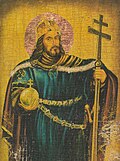 Stephen I of HungaryRight-Believing · King of HungaryAug 20
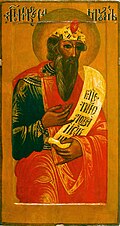 SamuelProphet · Prophet and JudgeAug 20
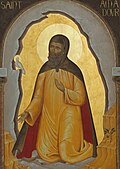 AmadourVenerable · Hermit of RocamadourAug 20
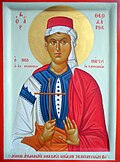 Theocharis of NeapolisNew Martyr · New martyr of NeapolisAug 20
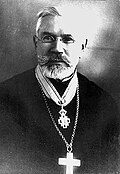 Peter PähkelConfessor · Bishop of Petseri and TartuAug 20
- Heliodorus of Bet ZabdaiHieromartyr · Bishop of Bet ZabdaiAug 20
- 37 Martyrs of PlovdivHoly MartyrsAug 20
- 37 Venerable Martyrs of BizyeHoly Venerable MartyrsAug 20
- Achilles of ThraceMartyrAug 20
- Agathon of ThraceMartyrAug 20
- Alexander GadalinNew MartyrAug 20
- Alypy IvlevHieromartyrAug 20