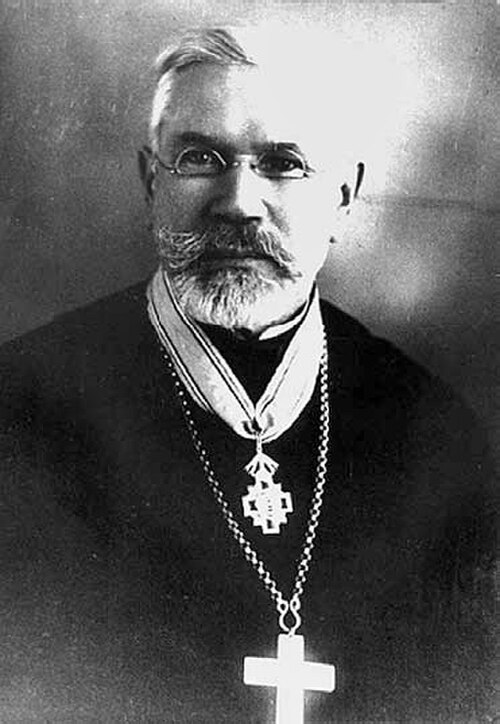
Confessor
Peter Pähkel
Bishop of Petseri and Tartu
Bishop of the Estonian Orthodox Church who died in the Arlyuk camp in Siberia in 1948; venerated in Constantinople.
- Feast
- August 20old style September 2
- Reposed
- 194820th century
- Place
- Käina Rural Municipality
- Order
- Confessors
Life
Bishop Peter Pähkel was a bishop of the Orthodox Church of Estonia, of Petseri and Tartu, born on 31 December 1875 at Käina and died on 20 August 1948 in the Arlyuk camp in Siberia. He is venerated as a saint in the Orthodox Church of Constantinople, not in the Moscow Patriarchate, and our sources give no day of commemoration. His case is discussed in the sources: the Moscow Patriarchate forbade him to serve in 1941, and he was consecrated bishop in 1943 during the German occupation.
He was born in Estonia, an Estonian by nationality. In 1891 he graduated from the theological school at Riga, and in 1897 from the Riga seminary, with first-class marks. In March 1901 he was ordained deacon, then priest, by Bishop Agathangel (Preobrazhensky) of Riga and Mitau. From 19 April 1914 to 10 November 1916 he was acting head clerk of the Riga spiritual consistory. From 1917 to 1920 he served as second priest of the Dormition cathedral in Azov, as archpriest and dean. After opting for Estonian citizenship he lived in Russia about eight months and returned to Estonia around autumn 1923. He worked as a teacher of Latin in Valga and served in a parish 34 kilometres from the town. From 1924 to 1933 he was teacher of Latin and the Law of God at the Valga secondary school. In August 1933 he became a teacher at the Petseri theological seminary.
During the German occupation he is mentioned as rector of the church of the Forty Martyrs of Sebaste in Petseri, within the Pskov spiritual mission. After 22 June 1941, with the consent of the mayor of Petseri, Luik, appointed by the Germans, he declared himself dean of the church district, rose against the Moscow Patriarchate, proposing that Metropolitan Sergius (Stragorodsky) no longer be commemorated and that, until the formation of the Estonian government, the commemoration at the Liturgy follow the order in use before June 1940, that is, before the Estonian Orthodox Church left the Patriarchate of Constantinople and passed to the Moscow Patriarchate. At the same time, with the mayor's consent, he declared himself abbot of the Pskov Caves Monastery (Pechory). On 18 September 1941, by decree of the exarch of Estonia, Metropolitan Sergius (Voskresensky), he was forbidden to serve until repentance.
On 7 August 1943, while under prohibition from his own Church, he was consecrated in the Transfiguration cathedral in Tallinn, by Metropolitan Alexander (Paulus) and Archbishop Nicholas (Leismann), himself forbidden to serve, bishop of Petseri and Tartu, in the Orthodox Church of Estonia under the jurisdiction of Constantinople. His diocese comprised the southwest of the German-occupied general district of Estonia. At the end of the war he lived in Petseri. He was arrested on 27 June 1945 and sentenced on 14 September of the same year by the military tribunal of the NKVD troops of the Pskov region, under Article 58-1a (treason), to 10 years in camp. He died in prison on 20 August 1948. He was rehabilitated on 31 October 1996.
At the proposal of the Holy Synod of the Estonian Apostolic Orthodox Church, under the jurisdiction of the Patriarchate of Constantinople, the Holy Synod of the Ecumenical Patriarchate canonized eight new martyrs of Estonia who suffered for Christ between 1944 and 1955, after the annexation of Estonia to the USSR: Bishop Peter (Pähkel) of Tartu and Petseri (1875 to 1948), Archimandrite Alypius (Ivlev) (1877 to 1950), Archpriest Vladimir Irodionov (1885 to 1945), the priests Seraphim Ulyanov (1906 to 1955), John Värk (1904 to 1952) and Leonid Lavrov (1882 to 1954), and the laymen Andres Punshun (1882 to 1955) and Alexander Gadalin (1878 to 1951).
Commemorated the same day August 20
 Stephen I of HungaryRight-Believing · King of HungaryAug 20
 SamuelProphet · Prophet and JudgeAug 20
 AmadourVenerable · Hermit of RocamadourAug 20
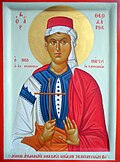 Theocharis of NeapolisNew Martyr · New martyr of NeapolisAug 20
- Heliodorus of Bet ZabdaiHieromartyr · Bishop of Bet ZabdaiAug 20
- 37 Martyrs of PlovdivHoly MartyrsAug 20
- 37 Venerable Martyrs of BizyeHoly Venerable MartyrsAug 20
- Achilles of ThraceMartyrAug 20
- Agathon of ThraceMartyrAug 20
- Alexander GadalinNew MartyrAug 20
- Alexander MalinovskyHieromartyrAug 20
- Alypy IvlevHieromartyrAug 20