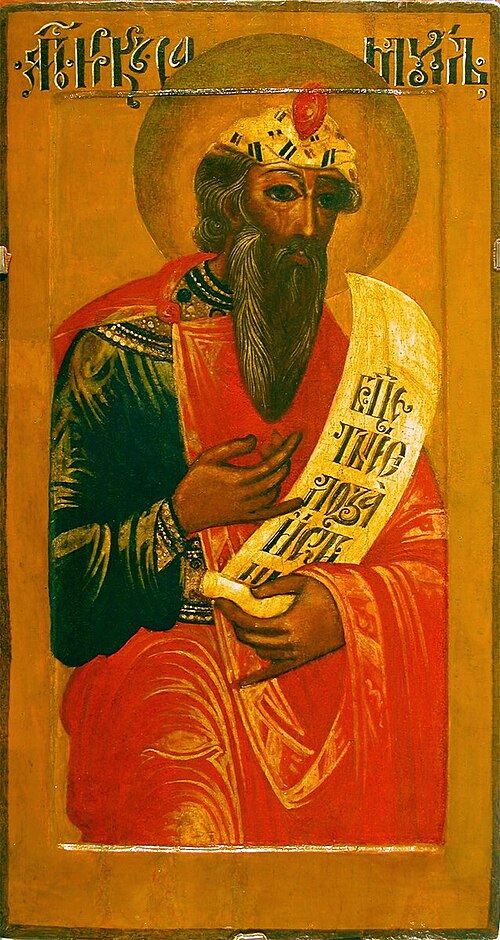
Prophet
Samuel
Prophet and Judge
Last judge of Israel, who anointed Saul and David as kings.
Life
The Holy Prophet Samuel was the last of the judges of Israel, prophet and priest, who anointed Saul and David as kings. He lived in the eleventh century before Christ, at the end of the age of the judges, when the people were defeated and enslaved by the Philistines. His life is told in the First Book of Kings (First Samuel), and Sirach praises him in its forty-sixth chapter.
Birth and childhood
His father, Elkanah, was a Levite of the hill country of Ephraim and lived at Ramathaim in the district of Zuph; his mother was Hannah. Elkanah had two wives, Peninnah, who had children, and Hannah, who was barren and suffered much from Peninnah's taunts. At the sanctuary at Shiloh, Hannah prayed with tears for a child, vowing to give him to the Lord as a nazirite. The high priest Eli at first took her for drunk, but on learning the cause of her grief he blessed her. Hannah bore a son and named him Samuel, 'I have asked him of the Lord'.
After she weaned him, at the age of three according to tradition, Hannah brought him to the sanctuary at Shiloh, where he grew up beside the high priest Eli. The story of his birth resembles those of other children given by God to the barren, such as Sarah, Rebecca and Rachel. At twelve, according to tradition, he received his first revelation from God, that punishment would fall on the house of Eli for the wickedness of his sons, Hophni and Phinehas. The revelation was fulfilled when the Philistines defeated the Israelites, killed Eli's two sons and captured the Ark of the Covenant. Eli, hearing it, fell and died at the age of ninety-eight.
Judge and prophet
After Eli's death Samuel remained judge of Israel. He called the people to repentance and to the service of the Lord and raised their spirits, so that the Israelites were freed from the bondage of the Philistines. According to tradition he founded a school of prophets, a fellowship of men devoted to prayer and teaching, which kept alive in the people love for their land and their faith. He judged the people into deep old age.
When he grew old, the Israelites, fearing to be left without a ruler, asked for a king, like the other nations. Samuel warned them of the danger of oppressors, but since they insisted, he anointed Saul of the tribe of Benjamin as the first king, after the Lord had shown him to Samuel. The two worked together for a time in the war with the Philistines, but then fell into conflict, because Saul did not obey the Lord's commands. Samuel then secretly anointed David, the young shepherd, at Bethlehem, and supported him in the first years of his trial with Saul. He died in deep old age, before David became king, and without having been reconciled with Saul.
Writings and veneration
Tradition ascribes to him the Book of Judges, the Book of Ruth and the first twenty-four chapters of the First Book of Kings. His relics were brought from Judea to Constantinople in the year 406. He is honoured as a prophet by Jews, Christians and Muslims, and our Church commemorates him on 20 August.
Commemorated the same day August 20
 Stephen I of HungaryRight-Believing · King of HungaryAug 20
 AmadourVenerable · Hermit of RocamadourAug 20
 Theocharis of NeapolisNew Martyr · New martyr of NeapolisAug 20
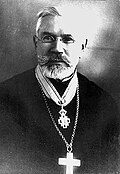 Peter PähkelConfessor · Bishop of Petseri and TartuAug 20
- Heliodorus of Bet ZabdaiHieromartyr · Bishop of Bet ZabdaiAug 20
- 37 Martyrs of PlovdivHoly MartyrsAug 20
- 37 Venerable Martyrs of BizyeHoly Venerable MartyrsAug 20
- Achilles of ThraceMartyrAug 20
- Agathon of ThraceMartyrAug 20
- Alexander GadalinNew MartyrAug 20
- Alexander MalinovskyHieromartyrAug 20
- Alypy IvlevHieromartyrAug 20