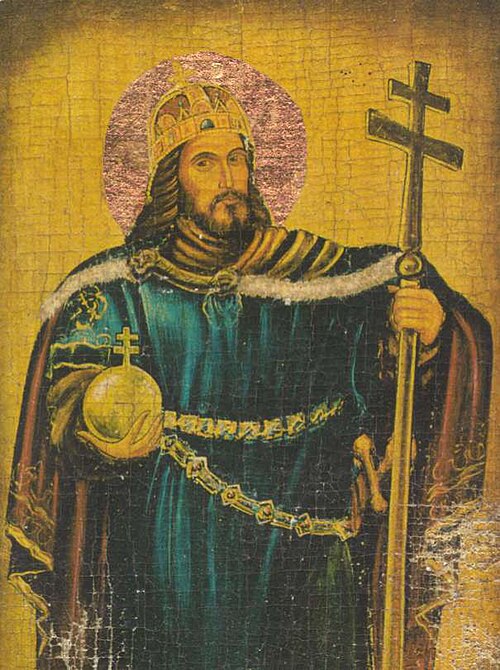
Right-Believing
Stephen I of Hungary
King of Hungary
First king of Hungary, who founded the Christian Hungarian state and organized the Church in his land.
- Feast
- August 20old style September 2
- Reposed
- 103811th century
- Place
- Szentkirály (Esztergom)
Life
Saint Stephen I of Hungary was the last grand prince of the Hungarians and the first king of Hungary, from 1000 or 1001 until 1038. The Church honours him for bringing his people to the Christian faith and for planting the Church in his land, with its bishops and monasteries. He was enrolled among the saints at Rome in 1083, and the Ecumenical Patriarchate of Constantinople proclaimed him a saint in the year 2000.
Childhood and baptism
He was born with the pagan name Vajk, around 975 at Esztergom, though the sources give years from 967 to 980. He was the only son of Grand Prince Géza of the house of Árpád and of Sarolt, daughter of a chieftain named Gyula. His mother's family had kept ties with Byzantine Christianity. According to a Russian source his grandfather was baptized at Constantinople and brought back a Greek monk as bishop, and Sarolt came into Géza's household with Greek priests. Although his parents were baptized, Stephen was the first in the family to live truly as a Christian.
The baptism itself is uncertain. The Greater Legend says that Bishop Adalbert of Prague, who stayed several times at Géza's court, baptized him. An Orthodox source says that he was baptized as a child according to the Greek rite. He received the name Stephen, after the first martyr. Around 995 he married Gisela, daughter of Duke Henry of Bavaria, of the imperial Ottonian family. The priests and monks who came with her increased the preaching and the influence of the Western Church.
Reign
After Géza died in 997, Stephen had to fight Koppány, a pagan kinsman who claimed the rule by the old customs and had many pagan warriors on his side. With the help of knights from Bavaria and lords at home, Stephen defeated him. Koppány fell in battle, and his body was quartered and the parts shown at the gates of the fortresses, as a warning to opponents.
Stephen was crowned on 25 December 1000 or 1 January 1001, with a crown sent by Pope Sylvester II. The coronation gave him recognition as a Christian king without making him a vassal of pope or emperor. A series of wars followed against half-independent chieftains, among them his uncle Gyula the Younger, ruler of Transylvania, and Ajtony, in the region of the river Maros, through which he united the Carpathian Basin. In 1030 he forced the army of Emperor Conrad II to withdraw from Hungary.
A Christian state
Stephen divided the land into dioceses, raised Esztergom to an archbishopric and made the Church in Hungary independent of the archbishops of the Empire. One source counts ten dioceses, others at least six bishoprics and one archbishopric. He founded Benedictine monasteries, among them Pannonhalma, the first, dedicated to Saint Martin, then Pécsvárad, Zobor and Bakonybél. He ordered that every ten villages build and furnish a church. So that Sunday would be a day for church, he had the markets held on that day, which is why Hungarian still calls Sunday by a word meaning market day.
He gave laws tied to the Christian life, punished severely those who ignored Christian customs, divided the land into counties around fortresses under royal officials, and had coins minted. His land enjoyed a long peace and became a road for pilgrims and merchants between the West, the Holy Land and Constantinople. He often welcomed the pilgrims himself and set up hostels for them in Constantinople, Jerusalem, Ravenna and Rome. For his son Emeric he wrote counsels, urging him to keep the faith, honour the bishops, judge justly and welcome strangers.
Trials and repose
Stephen lost his children one by one. The eldest, Emeric, died in 1031 in a hunting accident, a blow from which the king never recovered. The legends tell that in his last years he kept vigils and washed the feet of the poor. His cousin Vazul, who had the strongest claim to the throne, was blinded after being suspected of a plot, and Peter Orseolo, the son of the king's sister, was named heir.
Stephen fell asleep on 15 August 1038, aged 62 or 63, and was buried in his new basilica at Székesfehérvár, dedicated to the Most Holy Virgin, to whom he had dedicated his land. Decades of wars over the throne followed his death.
Canonization and veneration
In 1083 King Ladislaus I set the canonization in motion. On 15 August masses of believers began three days of fasting and prayer at Stephen's tomb. The opening of the tomb was followed by healings, and on 20 August the relics were raised, together with those of his son Emeric and of Bishop Gerard of Csanád. Pope Gregory VII allowed the canonization.
In the summer of 2000 the Synod of the Ecumenical Patriarchate of Constantinople enrolled him among the saints, and the Russian Orthodox Church entered his name in its calendar in 2007. The Greek troparion calls him a gentle and pious king who laid his sceptre in the hands of God. His feast is on 20 August. In Hungary he is one of the best loved saints, and 20 August is also a national holiday, the founding of the state. The royal crown of Hungary bears his name, and his right hand, preserved incorrupt, is venerated in Budapest.
Commemorated the same day August 20
 SamuelProphet · Prophet and JudgeAug 20
 AmadourVenerable · Hermit of RocamadourAug 20
 Theocharis of NeapolisNew Martyr · New martyr of NeapolisAug 20
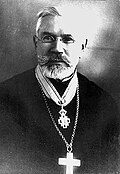 Peter PähkelConfessor · Bishop of Petseri and TartuAug 20
- Heliodorus of Bet ZabdaiHieromartyr · Bishop of Bet ZabdaiAug 20
- 37 Martyrs of PlovdivHoly MartyrsAug 20
- 37 Venerable Martyrs of BizyeHoly Venerable MartyrsAug 20
- Achilles of ThraceMartyrAug 20
- Agathon of ThraceMartyrAug 20
- Alexander GadalinNew MartyrAug 20
- Alexander MalinovskyHieromartyrAug 20
- Alypy IvlevHieromartyrAug 20