Martyr
Alexandra of Ancyra
A martyr of Ancyra, put to death for her faith in Christ.
Life
Saint Alexandra of Ancyra, a virgin martyr, suffered at the beginning of the fourth century in the city of Ancyra in Galatia, together with the holy martyr Theodotus and the other six virgins: Thecusa, Phaina, Claudia, Matrona, Julia and Euphrasia. They are commemorated on 31 May and on 19 November.
Saint Theodotus
Saint Theodotus and the seven virgins lived in the second half of the third century at Ancyra and died for Christ at the beginning of the fourth. Theodotus was an innkeeper, had his own inn and was married. Already then he had attained a high spiritual perfection: he kept purity and continence, subjected the body to the spirit, fasted and prayed. By his words he brought Jews and pagans to the Christian faith, and sinners to repentance. He had received from the Lord the gift of healing and cured the sick by laying his hands on them.
The persecution at Ancyra
In the time of the persecution of Diocletian (284 to 305) a governor known for his cruelty, Theotecnus, was sent to Ancyra. Many Christians fled the city, leaving their houses and property. Theotecnus announced that all Christians were bound to sacrifice to idols, and whoever refused would be given to torment and death. The pagans brought Christians to torture and plundered their property. Famine came upon the land. In those harsh days Theodotus gave shelter at his inn to Christians left without a roof, fed them, hid those pursued and from his own stores gave the devastated churches what was needed for the Divine Liturgy. He went fearlessly into the prisons, helping those unjustly condemned and urging them to remain faithful to the end. He did not fear to bury the remains of the holy martyrs, taking them secretly or redeeming them with money from the soldiers. When the Christian churches of Ancyra were laid waste and closed, the Liturgy was celebrated at his inn. Knowing that the struggle of martyrdom awaited him too, Theodotus foretold to the priest Fronto, in a conversation, that soon martyrs' relics would be brought to the place chosen by them both, and in proof he gave him his ring.
The martyrdom of the virgins and of Theodotus
At that time the seven holy virgins died for Christ, of whom the eldest, Saint Thecusa, was Theodotus's aunt. From youth they had devoted themselves to God, lived in prayer, fasting, continence and good works, and all had reached old age. Brought to trial as Christians, they boldly confessed their faith before Theotecnus and were put to torture, but remained unshaken. Then the governor gave them to shameless young men to be defiled. The holy virgins prayed fervently, asking God's help. Saint Thecusa fell at the young men's feet and, removing her head covering, showed them her grey head. The young men came to themselves, wept and went away. Then the governor ordered the saints to take part in the feast of the "washing of the idols", as the pagan priestesses did, but they refused again and were condemned to death. A heavy stone was tied to each one's neck and all seven were drowned in the lake. The next night Saint Thecusa appeared in a dream to Theodotus, asking him to take out their bodies and bury them in a Christian way. Theodotus, taking with him his friend Polychronius and other Christians, set out for the lake. It was dark, and the way was shown by a burning lamp. Meanwhile before the guard set by the pagans on the lake shore the holy martyr Sosander appeared. The frightened guards fled. The wind drove the water to the other side of the lake. The Christians approached the bodies of the holy martyrs and took them to the church, where they buried them. Learning of the theft of the bodies, the governor was enraged and ordered all Christians seized without distinction and given to torture. Polychronius too was seized, who, unable to bear the torments, said that Theodotus was guilty of the theft of the bodies. Theodotus prepared for death for Christ; after prayers, he left word that his body be given to the priest Fronto, to whom he had earlier given the ring. He stood before the judgment; various instruments of torture were shown him and great honours and riches were promised him if he would renounce Christ. Theodotus glorified the Lord Jesus Christ and confessed his faith. The pagans tortured him long, but God's power sustained him; he remained alive and was taken to prison. The next morning the governor ordered him tortured again, but soon understood that he could not shake his courage and ordered his head cut off. A storm prevented the soldiers from burning the body. On the road the priest Fronto was passing, leading a donkey loaded with wine from his vineyard; near the place where Theodotus's body lay the donkey suddenly fell. The soldiers helped it up and told Fronto that they were guarding the body of the executed Christian, Theodotus. The priest understood that the Lord had brought him there. He laid the holy remains on the donkey and took them to the place Theodotus had indicated and buried them with honour; later he built a church there. Saint Theodotus received death for Christ on 7 June 303 or 304.
Commemorated the same day May 18
 John I of RomeHieromartyr · Bishop of RomeMay 18
 Theodore I of RomeSaint · Bishop of RomeMay 18
 David the BuilderRight-Believing · King of GeorgiaMay 18
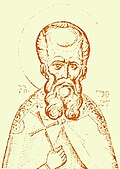 Theodotus of AncyraMartyr · Innkeeper of AncyraMay 18
 Venantius of CamerinoMartyr · Martyr of CamerinoMay 18
 Macarius of AltaiVenerable · Archimandrite and missionary in AltaiMay 18
- Ælfgifu of ShaftesburyRight-Believing · Queen of the EnglishMay 18
 John of KormyanyRighteous · Priest of BelarusMay 18
 Heraclius, Paulinus and VenedimusHoly Hieromartyrs · Martyrs of AthensMay 18
 Prosper of TarragonaSaint · Archbishop of TarragonaMay 18
- Dioscorus of AlexandriaSaintMay 18
- AghnaVenerableMay 18