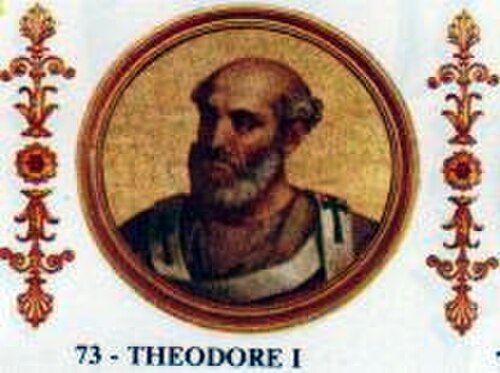
Saint
Theodore I of Rome
Bishop of Rome
Bishop of Rome from 642 to 649, whose pontificate was marked by the struggle against Monothelitism.
Life
Saint Theodore I of Rome was bishop of Rome from 24 November 642 until his repose on 14 May 649. His whole episcopate was a struggle for the true faith against Monothelitism, the teaching that there is only one will in Christ. Orthodox Christians commemorate him on 18 May.
Origin and election
According to the Book of the Pontiffs, Theodore was a Greek, born in Jerusalem, the son of a bishop of the same name. He was one of the clergy of the East who found refuge in Rome after the Arab conquest of the Near East. He was a deacon at Rome around 640, and his election as bishop was supported by the exarch of Ravenna. He was installed on 24 November 642, after Pope John IV.
The struggle against Monothelitism
Theodore refused to recognise Paul II as patriarch of Constantinople, because Paul's predecessor Pyrrhus had not been removed according to the canons. He pressed Emperor Constans II to withdraw the Ekthesis, the edict by which Heraclius had imposed Monothelitism. His efforts made little impression at Constantinople, but in the West they strengthened the resistance to the heresy.
In 645 Pyrrhus renounced Monothelitism for a time and came to Rome, where he was kindly received. He then went to Ravenna and returned to the false teaching. Theodore deposed and anathematised him in 648, in a synod held at the tomb of Saint Peter. Tradition says that he signed the sentence with ink mixed with the consecrated wine of the chalice, a detail also mentioned by the chronicler Theophanes the Confessor. He later did the same to Paul II, in 649.
Paul answered by tearing down the Roman altar in the palace of Placidia and by exiling or imprisoning the pope's envoys. In 648 Constans forbade by his edict, the Typos, any further discussion of the wills of Christ. Theodore sent Bishop Stephen of Dor to Palestine to defend the faith there, and began to prepare a great council against the heresy. The chronicles praise his mercy, generosity and gentleness, as well as his firmness in the dispute with Constantinople.
Repose and commemoration
Theodore fell asleep on 14 May 649, before he could gather the council. His work was carried on by his successor, Saint Martin the Confessor, who held the Lateran Council in the same year. Saint Theodore was buried in the Basilica of Saint Peter.
The Greek Synaxarion calls him a hieromartyr and keeps his memory on 18 May, but it admits itself that it doubts he died a martyr. The sources record no such suffering, but a death in office at Rome.
Commemorated the same day May 18
 John I of RomeHieromartyr · Bishop of RomeMay 18
 David the BuilderRight-Believing · King of GeorgiaMay 18
 Theodotus of AncyraMartyr · Innkeeper of AncyraMay 18
 Venantius of CamerinoMartyr · Martyr of CamerinoMay 18
 Macarius of AltaiVenerable · Archimandrite and missionary in AltaiMay 18
- Ælfgifu of ShaftesburyRight-Believing · Queen of the EnglishMay 18
 John of KormyanyRighteous · Priest of BelarusMay 18
 Heraclius, Paulinus and VenedimusHoly Hieromartyrs · Martyrs of AthensMay 18
 Prosper of TarragonaSaint · Archbishop of TarragonaMay 18
- Dioscorus of AlexandriaSaintMay 18
- AghnaVenerableMay 18
- Alexandra of AncyraMartyrMay 18