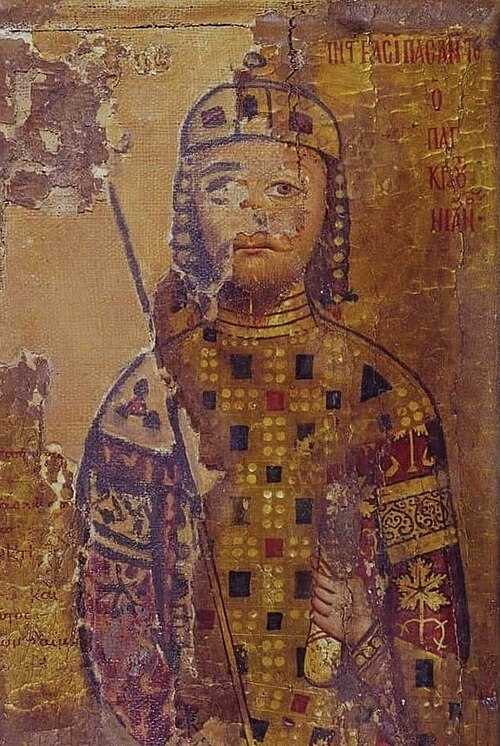
Right-Believing
David the Builder
King of Georgia
King of Georgia from 1089 to 1125, who united the country and built churches and monasteries.
- Feast
- May 18old style May 31
- Reposed
- 112512th century
- Place
- Tbilisi
Life
David the Builder was king of Georgia from 1089 to 1125, counted the greatest and most successful ruler in the history of the country. He freed Georgia from the Seljuks, united it, raised churches and monasteries and laid the foundations of the country's Golden Age. The Georgian Orthodox Church placed him among the saints as a right-believing king. He is commemorated on 26 January by the old calendar (8 February in the new style).
The beginning of his reign
He was born in 1073 at Kutaisi, of the Bagrationi dynasty, the only son of King George II and Queen Helen. At the end of the eleventh century Georgia was passing through great trials: the Seljuk Turks had devastated the land, the people fled to the mountains and forests, and a terrible earthquake had spoiled the Paschal celebrations. In 1089, when he was sixteen, his father gave up the throne and crowned David. The Georgian chronicles say that after twelve years of darkness the sun of all the kingdoms began to rise.
George remained king in name until his death, about 1112, but real power was in David's hands. The young king formed small fighting units, brought the nobles to order and stopped the plundering. In 1099 he ceased paying tribute to the Seljuks. Those who had plotted against him, like Duke Liparit, he punished with prison and exile.
The reform of the Church
David took great care of the Church. At the council of Ruisi and Urbnisi, in 1103, he supported the decisions to cleanse church life, against unworthy bishops and against nobles who opposed royal power. His adviser George of Chqondidi, his teacher and counsellor, received at that time the dignity of bishop as well. So the Church remained the foundation of the unity of the Georgian people.
In 1106 he began the building of Gelati Monastery, near Kutaisi, which he endowed with much of the wealth taken in war. He gathered scholars there from the country and from abroad and founded the theological Academy of Gelati, a second Athens, as he imagined it. He also helped other churches, in Georgia and beyond.
The freeing of the country
In the years after 1110 he drove the Turks out, one region after another, from the east of the country, from Tao-Klarjeti and from the banks of the Aras. For a standing army he took in the Kipchaks from the steppe, whose chief was his father-in-law Atrak, whose daughter Gurandukht he had married. He chose forty thousand of them, besides the five thousand Georgians he already had, and came to an army of forty-five thousand soldiers.
His greatest victory was the battle of Didgori, on 12 August 1121, in which his much smaller army crushed the Muslim coalition brought by the Seljuk sultan. Before the battle the king urged his soldiers, calling them soldiers of Christ, to fight for the faith. The writings of the age say that the Holy Great-martyr George led the army visibly. In 1122 David freed Tbilisi, which had borne the yoke for four hundred years, and moved his capital there. Ani and other fortresses in Armenia followed. On the coins of the time he was named King of Kings, Sword of the Messiah.
A man of prayer and almsgiving
The warrior king was a man of letters and of almsgiving. He read Holy Scripture and the sciences, and carried his books with him even to war, hauled by donkeys and camels. One biographer says that he read the Epistles twenty-four times in a single year. He always carried a pouch of money for the poor, visited the sick like a father and set up a kind of ambulance. He wrote the Hymns of Repentance, prayers in verse in which he asks forgiveness, considered by Orthodox sources equal to the works of the great writers of the Church.
His tomb and legacy
Near the end of his life he drew up a will in which he confessed his sins with deep lamentation and asked forgiveness of God. He entrusted his sword to his son Demetre and made him his successor in 1125. He fell asleep in peace at fifty-three, on 24 January 1125. He was buried at the entrance of Gelati Monastery, and the wish carved on his tombstone reads: This is My rest for ever and ever; here I will dwell, for I have chosen her (Psalm 131). According to tradition, he ordered this out of humility, so that all who enter the monastery would walk over his tomb. After the canonization the entrance was closed, and the grave is fenced with a red ribbon.
The epithet Builder (in Georgian Aghmashenebeli) became fixed to his name only in the works of historians of the seventeenth and eighteenth centuries. His son Demetre later became the monk Damiane.
Commemorated the same day May 18
 John I of RomeHieromartyr · Bishop of RomeMay 18
 Theodore I of RomeSaint · Bishop of RomeMay 18
 Theodotus of AncyraMartyr · Innkeeper of AncyraMay 18
 Venantius of CamerinoMartyr · Martyr of CamerinoMay 18
 Macarius of AltaiVenerable · Archimandrite and missionary in AltaiMay 18
- Ælfgifu of ShaftesburyRight-Believing · Queen of the EnglishMay 18
 John of KormyanyRighteous · Priest of BelarusMay 18
 Heraclius, Paulinus and VenedimusHoly Hieromartyrs · Martyrs of AthensMay 18
 Prosper of TarragonaSaint · Archbishop of TarragonaMay 18
- Dioscorus of AlexandriaSaintMay 18
- AghnaVenerableMay 18
- Alexandra of AncyraMartyrMay 18