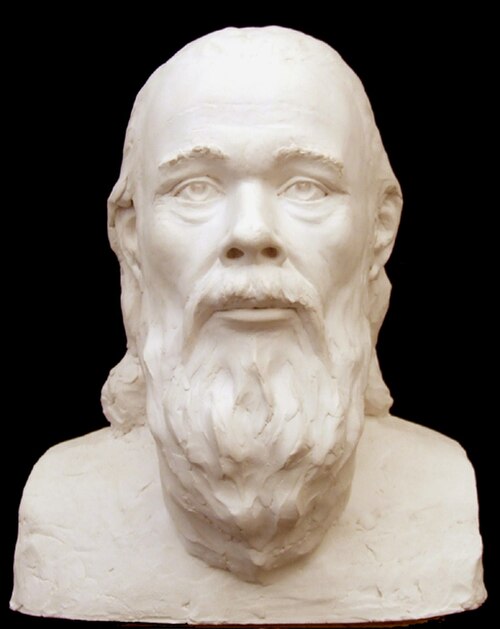
Venerable
Macarius of Altai
Archimandrite and missionary in Altai
Russian archimandrite and missionary who undertook one of the first attempts to translate the Bible into Russian; died in 1847.
- Feast
- May 18old style May 31
- Reposed
- 184719th century
- Place
- Bolkhov
- Order
- Venerables
Life
Venerable Macarius of Altai was an archimandrite and missionary, founder of the Altai Spiritual Mission and one of the first to attempt a translation of the Bible into Russian. In the world he was Mikhail Yakovlevich Glukharev. He was born in 1792 at Vyazma and reposed in 1847 at Bolkhov. He is commemorated on 18 May.
Studies
He studied at the school in Vyazma (1800 to 1803) and at the seminary in Smolensk (1803 to 1813), with a pause in 1812 because of Napoleon's invasion. He had a rare gift for languages: from the age of seven he could translate short texts from Russian into Latin, and by about twenty he had learned Hebrew, Greek, German and French. In 1814 he was sent with another pupil to the Saint Petersburg Theological Academy, where he graduated tenth. The rector, Philaret (Drozdov), remained his spiritual guide all his life.
Monastic life and wandering
In 1817 he was appointed inspector and professor of church history and German at the seminary of Yekaterinoslav, and then rector of the town schools. There too he was tonsured by Archbishop Job (Potemkin) on 24 June 1818, with the name Macarius, ordained hierodeacon the next day and hieromonk three days later. In the summer of 1819 he met two Quakers, Stephen Grellet and William Allen, and was accused of unorthodoxy. For this reason he is sometimes regarded as the founder of the Russian Orthodox ecumenical movement.
In 1821 he was made rector of the seminary of Kostroma and raised to archimandrite. In 1824 he obtained his release and set out for the Kyiv Caves Lavra. On the way he passed through Sarov, where Saint Seraphim foretold a heavy cross in his life, and visited his confessor, the elder Liverius. The Lavra seemed to him too noisy, he found no stillness at Kitaev either, and in 1825 he settled at Glinsk. There he translated from the Holy Fathers: the Confessions of Blessed Augustine, the Ladder of Saint John Climacus and homilies of Saint Gregory the Theologian. He also wrote spiritual hymns and, in 1829, a history of the Glinsk Hermitage.
The Altai mission
He wished to renew the missionary work of the Church in the empire. In 1829 he asked to be sent to Siberia and was appointed to the diocese of Tobolsk. The Altai Spiritual Mission was founded in May 1830, and on 23 August he reached Biysk, which became its centre, with two seminarians from Tobolsk. With experience he came to prefer the Russian language for the teaching of the faith and wrote textbooks both for baptised Altaians and for Russians, quoting the Scriptures in Russian. In a letter of 1834 to Metropolitan Philaret he argued that Scripture must be translated from the original languages: the Old Testament from Hebrew, the New from Greek.
He translated the Book of Job (1837) and the Book of Isaiah (1839). In 1839 he came to Saint Petersburg hoping for leave to publish them, but the Holy Synod did not grant it. He reposed in 1847 at Bolkhov, where he had spent his last years.
Commemorated the same day May 18
 John I of RomeHieromartyr · Bishop of RomeMay 18
 Theodore I of RomeSaint · Bishop of RomeMay 18
 David the BuilderRight-Believing · King of GeorgiaMay 18
 Theodotus of AncyraMartyr · Innkeeper of AncyraMay 18
 Venantius of CamerinoMartyr · Martyr of CamerinoMay 18
- Ælfgifu of ShaftesburyRight-Believing · Queen of the EnglishMay 18
 John of KormyanyRighteous · Priest of BelarusMay 18
 Heraclius, Paulinus and VenedimusHoly Hieromartyrs · Martyrs of AthensMay 18
 Prosper of TarragonaSaint · Archbishop of TarragonaMay 18
- Dioscorus of AlexandriaSaintMay 18
- AghnaVenerableMay 18
- Alexandra of AncyraMartyrMay 18