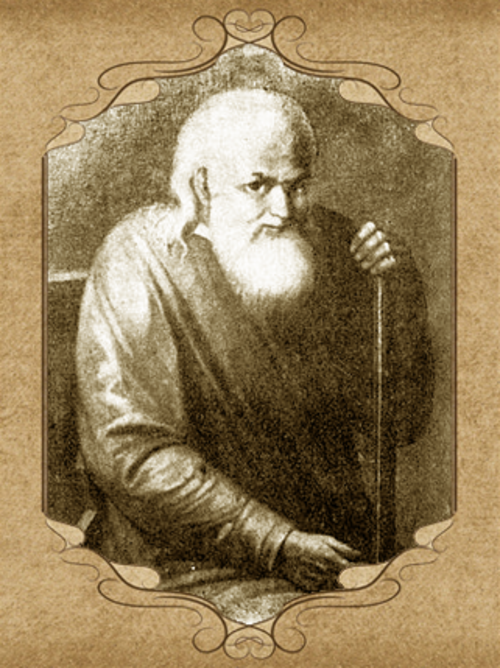
Righteous
Alexis of Bortsurmany
Priest at Bortsurmany
Priest of the Dormition Church in the village of Bortsurmany, Simbirsk province, honored as righteous; died in 1848.
- Feast
- April 21old style May 4
- Reposed
- 184819th century
- Place
- Bortsurmany
- Order
- The Righteous
Life
Righteous Alexis of Bortsurmany (born Alexei Alexeevich Gneushev, 1762 to 1848) was a priest at the church of the Dormition in the village of Bortsurmany, Simbirsk province, a man of prayer and almsgiving. He was glorified by the Council of Bishops of the Russian Orthodox Church in August 2000. He is commemorated (Old Style) on 21 April, 4 August and 17 August, the day of the translation of his relics in 2000.
Life
He was born into a priest's family in the village of Bortsurmany, in the Kurmysh district, Simbirsk province, today in the Nizhny Novgorod region. He finished the seminary at Nizhny Novgorod at twenty-two and married. In 1784 he was ordained deacon by Bishop Damascene of Nizhny, for the church of the Dormition at Bortsurmany, and thirteen years later, in 1797, Bishop Paul ordained him priest for the same church. At first he was not marked by strictness of life. But his life changed after an incident: one night he was called as a priest to give communion to a dying man in a neighbouring village; he grew angry, drove away the man who had come and went to bed, but then, tormented by conscience, set out. Entering the house, he saw the peasant already dead, and beside him an angel with the Holy Chalice in his hands. The vision shook him; he fell on his knees and prayed all night.
From that day he gave himself wholly to the service of God and men, leading a righteous and ascetic life. He served the Liturgy daily, kept as far as he could the monastic cell rule, received those who came to him, helped the needy and those in trouble in secret, and treated people with such meekness and love that he won hearts without trying. He was very strict only with sorcerers and fortune-tellers: he would not receive them and ordered it to be told them that he would receive them only when they repented and abandoned their devilish occupation; he rebuked in the same way those who went to them. For his righteous and ascetic life he received from God the gifts of healing and foresight and was granted many divine revelations. In the war of 1812, praying at the Liturgy for Russia's victory, he saw an angel who told him that the heavenly powers had already moved to help and that the enemy would be crushed. Nine years before his death he retired from the staff, but he served the Liturgy almost daily, without shortening the services, following the rule in all things. In his last years he lived in a small cell built especially for him, under the same roof as his house, where he gave himself to ascetic and prayer labours: he wore a hair shirt, slept on hard felt, ate once a day, did not eat meat and kept the fasts strictly. His fame as a great man of prayer and wonderworker spread far.
The words of Saint Seraphim and the miracles
When people from the region where Alexis lived came to Saint Seraphim of Sarov, the saint sent them back, assuring them that they had their own zealous intercessor: "This man, by his prayers, is like a candle lit before the throne of God. Here is a labourer who, without monastic vows, stands higher than many monks. He burns like a star on the Christian horizon." The raising of a dead boy and the healing of a six-year-old girl who could not walk from birth are attributed to him. Before his death he said, as consolation, that he would not forget those who remembered him. He reposed in 1848 and was buried in front of the altar of the church of the Dormition at Bortsurmany.
Veneration
The people around honoured his grave and served memorial services, after which many who asked for healing were freed from their illnesses. There was also a custom of taking earth from his grave and taking it with water in grave illness. In October 1913 a commission of the consistory of Nizhny Novgorod investigated at Bortsurmany the oral and printed reports of miracles, which were confirmed, but the revolution and persecution did not let the canonization be carried through. In Soviet times the authorities tried several times to destroy the grave, but the veneration of the people and the miracles prevented it. He was glorified by the Council of Bishops in August 2000; on 17 August 2000 his relics were moved to the church of the Dormition at Bortsurmany, where they are today.
Commemorated the same day April 21
 JanuariusHieromartyr · Bishop of BeneventoApr 21
 Maximianus of ConstantinopleSaint · Archbishop of ConstantinopleApr 21
 Apollonius the ApologistMartyr · Roman apologistApr 21
 Theodore of SanaksarVenerable · Hieromonk at SanaksarApr 21
 Theodorus of PergeMartyrApr 21
- PausilypusMartyrApr 21
 Basil MartyszHieromartyr · Priest of TeratynApr 21
- Cyprianus of BresciaSaint · Bishop of BresciaApr 21
- Euthymius ShervashidzeSaint · Metropolitan of GelatiApr 21
- Theodore the Philosopher of BolgarMartyr · MerchantApr 21
- Abdecalas, Ananias and a Hundred CompanionsHoly HieromartyrsApr 21
- Acutius of PozzuoliMartyrApr 21