Martyr
Apollonius the Apologist
Roman apologist
Christian apologist of the second century, put to death in Rome in 185 under Emperor Commodus.
Life
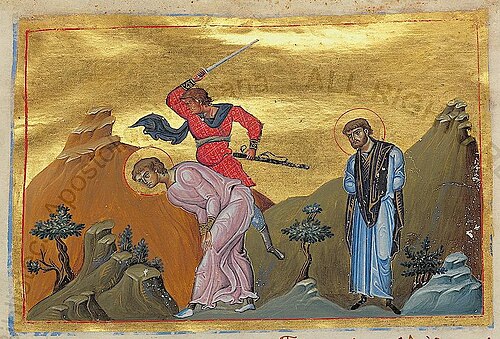
Saint Apollonius the Apologist was a defender of the Christian faith in the second century, who died a martyr at Rome on 21 April 185, under the emperor Commodus. The Church remembers him on 21 April.
Four sources speak of him: a record of the trial incorporated into the Ecclesiastical History of Eusebius of Caesarea, chapters 40 and 42 of Saint Jerome's On Illustrious Men, and two versions of his Passion, one Greek, one Armenian, discovered in the late nineteenth century. They present him as an illustrious Roman, by some even a senator, a very gifted man well trained in philosophy. A servant of his denounced him as a Christian before the praetorian prefect Perennis. Called to defend himself, he read before the senate, says Jerome, "a remarkable volume", in which, instead of recanting, he defended the Christian faith. He attacked paganism and showed gods of wood and metal to be lifeless: "I worship and serve only the God who lives in heaven, not idols made by human hands." He was sentenced to death on the basis of the law given by Trajan. His defence was translated into Greek and placed by Eusebius in his history of the martyrs, but it is lost.
The sources say he was put to two investigations, the first by the prefect Perennis, the second, three days later, by a group of senators and jurists. The hearings were conducted calmly and courteously. Apollonius was allowed to speak, with rare interruptions, to moderate remarks that made him liable to punishment. He did not fear death, for, he said, "something better awaits me: eternal life, given to the one who has lived well on earth." He argued for the superiority of the Christian teaching on death and life. The sources do not agree on the manner of death: the Greek Passion says he died with his legs crushed, a punishment inflicted also on the slave who denounced him, and the Armenian that he was beheaded.
He is not mentioned in the earliest martyrologies. In the Middle Ages he was confused with two other saints, Apollo of Alexandria and Apollonius, martyred with Valentine, whose feasts are on 18 April, a date thus assigned to him too, even in some editions of the Roman Martyrology, whose current editions have restored the date of 21 April. The Roman Martyrology says: "At Rome, commemoration of Saint Apollonius, philosopher and martyr, who under the emperor Commodus defended, before the prefect Perennis and the senate, the Christian faith in a finely argued address, then, condemned to death, confirmed it by the witness of his blood."
Commemorated the same day April 21
 JanuariusHieromartyr · Bishop of BeneventoApr 21
 Maximianus of ConstantinopleSaint · Archbishop of ConstantinopleApr 21
 Theodore of SanaksarVenerable · Hieromonk at SanaksarApr 21
 Alexis of BortsurmanyRighteous · Priest at BortsurmanyApr 21
 Theodorus of PergeMartyrApr 21
- PausilypusMartyrApr 21
 Basil MartyszHieromartyr · Priest of TeratynApr 21
- Cyprianus of BresciaSaint · Bishop of BresciaApr 21
- Euthymius ShervashidzeSaint · Metropolitan of GelatiApr 21
- Theodore the Philosopher of BolgarMartyr · MerchantApr 21
- Abdecalas, Ananias and a Hundred CompanionsHoly HieromartyrsApr 21
- Acutius of PozzuoliMartyrApr 21