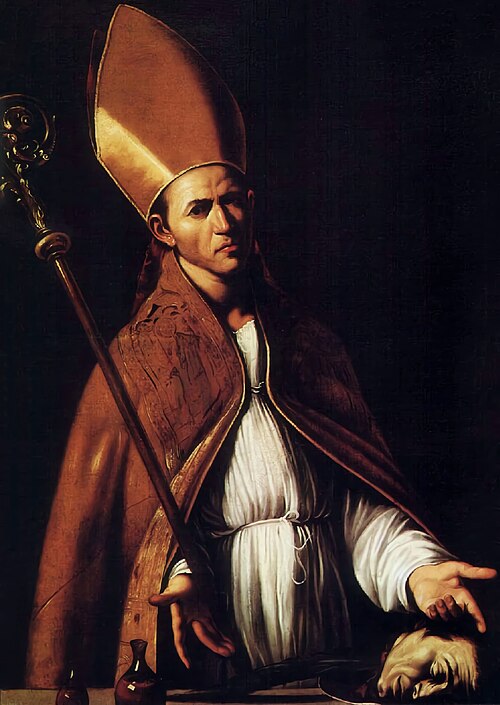
Hieromartyr
Januarius
Bishop of Benevento
Bishop of Benevento, killed for his faith in the persecution of Diocletian in the early fourth century.
Life
Saint Januarius (Italian Gennaro), hieromartyr, was bishop of Benevento and received the crown of martyrdom in the persecution of Diocletian, at the beginning of the fourth century, around 305. He is the patron of the city of Naples. The Orthodox Church commemorates him with his companions on 21 April, and the Roman Catholic Church on 19 September.
The sources
Few certain things are known of his life, and no writings from his own time survive. The earliest mention is a letter of Uranius, bishop of Nola, dated 432, on the death of Saint Paulinus of Nola in 431. It says that three days before he died Paulinus saw Januarius and Saint Martin of Tours, and says of Januarius only that he was "bishop as well as martyr, an illustrious member of the Neapolitan church". The rest comes from later accounts: the Acts of Bologna (not earlier than the sixth century) and the Vatican Acts (ninth century), and popular legend.
Martyrdom
According to these sources, Januarius was born at Benevento into a wealthy family. He became bishop and during the persecution of Diocletian sheltered persecuted Christians. Going to visit the deacon Sossius of Misenum in prison, he was arrested himself. According to the synaxarion, the governor of Campania had him thrown into a burning furnace, from which he came out unharmed, like the youths of Babylon. He was then beaten with iron rods. The deacon Festus and the reader Desiderius, who wept at his sufferings, were also cast into prison at Pozzuoli, where the deacons Sossius and Proculus and the laymen Eutyches and Acutius were already held.
The next day all were brought out to the circus to be torn by wild beasts, but the beasts did not touch them. The governor said the wonders were sorcery and was struck blind. Januarius prayed for him and he recovered his sight, but still did not repent. All were beheaded outside the city, near Pozzuoli, around 305.
Relics and the blood
According to an early life, the relics were taken by Bishop Severus of Naples to the catacombs near the city. In the early ninth century the body was moved to Benevento while the head stayed at Naples. The body later came to the abbey of Montevergine, where it was found again in 1480. In 1497 it was brought to Naples, into a richly decorated crypt beneath the cathedral.
At Naples dried blood is kept in two ampoules, which tradition says was gathered by a woman after the martyrdom. Three times a year, on 19 September, 16 December and the Saturday before the first Sunday of May, crowds gather at the cathedral to see the blood liquefy. The first certain report of liquefaction is from 1389; a chronicle of 1382 mentions neither the relic nor the miracle. The Neapolitans have called on him against the eruptions of Vesuvius, above all in 1631, when the lava stopped.
Commemorated the same day April 21
 Maximianus of ConstantinopleSaint · Archbishop of ConstantinopleApr 21
 Apollonius the ApologistMartyr · Roman apologistApr 21
 Theodore of SanaksarVenerable · Hieromonk at SanaksarApr 21
 Alexis of BortsurmanyRighteous · Priest at BortsurmanyApr 21
 Theodorus of PergeMartyrApr 21
- PausilypusMartyrApr 21
 Basil MartyszHieromartyr · Priest of TeratynApr 21
- Cyprianus of BresciaSaint · Bishop of BresciaApr 21
- Euthymius ShervashidzeSaint · Metropolitan of GelatiApr 21
- Theodore the Philosopher of BolgarMartyr · MerchantApr 21
- Abdecalas, Ananias and a Hundred CompanionsHoly HieromartyrsApr 21
- Acutius of PozzuoliMartyrApr 21