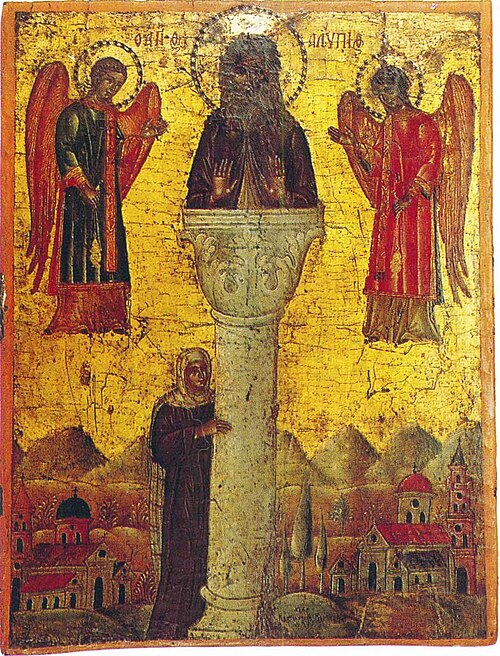
Stylite
Alypius the Stylite
Stylite and founder of monasteries
Stylite ascetic of the seventh century, monastic founder and a much sought-after spiritual guide.
- Feast
- November 26old style December 9
- Reposed
- 7007th century
- Place
- Eskipazar
- Order
- Stylites
Life
Saint Alypius the Stylite was a monk of the seventh century, born at Hadrianopolis in Paphlagonia, who lived for decades on a pillar and founded two monasteries. He is venerated as a spiritual father, much sought after in his lifetime, and as a helper of the childless. The Church counts him, with Simeon the Elder and Daniel, among the three great stylites and remembers him on 26 November.
Childhood and calling Most sources place his birth about the year 515 or, as the calendars of the Church give it, 522. His Life says that at his birth his mother saw a wonderful vision, the whole room filled with divine light, a sign of the righteous life to come. His mother, a Christian, was widowed early, gave all she had to the poor, became a deaconess and lived in asceticism, and entrusted her son to be raised by Bishop Theodore of Hadrianopolis. The bishop ordained him deacon.
The young man longed for the life of a hermit, but Theodore would not allow it. One day, while accompanying the bishop to Constantinople, he saw in a dream the Holy Great Martyr Euphemia, who told him to return to his own region and build a church in her name on the site of an old pagan cemetery. According to the Serbian sources, he first fled to the city of Euchaita, but was brought back by Bishop Theodore and the people of his region.
On the pillar Alypius built the church on the site of an abandoned pagan temple and beside it set up in the open air a pillar made from an old column, on which he lived for most of his adult life, in prayer, fasting, cold and heat. According to Demetrius of Rostov, legions of demons rushed upon the church and his cell, wishing to tear them down and drive him out, but were overcome by the saint's prayer and left the place for ever. Alypius received the gift of prophecy, of casting out demons and of healing disease. People began to come to him for consolation, teaching and healing.
Two monasteries were built beside the pillar, one of monks and one of nuns, which Alypius guided spiritually until his death and for which he set strict rules. In the nuns' monastery lived his mother and his sister Maria. According to tradition he stood upright for fifty-three years, then, his feet being diseased, lay on his side for another fourteen, bearing heavy suffering without complaint and thanking God. In all, this makes sixty-seven years on the pillar.
His end and veneration He departed to the Lord in 640, in the time of the Emperor Heraclius, at an age which tradition gives as a hundred and eighteen years. His relics were laid in the church of Saint Euphemia that he had built, and his head is kept at the monastery of Koutloumousiou on Mount Athos. The Orthodox Church celebrates him on 26 November (9 December on the new calendar), and the Roman Catholic Church commemorates him on the same day. In Serbia Saint Alimpije is greatly honoured and many keep his day as their family patron feast, which falls in the Nativity fast. An altar of a church at Antalya, in the Ecumenical Patriarchate, is dedicated to him.
Commemorated the same day November 26
 Siricius of RomeSaint · Bishop of RomeNov 26
 Conrad of ConstanceSaint · Bishop of ConstanceNov 26
 Innocent of IrkutskSaint · First Bishop of IrkutskNov 26
 Nikon the MetanoeiteVenerable · Itinerant preacherNov 26
 Stylian of PaphlagoniaVenerable · Hermit of PaphlagoniaNov 26
 BasolusVenerable · Hermit near ReimsNov 26
 Alexei VeselovskyHieromartyr · PriestNov 26
- Elias ZachateyskyHieromartyr · PriestNov 26
- James the HermitVenerable · Syrian hermitNov 26
- Nicholas VinogradovHieromartyr · Archpriest of DmitrovNov 26
- Acacius of the LadderVenerableNov 26
- Amator of AutunSaint · Bishop of AutunNov 26