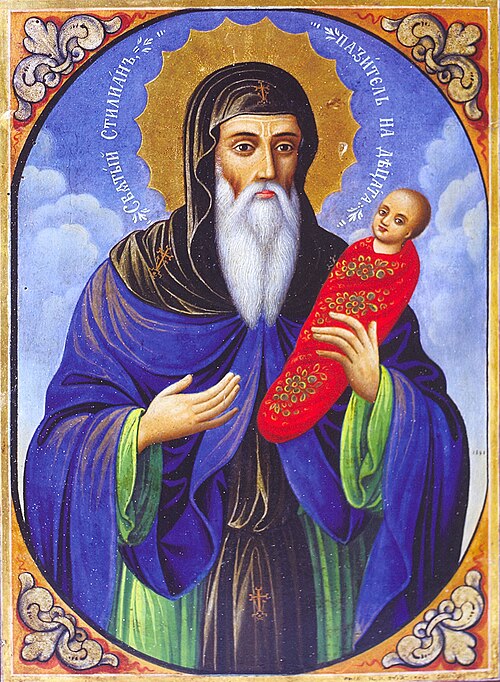
Venerable
Stylian of Paphlagonia
Hermit of Paphlagonia
Hermit of Adrianopolis in Paphlagonia, whom tradition regards as a protector of children.
- Feast
- November 26old style December 9
- Born
- 3504th century
- Place
- Hadrianopolis in Paphlagonia
- Order
- Venerables
Life
The Venerable Stylian of Paphlagonia was a hermit of Hadrianopolis in Paphlagonia, in present-day Turkey, venerated as a protector of children. Few sure things are known of his life. Sources place him between 400 and 500, others in the sixth century, around 550, and the date of his death is not known. He is commemorated on 26 November (9 December by the new calendar).
Life
He was born at Hadrianopolis in Paphlagonia, according to one source in a wealthy family. When he came of age, he distributed his inheritance from his parents to the poor and left the city to live in a monastery. His zeal and asceticism provoked the jealousy of other monks, so he left and lived as a hermit in a cave in the wilderness, in prayer and fasting. He prized especially the words of the Gospel: "Unless you turn and become like children, you will not enter the kingdom of heaven." In the quiet of the desert he had time to observe creation and meditate upon it, and he saw the Creator in all things. His holiness became known in the region: people came to hear his teaching or to be cured by his prayers. He knew how to calm troubled souls and other ascetics joined him. A Ukrainian source tells that on one night of prayer the saint was granted the divine presence and received the grace of the Holy Spirit. He came out of the cave in the morning with a joy and calm he had not known before. Then he laid his hand on a sick child, something he had not dared before, and felt the power of the Lord pass through his hand to the child, who was healed. From then on the sick, young and old, came to him from the whole region. Those who came to tempt him with offers of gain from his gifts received a single answer: that for all his gifts he had been paid in advance by the Holy Spirit, when He came down upon him, and he smiled as they left.
Love of children
He was known for his smiling face and cheerful disposition. From time to time he left his hermitage and made pastoral visits to the neighbouring villages. He believed that, to be saved, a person must have a soul like that of a little child. Families of every class entrusted their children to him to bring up, sometimes parents left them with him for a while to receive spiritual guidance, and those in need were so many that he had to seek a larger place and call his hermit friends to help. Children were healed by his prayer, and parents came from distant places; the saint attributed the cure to the holy name of God. By his prayers childless couples had children, and a young woman who had helped him with the children but could not bear one herself became pregnant, her husband spread the news through the region, and many barren women began to come to the great hermit. It is said that he lived to a great age and that at his burial his face was lit by a faint smile. In Paphlagonia it was believed that he healed even after death: when a child fell sick, an icon of Saint Stylian was painted and hung over the child's bed. It is also said that he had a friend and contemporary in Saint Alypius the Stylite.
Veneration and iconography
The saint is shown in icons as an old man holding a swaddled infant in his arms, sometimes with a scroll reading: "I am by nature the guardian of children, but this gift is from God." Scholars in general think he was historical, though the Bollandist Hippolyte Delehaye argued that he never existed and was a confusion with Alypius the Stylite, who shares his feast day and city of birth, the attribute of stylite being confused with a cognomen Στυλιανός (both from "stylos", pillar). Delehaye's views have been criticized, and another source says Stylian was "most likely a different person" from Alypius, given the differences between their lives. In Greece the saint's name has also been linked with the verb "to strengthen": he is believed to strengthen the health of children, and on the feast mothers of infants abstain from all work. On Ikaria houses had his icon, and when a child fell ill the service was held before the icon and the child was signed with the cross with it. On Crete, parents whose children died gave the name Stylianos or Styliani to the newborn. Among Thracians and Vlachs the name Stergios, a variant of Stelios, is given after a vow by women who had been unable to have children, and in Greece those named Stergios also celebrate on the same day. In Bulgaria, on his day, those named Stilian, Stela and the like keep their name day, and by popular belief nothing is worked at home, lest the children fall sick; women knead and hand out loaves and boiled corn for the health of the children. Bulgaria has four chapels dedicated to him, the oldest at Asenovgrad (built about the middle of the nineteenth century, collapsed in 1937 and rebuilt a year later), others at the Saparevo Banya monastery, at Simitli and in a centre for children with oncohematological diseases built in the village of Opitsvet in 2020, and there is an akathist to the saint in Bulgarian. In Asia Minor, Greece and Cyprus churches were consecrated in his name.
Commemorated the same day November 26
 Siricius of RomeSaint · Bishop of RomeNov 26
 Alypius the StyliteStylite · Stylite and founder of monasteriesNov 26
 Conrad of ConstanceSaint · Bishop of ConstanceNov 26
 Innocent of IrkutskSaint · First Bishop of IrkutskNov 26
 Nikon the MetanoeiteVenerable · Itinerant preacherNov 26
 BasolusVenerable · Hermit near ReimsNov 26
 Alexei VeselovskyHieromartyr · PriestNov 26
- Elias ZachateyskyHieromartyr · PriestNov 26
- James the HermitVenerable · Syrian hermitNov 26
- Nicholas VinogradovHieromartyr · Archpriest of DmitrovNov 26
- Acacius of the LadderVenerableNov 26
- Amator of AutunSaint · Bishop of AutunNov 26