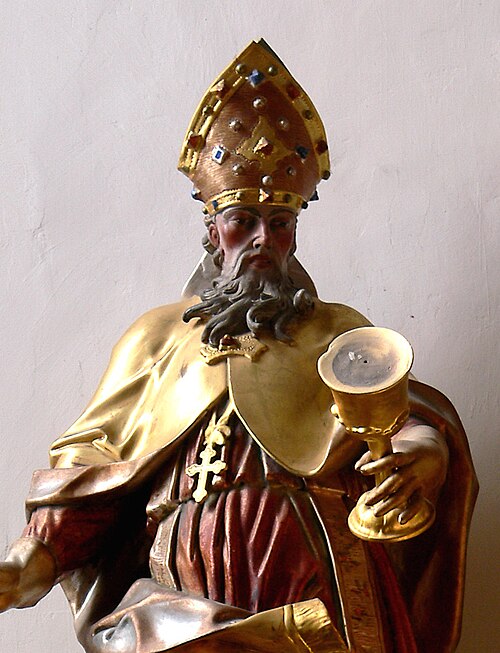
Saint
Conrad of Constance
Bishop of Constance
German bishop of Constance, venerated as a saint, who died in 975.
- Feast
- November 26old style December 9
- Reposed
- 97510th century
- Place
- Constance
- Order
- Hierarchs
Life
Saint Conrad was bishop of Constance from 934 until his repose on 26 November 975, of the powerful Welf family. He was enrolled among the saints in 1123, at the First Lateran Council, and since 2006 is also venerated in the Orthodox Church as a locally venerated saint in Germany. His feast is on 26 November.
Life
He was the son of Count Heinrich of Altdorf. He studied at the cathedral school of Constance, where he distinguished himself by a fine mind, diligence and a gift for organising. He became a canon and provost of the cathedral and, with the support of Bishop Ulrich of Augsburg, was consecrated bishop of Constance in 934. It is counted among his achievements that he avoided becoming entangled in the politics of the day and kept his energies for his episcopal duties; he was nevertheless close to the emperor Otto I, with whom he went to Italy, in 962, and was a witness of his coronation at Rome, in the winter of 961-962. With Otto he had not only a working bond but friendship, for they were related in spirit; the emperor visited Constance in 972.
Pilgrimages and buildings
He made three pilgrimages to Jerusalem, praying at the holy places and bringing relics to Constance, and several to Rome. After these journeys he raised churches in Constance, taking as model the forms of the churches he had seen in the Eternal City and the Holy Land. He had as patrons Saints Maurice and Lawrence; in his time churches were built dedicated to Saint Maurice, Saint John the Baptist, Saint Lawrence and the holy Apostle Paul. He founded several churches on the episcopal estates and the hospital at Kreuzlingen, named after a portion of the True Cross which he brought from Jerusalem and gave to it.
Veneration
His body was buried in the church of Saint Maurice, then the relics were moved to the cathedral; at the Reformation they were thrown into Lake Constance. His life was written around 1120 by Udalschalk, a monk of the abbey of Saint Ulrich and Saint Afra at Augsburg, later abbot; because of its late date it has little content. His memory as a model of courage was supported by Bishop Ulrich I of Dillingen. In icons he is shown as a bishop with a chalice in which, or over which, there is a spider: the story says that once, during the Liturgy, a spider fell into the chalice; spiders were then thought poisonous, but Conrad drank the Blood of Christ, spider and all, as a token of faith; according to the story, the spider afterward came out unharmed from the saint's mouth.
Commemorated the same day November 26
 Siricius of RomeSaint · Bishop of RomeNov 26
 Alypius the StyliteStylite · Stylite and founder of monasteriesNov 26
 Innocent of IrkutskSaint · First Bishop of IrkutskNov 26
 Nikon the MetanoeiteVenerable · Itinerant preacherNov 26
 Stylian of PaphlagoniaVenerable · Hermit of PaphlagoniaNov 26
 BasolusVenerable · Hermit near ReimsNov 26
 Alexei VeselovskyHieromartyr · PriestNov 26
- Elias ZachateyskyHieromartyr · PriestNov 26
- James the HermitVenerable · Syrian hermitNov 26
- Nicholas VinogradovHieromartyr · Archpriest of DmitrovNov 26
- Acacius of the LadderVenerableNov 26
- Amator of AutunSaint · Bishop of AutunNov 26