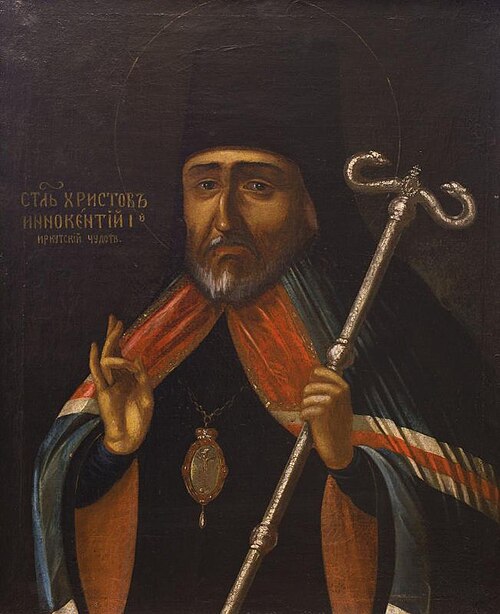
Saint
Innocent of Irkutsk
First Bishop of Irkutsk
Missionary to Siberia and first bishop of Irkutsk, born to a noble family of Chernigov; died in 1731.
- Feast
- November 26old style December 9
- Reposed
- 173118th century
- Place
- Irkutsk
- Order
- Hierarchs
Life
Saint Innocent of Irkutsk, the first bishop of Irkutsk, was a missionary to Siberia, born around 1680 into a noble family of the diocese of Chernigov, with the name Ivan Kulczycki. He fell asleep on 27 November 1731. The Russian Church canonized him in 1804 or 1805, the third canonization of the synodal era, after those of Saint Dimitry of Rostov and Theodosius of Totma. He is commemorated on 26 November, the day before his repose, because the day of his repose coincides with the icon of the Mother of God "of the Sign" of Novgorod, and on the third Sunday after Pentecost, in the Synaxes of the Saints of Galicia and of Saint Petersburg.
From 1695 he studied at the college in Kyiv, which he finished in 1706 or 1708. He was tonsured with the name Innocent at the Kyiv Caves Lavra in 1706 or 1708 and ordained hieromonk. In 1710 he was called to the Slavo-Greco-Latin Academy in Moscow, where he taught literature, then, in 1714, was prefect of the academy and professor of philosophy, metaphysics and moral theology. In 1719 he was called to the Alexander Nevsky monastery in Saint Petersburg as cathedral hieromonk, then served as hieromonk on ship and in Finland, and was named head of the mission to China. In 1721, after the Holy Synod decided he should be made bishop but without the title of cities bordering China, lest the Jesuits misinterpret it, he was consecrated bishop of Pereyaslavl, in the Trinity Cathedral of the Alexander Nevsky Lavra, in the presence of Peter the Great. He was not allowed into Beijing and was forced to spend three years at the Trinity-Selenga monastery in Buryatia, where he painted icons, opened a school and learned the Mongolian language. According to one tradition he called the baptized "brothers", and they, unable to pronounce the word, said "Burat", whence supposedly the name of the Buryats. In 1727 he was appointed to Irkutsk, to the newly created see, and was the first ruling bishop of Eastern Siberia. In his diocese, with fifty churches and four monasteries, he preached the word, converted many and fought old savage customs, debauchery and drunkenness. His health weakened in the harsh climate.
He fell asleep in 1731 and was buried beneath the altar of the Tikhvin church of the Ascension Monastery at Irkutsk. In 1764, during restoration of the church, his relics were found incorrupt, and after many miracles attributed to his intercession he was glorified. In 1921 the Soviet government confiscated the relics and displayed them in museums as a "Siberian mummy", and the church was burned. The relics were returned to the church on 7 September 1990. He is sometimes confused with Innocent of Alaska, who was named in his honour. Because he led the Orthodox mission in China, many Chinese Orthodox regard him as the patron of China.
Commemorated the same day November 26
 Siricius of RomeSaint · Bishop of RomeNov 26
 Alypius the StyliteStylite · Stylite and founder of monasteriesNov 26
 Conrad of ConstanceSaint · Bishop of ConstanceNov 26
 Nikon the MetanoeiteVenerable · Itinerant preacherNov 26
 Stylian of PaphlagoniaVenerable · Hermit of PaphlagoniaNov 26
 BasolusVenerable · Hermit near ReimsNov 26
 Alexei VeselovskyHieromartyr · PriestNov 26
- Elias ZachateyskyHieromartyr · PriestNov 26
- James the HermitVenerable · Syrian hermitNov 26
- Nicholas VinogradovHieromartyr · Archpriest of DmitrovNov 26
- Acacius of the LadderVenerableNov 26
- Amator of AutunSaint · Bishop of AutunNov 26