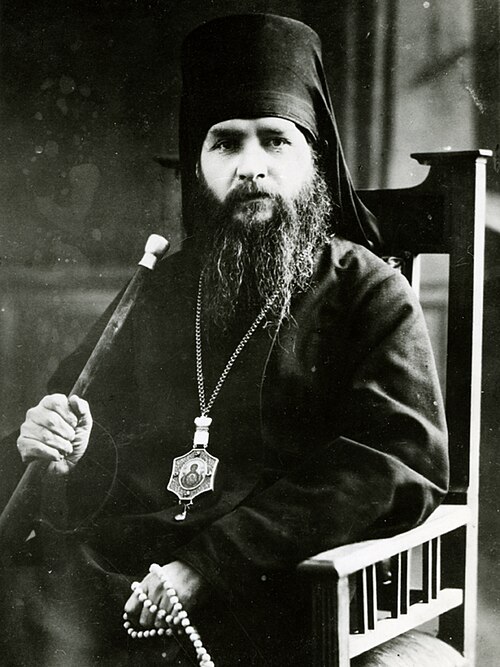
Hieromartyr
Amphilochius Skvortsov
Bishop of Melekess
Bishop of Melekess, vicar of the Samara diocese, who died a martyr in 1937; glorified in 2000.
- Feast
- September 18old style October 1
- Reposed
- 193720th century
- Place
- Novosibirsk Oblast
- Order
- Martyrs
Life
Saint Amphilochius Skvortsov, the Hieromartyr (in the world Alexander Yakovlevich Skvortsov, 1885 to 1937), was bishop of Melekess, vicar of the diocese of Samara, and earlier bishop of Krasnoyarsk and Yeniseisk. A learned missionary among the Kalmyks and a connoisseur of the Kalmyk, Mongolian and Tibetan languages, he opposed the Renovationists, lived the life of a hermit and spiritual father of a small community of nuns in Khakassia, and was held for years in the Siblag camps. He was shot on 1 October 1937. The Russian Church numbered him among the saints in 2000. He is commemorated on 18 September.
Childhood and studies
He was born in the village of Russkie Norvashi, Tsivilsk district, Kazan province, in the family of the psalm-reader Yakov Vasilievich Skvortsov, who had eleven children, three sons and eight daughters. Alexander was the youngest. He graduated from the Cheboksary theological school, the Kazan seminary (1906) and the Kazan Theological Academy (1910), with the degree of candidate in theology. His work, on religious and moral translations into the Kalmyk language as a means of missionary influence, received the Metropolitan Joseph prize. He learned the Kalmyk language perfectly, and the literature, mostly in manuscript, on translations of sacred and liturgical texts into this language. In 1910 to 1911 he listened to lectures at the Oriental Faculty of Saint Petersburg University, to learn the Mongolian language to free understanding of the sacred manuscripts of Lamaism. In 1911 to 1912 he was a professorial fellow of the academy.
Missionary and teacher
On 22 March 1907, in the first year at the academy, he was tonsured into the mantle with the name Amphilochius. In 1908 he was raised hierodeacon. In 1909 he was sent to the Kalmyk steppe of Astrakhan to learn the Kalmyk language and work in the Orthodox mission among the Kalmyks. He took an active part in the missionary congresses where translations of Holy Scripture and liturgical texts into Kalmyk were discussed. From 1910 he was hieromonk. From 1911 he was lecturer at the Kazan Academy, in the chair of Mongolian language, history and refutation of Lamaism. In 1912 to 1914 he was in Mongolia, where he had been sent to study the Tibetan language and Tibetan literature on Lamaism. On his return he continued to teach and was assistant to the director of the historical and ethnographic museum at Kazan, to which he gave a collection of over a hundred objects of Buddhist and Lamaist worship. He brought three Chinese to Orthodoxy. He was known as a gifted preacher and missionary.
In Siberia
In 1918 to 1919 he lived in the Dormition monastery for monks, not far from Krasnoyarsk. In 1919 to 1921 he lived in a skete founded by him with five monks on Lake Tiberkul, in the Minusinsk district. In 1921 he was sent to serve at the church in the village of Bely Yar. In September 1922 Bishop Zosima (Sidorovsky) of Yenisei and Krasnoyarsk went over to the Renovationists and governed the diocese as a Renovationist bishop. He knew Hieromonk Amphilochius well from when he was bishop of Irkutsk and, summoning him to Krasnoyarsk, proposed that he join the Renovationists. Amphilochius, who had studied the Renovationist movement already before the revolution and regarded it with distrust, refused, and Zosima removed him from the parish. As there was no lawful authority in the diocese, Patriarch Tikhon being under arrest in Moscow, in November 1922 he went to the convent in the village of Matur, where he stayed about half a year. There he met the nun Barbara (Tsivileva), who became his spiritual daughter and accompanied him afterwards in all his moves, both free and in chains. In 1923 he was arrested by the OGPU but soon released for lack of evidence. From June 1924 he was rector of the cemetery church at Minusinsk, fought against the Renovationists and was briefly arrested again.
Bishop
On 8 March 1925 he was consecrated at Moscow bishop of Krasnoyarsk and Yeniseisk. The consecration was performed by Patriarch Tikhon, with Metropolitan Peter (Polyansky) and Archbishops Gury (Stepanov) and Procopius (Titov). On 13 July 1926 he was arrested for continuing the struggle against Renovationism. He was held in the prison at Krasnoyarsk, then sentenced to three years in the Solovki Special Purpose Camp. In April 1928 he was released. He was told to appear at the Lubyanka, where he learned he could not enter Krasnoyarsk. In 1928 the deputy Locum Tenens, Metropolitan Sergius, named him bishop of the Don and Novocherkassk, but the OGPU of the region refused him entry. Then he was named bishop of Melekess, vicar of the diocese of Samara. At a personal meeting with Metropolitan Sergius (Stragorodsky) he proposed that the authorities be commemorated by the formula: "We pray still for our country and for its rulers, that the Lord turn them to the true knowledge of the holy faith and turn them to the path of repentance". This position was acceptable neither to the Bolsheviks nor to Metropolitan Sergius, and Bishop Amphilochius was put into retirement.
The illegal monastery in Khakassia
In July 1928 he arrived in the village of Anchul, in the Tashtyp district of Khakassia, where lived the nuns of the small Matur convent, closed in 1926. He headed the small monastery formed in the village, served in the house church and held with the nuns talks on religious themes and on the present state of the Church. In April 1931 he was arrested with a priest and nuns and held in the prison of the Minusinsk labour colony. He was accused of founding an illegal monastery and of the local peasants, under the influence of religious agitation, refusing to join collective farms and to fulfil the tasks of logging and haymaking. At the interrogation he said he did not consider himself guilty of the charge, that he had not agitated, but did not deny that he expressed lack of sympathy for the Soviet power.
Siblag and death
On 16 November 1931 he was sentenced to five years in a camp (the nuns were exiled for five years to eastern Siberia). He was in Siblag, at Mariinsk (1931 to 1932), in the Osinovsk section (from 1932). On 12 December 1932 he was put in a punitive detachment, then moved to a punitive group and worked in the mines extracting coal. On 28 April 1933 he was arrested in the camp, accused of counter-revolutionary activity, of organizing an anti-Soviet group and of intending to flee from the camp. At the interrogation he said that earlier, in interrogations, he had affirmed that he was an opponent of the Soviet power and that the existing order was hostile to his convictions, and that he now declared again that he desired the fall of the Soviet power and its way, finding in this the possibility of restoring the true spiritual life of the people. But he showed that his influence on the prisoners was exclusively spiritual, inspiring a religious disposition: to be patient in their personal camp life, not to murmur and to submit to fate, seeing in everything God's will. No proof of the existence of an anti-Soviet group was found. So on 28 January 1934 the OGPU Collegium limited itself to increasing the bishop's sentence by one year.
At the end of the term, in April 1937, he was not released. On 4 June a new case was opened against him, with the motive that his term was ending, he was to be released from the camp, and that, being free, he would again do counter-revolutionary activity, so the prisoner Skvortsov should not be released. As before, he did not plead guilty. The investigation even noticed that the bishop kept some oak boards, found in a search. He said that after release he wanted to make from them little crosses for those who might need them, and the investigation charged him that he wished to spread crosses illegally and conduct religious propaganda. He rejected this charge too. On 20 September 1937 the troika of the UNKVD for the West Siberian Territory sentenced him to death. He was shot on 1 October.
Glorification
In preparing the canonization made by the Russian Church Outside Russia in 1981, his name was entered in the working list, with a wrong circumstance of his end: "He died in 1946, never recognizing the Moscow Patriarchate". The nominal list was published only at the end of the 1990s. In August 2000 the Jubilee Bishops' Council of the Russian Church numbered him among the New Martyrs and Confessors of Russia, for veneration throughout the Church. In July 2015 a group of scouts and clergy from Krasnoyarsk and Abakan made a pilgrimage and search expedition on the places where the saint lived between 1922 and his arrest in April 1931.
Commemorated the same day September 18
 RichardisRight-Believing · Carolingian empressSep 18
 Ariadne of PhrygiaMartyr · Martyr of PhrygiaSep 18
 Constantius of the Theban LegionMartyr · Soldier of the Theban LegionSep 18
 Eumenes of GortynaSaint · Bishop of Gortyna in CreteSep 18
 Euphrosyne of SuzdalVenerable · Princess and nun of SuzdalSep 18
 Hilarion of OptinaVenerable · Hieroschemamonk of OptinaSep 18
 Sophia and Irene of EgyptHoly MartyrsSep 18
- Bidzina CholokashviliMartyr · Leader of the Bakhtrioni UprisingSep 18
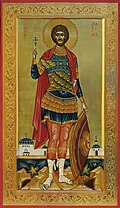 Juventinus and MaximinusMartyrSep 18
- Romylos of RavanicaVenerableSep 18
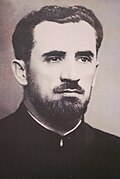 Ilarion FeleaConfessor · Priest and theologianSep 18
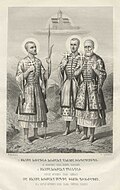 Shalva of KsaniMartyr · Duke of KsaniSep 18