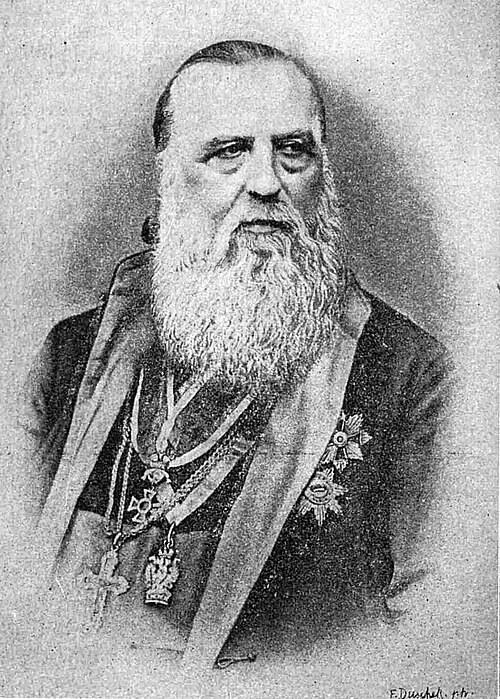
Saint
Andrei Șaguna
Metropolitan of Transylvania
Metropolitan of Transylvania, scholar and leader of the Romanians in the Habsburg monarchy; died in 1873.
- Feast
- November 30old style December 13
- Reposed
- 187319th century
- Place
- Sibiu
- Order
- Hierarchs
Life
Saint Andrei Șaguna, Metropolitan of Transylvania, was a shepherd, scholar and organizer of the Orthodox Church of the Romanians in the Habsburg Empire, and one of the leaders of the Romanian people in the Revolution of 1848. He passed to the Lord on 28 June 1873 at Sibiu. The Holy Synod of the Romanian Orthodox Church canonized him in 2011. His feast is kept on 30 November. He was an honorary member of the Romanian Academy.
Beginnings He was born at Miskolc in Hungary on 20 January 1808, or according to some sources 20 December, into the family of a merchant, Naum Șaguna, an Aromanian from Grabova, now in Albania. The family was related to the Sina bankers, who later supported him in church works. He was baptized in the Orthodox church at Miskolc with the name Anastasie. In 1814 his father went over to Catholicism, to gain a better standing than the second-class one given to Orthodox subjects of the empire, but the family remained, it seems, secretly Orthodox. He studied at the school of his native town, then at the Piarist gymnasium in Pest, graduating in 1826. From 1826 to 1829 he studied philosophy and law at the University of Pest, living with his uncle Anastasie Grabovski. Returned to the Orthodox Church, he studied theology at Vršac. On 24 October 1833 he was tonsured a monk at Hopovo monastery with the name Andrei, and on 2 February 1834 was ordained deacon in the cathedral of Karlovci. He was secretary to Metropolitan Stefan Stratimirović, taught at the seminary in Karlovci, became archimandrite in 1842 and was abbot at Hopovo and then at Kovilj. On 15 June 1846 he was named vicar general at Sibiu. In that office he handed over to the imperial authorities Ecaterina Varga, a fighter for the rights of Romanians, in January 1847, a deed that remains controversial in his life.
Bishop in the time of the Revolution On 2 December 1847, at Turda, the assembly of archpriests chose him among the candidates for the episcopal see. He was consecrated bishop on 18 April 1848, Thomas Sunday, at Karlovci, by the Serbian metropolitan Josif Rajačić. He said then that it was asked of him that through his shepherding the revival of the Transylvanian diocese be put into action, according to the need of the Church, the salvation of the people and the spirit of the time. On 3/15 May 1848 he presided, with the Greek Catholic bishop Ioan Lemeni, over the Assembly of Blaj, where he held a moderate position. He was elected to the leadership of the Romanian movement and carried the petition to Vienna, to the emperor. When the Hungarians imposed the union of Transylvania with Hungary, he stayed on the side of those seeking an understanding, then, when war broke out between Hungary and the Habsburgs, the Romanians came to terms with Vienna. In October, when Transylvania became a battlefield, he found shelter at Sibiu. On 28 December 1848 he organized an assembly at Sibiu, from which he sent a new petition to the emperor, with the idea of the unity of the Romanians of Transylvania, Banat and Bukovina. Under pressure from General Puchner the Romanians asked the Russians for help through an unsigned petition of the "citizens of Sibiu", which roused the anger of the Hungarian leaders; Kossuth called him an enemy and ruled that amnesty should not include him. In February 1849 he left for Austria, where he tried to revive the project of a common land of the Romanians in the empire.
Shepherd and organizer of the Church In 1850 he led a delegation to Vienna again and asked Emperor Franz Joseph for an institution of higher learning and more liberties and school rights for the Romanians. Much remained unanswered. In 1864 he became the first head of the independent Orthodox Metropolis of Transylvania, with its seat at Sibiu, separated from the Serbian Patriarchate of Karlovci, which he led until his death. He founded the Romanian gymnasium at Brașov in 1851, worked for schools, a printing house and the press, and composed works on canon law, church history and pastoral theology, among them the Compendium of Canon Law, printed in several editions. He laid the foundations of church organization, in which laity and clergy meet in diocesan assemblies and in a national church congress, an order kept in the Romanian Orthodox Church.
He fell asleep at Sibiu on 28 June 1873 and was buried in the metropolitan cathedral. The Romanian Orthodox Church canonized him in 2011, with commemoration on 30 November.
Commemorated the same day November 30
 AndrewApostle · The First-CalledNov 30
 FrumentiusSaint · Bishop of AxumNov 30
 Vakhtang I of IberiaSaintNov 30
- AlexanderSaint · Bishop of MethymnaNov 30
- BaethghusSaintNov 30
- Caoimhseach of Dermhagh Chuile CaennaSaintNov 30
- Carion of NicomediaSaintNov 30
- Castulus and EuprepisHoly MartyrsNov 30
- Constantius of RomeHieromartyrNov 30
- CredaSaintNov 30
- CridaSaintNov 30
- EliasVenerableNov 30