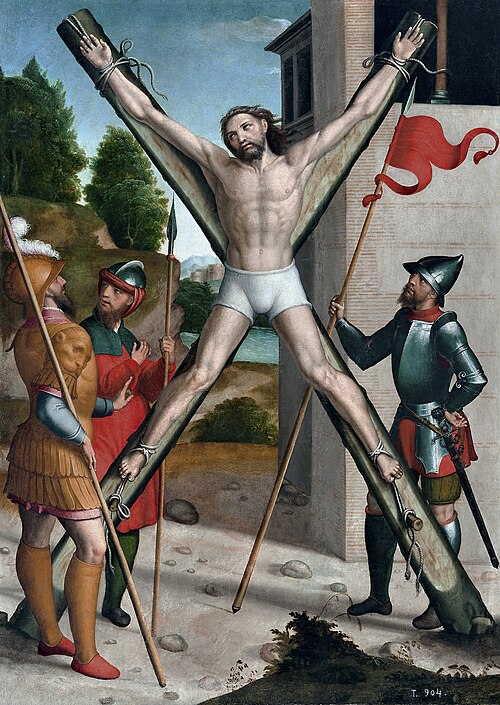
Apostle
Andrew
The First-Called
Galilean fisherman, the first-called apostle, who preached the Gospel and was crucified at Patras.
- Feast
- November 30old style December 13
- Reposed
- 601st century
- Place
- Patras
- Order
- Apostles
Life
The holy Apostle Andrew the First-Called was a Galilean fisherman, the brother of the Apostle Peter, and the first to follow Christ. He preached the Gospel in the lands of the Black Sea and Greece, and received the crown of martyrdom by crucifixion at Patras. The Romanian Orthodox Church honours him as protector of Romania.
The first called
Andrew came from Bethsaida in Galilee, the son of Jonah, and fished with his brother. From youth he turned his soul to God and became the closest disciple of Saint John the Baptist. When the Forerunner pointed to Jesus and said "Behold the Lamb of God", Andrew, with John the Evangelist, followed the Lord. He then brought his brother Peter to Christ. For this reason he is called the First-Called. The synaxarion says that he did not marry.
Preaching
After the descent of the Holy Spirit Andrew set out for the eastern lands. The synaxarion names Asia Minor, Thrace, Macedonia, the Danube, the Black Sea coast, Crimea and the Dnieper, where he blessed the hills on which the city of Kiev would rise and set up a cross. The historian Eusebius, quoting Origen, writes that Scythia fell to his lot. The Romanian Orthodox Church teaches that he preached in Scythia Minor, in present-day Dobruja; Wikipedia notes that this tradition was not widely acknowledged before the twentieth century. Tradition also says that he reached Byzantium, where he founded the Church and made the Apostle Stachys its bishop; for this reason the Patriarchate of Constantinople regards him as the founder of its see.
On his journeys he suffered much from pagans, who drove him out of their cities and beat him. At Sinope he was stoned but remained unharmed and went on preaching. According to a Cypriot tradition, when his ship stopped off Cyprus he prayed for water on a dry rock; the spring that gushed forth is known as a holy spring, and a blind child was healed there.
Martyrdom at Patras
The last city he reached was Patras, in Achaia. Through his prayers many sick were healed, among them Sosius, Maximilla, the wife of the governor of the city, and Stratocles, the governor's brother, and almost all the citizens accepted the faith. Few pagans were left, among them the governor Aegeatos. Angered that his wife had believed in Christ, Aegeatos ordered the apostle crucified, thinking to undo his preaching.
Saint Andrew received the sentence with joy and prayer. To prolong his suffering, the executioners did not nail him but tied him to the cross. For two days he taught the crowd that gathered, who wished to take him down, and Aegeatos, fearing a riot, ordered the crucifixion stopped. But the apostle prayed to receive death on the cross. The soldiers lost the use of their hands. The saint said, "Lord Jesus Christ, receive my spirit", and a ray of light surrounded the cross. When the light faded, the apostle had given up his soul. Maximilla took down his body and buried it with honour. Tradition says Andrew was crucified on an X-shaped cross, but this iconography was fixed only in the late Middle Ages, and the earliest texts speak of a Latin cross. His death is placed around the year 60.
Relics
The synaxarion says that in the time of Constantine the Great his relics were moved to Constantinople, to the church of the Holy Apostles, next to those of the Evangelist Luke and of Timothy; according to Wikipedia the translation took place around 357 under Constantius II. The head remained at Patras. In 1460 or 1461, when the Turks threatened the city, Thomas Palaiologos carried the head to Italy, where Pope Pius II placed it in Rome. In September 1964 Pope Paul VI returned it to the Church of Patras, and in 1980 the cross of the martyrdom was brought back there too. They are kept in the Cathedral of Saint Andrew at Patras.
Veneration in the Romanian Orthodox Church
The Church celebrates him on 30 November. From 1995 a decision of the Holy Synod marked his feast with a red cross in the calendar. In 1996 the reliquary with the head of Saint Andrew was brought from Patras to Iași, during the pilgrimage to the relics of Saint Parascheva, through the care of Patriarch Daniel, then Metropolitan of Moldavia and Bukovina. In February 1997 he was proclaimed Protector of Romania, and from 2002 his feast is a National Church Feast. The bringing of the relics to Iași is commemorated on 13 October. He is also patron of Russia, Scotland and Patras.
Commemorated the same day November 30
 FrumentiusSaint · Bishop of AxumNov 30
 Vakhtang I of IberiaSaintNov 30
 Andrei ȘagunaSaint · Metropolitan of TransylvaniaNov 30
- AlexanderSaint · Bishop of MethymnaNov 30
- BaethghusSaintNov 30
- Caoimhseach of Dermhagh Chuile CaennaSaintNov 30
- Carion of NicomediaSaintNov 30
- Castulus and EuprepisHoly MartyrsNov 30
- Constantius of RomeHieromartyrNov 30
- CredaSaintNov 30
- CridaSaintNov 30
- EliasVenerableNov 30