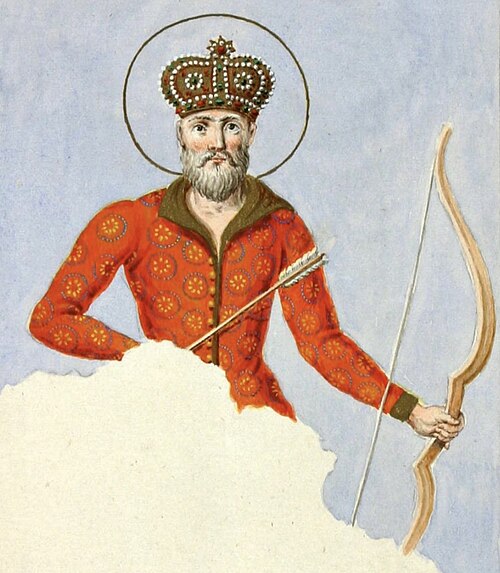
Saint
Vakhtang I of Iberia
Vakhtang I Gorgasali (Georgian: ვახტანგ I გორგასალი, romanized: vakht'ang I gorgasali; c. 439 or 443 – 502 or 522), of the Chosroid dynasty, was a king (mepe) of Iberia, natively known as Kartli (eastern Georgia) in the second half of the 5
- Feast
- November 30old style December 13
- Reposed
- 5026th century
- Place
- Ujarma
Life
Saint Vakhtang I Gorgasali was king of Iberia (Kartli, in the east of today's Georgia) in the second half of the fifth century and the early sixth. He is remembered as a warrior king who fought to free his land from Persian rule, who reorganised the Georgian Church, and who, according to tradition, founded the city of Tbilisi. The Georgian Orthodox Church honours him as a holy and right-believing king, and his memory is kept on 30 November by the Old Style, which is 13 December in the civil calendar.
Sources and dates
The main source is the Life of Vakhtang Gorgasali, attributed to Juansher and written in the eighth or the eleventh century. It mixes history with epic legend, so scholars treat its details with care. The dates are disputed: his birth is placed between about 439 and 467, and his death between about 502 and 527. The Georgian page of the calendar of saints gives 502. Some historians think he is the king Gurgenes whom the Byzantine historian Procopius mentions. The name Gorgasali is explained as "wolf's head," after the shape of his helmet.
Youth and rule
He was the son of King Mihrdat V and Queen Sagdukht, a Persian who had become a Christian. When he was seven years old his father died, and his mother ruled as regent. The land suffered from the efforts of Persia to spread fire worship and from a raid of northern tribes, called Ossetians in the Life. According to the Life, at sixteen Vakhtang led an army against them, won a single combat against their champion and freed his sister Mirandukht, who had been carried off as a captive.
As a vassal of the Persian king, he took part in Persian campaigns, including one against the Hephthalites and one against Rome in 472, in which, according to the Life, Iberia gained Egrisi and Abkhazia.
The Church and the war with Persia
Resenting Persian pressure, Vakhtang turned toward Byzantium. He married Helena, called a daughter or relative of the emperor Zeno, and obtained leave from Constantinople to raise the bishop of Mtskheta to the rank of catholicos. The new catholicos and twelve new bishops were sent to be consecrated at Antioch, so that the Georgian Church became more independent. The king met opposition in this, notably from the bishop he replaced.
In 482 Vakhtang had Varsken executed. Varsken was a powerful vassal who had accepted Zoroastrianism and had killed his Christian wife, Saint Shushanik. This put the king in open revolt against Persia. The Armenians under Vahan Mamikonian joined him, but the allies were defeated, Iberia was ravaged in 483 and 484, and Vakhtang fled to Lazica, held by the Romans. After the death of the Persian king Peroz in 484, the new king Balash made peace, and Vakhtang returned to his kingdom.
Years later, King Kavadh summoned him to a war against Rome. Vakhtang refused, and a Persian army invaded Iberia. In his last years he spent time in war and exile, vainly asking for help from the Romans.
Death and legacy
According to the Life, he died in battle against the Persians: a renegade slave shot him through a gap in his armour. He was carried to the castle of Ujarma, where he died, and he was buried in the cathedral of Svetitskhoveli at Mtskheta. His will called on his son Dachi and the Georgians to hold firmly to the faith and not to give up the friendship of the Greeks. Dachi succeeded him.
The tradition of the foundation of Tbilisi says that while Vakhtang was hunting, his falcon chased a pheasant, and both fell into a hot spring. The king, seeing the steam rising, ordered a city built there and called it Tbilisi, "the place of warm springs." The Georgian Church formally entered him in its calendar and a church in his honour was built at Rustavi early in the 1990s, though he had probably been regarded as a saint long before. The Order of Vakhtang Gorgasali, created in 1992, is one of Georgia's highest military decorations.
Commemorated the same day November 30
 AndrewApostle · The First-CalledNov 30
 FrumentiusSaint · Bishop of AxumNov 30
 Andrei ȘagunaSaint · Metropolitan of TransylvaniaNov 30
- AlexanderSaint · Bishop of MethymnaNov 30
- BaethghusSaintNov 30
- Caoimhseach of Dermhagh Chuile CaennaSaintNov 30
- Carion of NicomediaSaintNov 30
- Castulus and EuprepisHoly MartyrsNov 30
- Constantius of RomeHieromartyrNov 30
- CredaSaintNov 30
- CridaSaintNov 30
- EliasVenerableNov 30