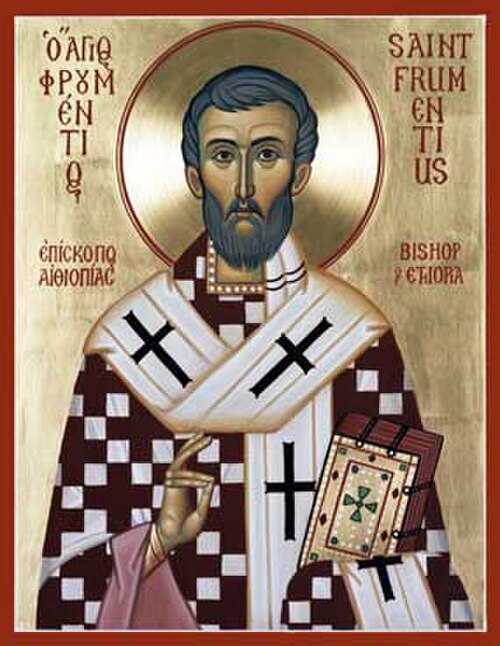
Saint
Frumentius
Bishop of Axum
Phoenician missionary and first bishop of Axum, who brought Christianity to Ethiopia.
- Feast
- November 30old style December 13
- Reposed
- 3804th century
- Place
- Axum
- Order
- Hierarchs
Life
Saint Frumentius was a missionary from Tyre, the first bishop of Axum and, according to tradition, the man who brought Christianity to Ethiopia. He is called Abuna (“our father”), Abba Salama (“father of peace”) and Kesate Birhan (“revealer of light”). The Orthodox Church commemorates him on 30 November; the Coptic Church on 18 December, and the Catholic Church on 20 July.
Life
According to Rufinus of Aquileia, who cites Edesius, Frumentius’ brother, the two were born at Tyre, in Phoenicia, in a Christian family of Greek or Syro-Phoenician origin. Around 316, as children, they set out with their uncle, the philosopher Meropius, on a sea voyage toward “India”. When their ship put into a port on the Red Sea, the locals killed the whole crew, sparing only the two boys, who were taken as slaves to the king of Axum. Edesius was made cupbearer, and Frumentius, the older, secretary and treasurer. Shortly before his death the king freed them. The widowed queen asked them to stay at court, to bring up the young heir, Ezana, and to help govern the kingdom during his minority. They stayed, and Frumentius used his influence to spread Christianity: first he encouraged the Christian merchants to confess their faith openly and helped them find places of prayer, then he brought some of the natives to the faith.
When Ezana came of age, Edesius returned to Tyre, where he was ordained priest. Frumentius, eager for the conversion of Ethiopia, accompanied him as far as Alexandria and asked Patriarch Athanasius to send a bishop and priests as missionaries. By Athanasius’ own account, he thought Frumentius the most suitable for the task and ordained him bishop, traditionally in 328, according to others between 340 and 346.
Bishop of Axum
Returning to Ethiopia, he set his see at Axum, converted and baptized King Ezana (and his brother Saizana). Ezana built many churches, and the faith spread through the country. Frumentius founded the first monastery of Ethiopia, Dabba Selama. He was the first Abuna, the title given to the head of the Church in Ethiopia, which began the custom that the bishops of Ethiopia be appointed by the patriarch of Alexandria. Ethiopian tradition credits him with the first translation of the New Testament into Ge’ez and a part in developing the Ge’ez script.
Around 356 the emperor Constantius II, who favoured the Arians, wrote to King Ezana and his brother Saizana, asking them to replace Frumentius, appointed by Athanasius, with Theophilus the Indian, on the Arian side. The king refused. The sources show that Christianity was known in the region already earlier, and Frumentius’ role was above all to establish it as the order of the Church and to have it recognised by the state. He died around 383, and the Ethiopian and Eritrean Churches celebrate his consecration on 18 Tahsas and his repose on 26 Hamle (20 July). He is patron of the former Kingdom of Aksum.
Commemorated the same day November 30
 AndrewApostle · The First-CalledNov 30
 Vakhtang I of IberiaSaintNov 30
 Andrei ȘagunaSaint · Metropolitan of TransylvaniaNov 30
- AlexanderSaint · Bishop of MethymnaNov 30
- BaethghusSaintNov 30
- Caoimhseach of Dermhagh Chuile CaennaSaintNov 30
- Carion of NicomediaSaintNov 30
- Castulus and EuprepisHoly MartyrsNov 30
- Constantius of RomeHieromartyrNov 30
- CredaSaintNov 30
- CridaSaintNov 30
- EliasVenerableNov 30