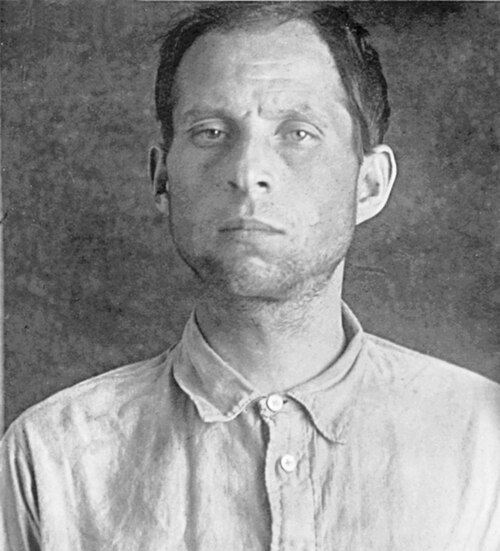
Martyr
Andrew Argunov
Chairman of the parish council
Chairman of a parish council, born in 1904, who died a martyr in a camp in 1938; canonized in 2005.
- Feast
- January 25old style February 7
- Reposed
- 193820th century
- Place
- gulag camp
- Order
- Martyrs
Life
Saint Andrew Argunov, martyr (1904 to 5 August 1938), was a peasant and chairman of the parish council of the church of the Protection in the village of Prudtsy, who opposed the demolition of the church wall and died in a camp in 1938. He was numbered among the new martyrs and confessors of Russia on 20 April 2005 by the Holy Synod of the Russian Orthodox Church, for veneration in the whole Church. He is commemorated (Old Style) on 25 January, in the Synaxis of the New Martyrs of Russia, and on 23 July.
Life at Prudtsy
He was born into a peasant family, that of Ivan Kuzmich and Pelagia Vasilievna Argunov. His father died early and the family lived in need, but Andrew managed to study at the village school. He was a craftsman in an artel that made toothbrushes, sang in the church choir and was chairman of the parish council of the church of the Protection at Prudtsy. The events that led to his death took place in the 1930s. In 1933 a "godless" collective farm was organized in the village, which Andrew, twenty-nine, would not join; in the next three years everything was taken from him: his house, sheds, barn, horse and cow. In 1936, as an individual peasant, he was required to give the state 60 kg of meat a year, which he could not do.
In October 1936 the local authorities wanted to demolish the brick wall of the church for a power station for the artel. Argunov, as chairman of the parish council, said that they did not give and would not give their consent, that the Christian faith had suffered enough from the persecutors of the Church. In 1937 he was arrested for selling toothbrushes made in the artel and sentenced to six months; after release he was sentenced to forced labour for cutting down a few birches in the fence of the church cemetery without permission of the village soviet.
Arrest, camp and canonization
On 14 September 1937 he was arrested and imprisoned at Taganka, being interrogated at once, which was not usual. The charge: "counter-revolutionary activity, spreading slander against the Soviet power". At the interrogation he did not admit guilt. He said that he had opposed the demolition of the wall and had urged all members of the council to protest, saying that Christ bore His Cross and that we too must suffer from the persecutors of the Church for the Christian faith. He also said that, pointing toward the communists, he had said: "You guard your leaders in the Kremlin behind a brick wall and do not demolish it; we do not care about your power station, whatever you build, the time will come when everything will collapse". He said he had told people of Prudtsy that the faith and the Church must be kept, that without it we would all perish, and that he regards the communists as persecutors and enemies of the Church, and does not consider his words slander but truth. On 10 October 1937 a special troika of the NKVD for the Moscow region sentenced him to eight years in a camp. He was sent to Bamlag, where he did not work a year; he died in the camp on 5 August 1938 and was buried in an unknown place. The diocese of Moscow proposed him for canonization, and on 20 April 2005 the Holy Synod glorified him for veneration in the whole Church, as a martyr, in the Synaxis of the New Martyrs and Confessors of Russia.
Commemorated the same day January 25
 Gregory the TheologianSaint · Archbishop of ConstantinopleJan 25
 Felicitas of RomeMartyrJan 25
 Vladimir of KyivHieromartyr · Metropolitan of Kyiv and HalychJan 25
- Castinus of ByzantiumSaint · Bishop of ByzantiumJan 25
 Peter ZverevHieromartyr · Archbishop of VoronezhJan 25
 Anatoly of OptinaVenerable · Elder of OptinaJan 25
 Moses of NovgorodSaint · Archbishop of Novgorod and PskovJan 25
 Constantine VeretskyHieromartyr · ArchpriestJan 25
- Bretanion of TomisSaint · Bishop of TomisJan 25
 Joasaph of BorovskHieromartyr · Archimandrite of the Trinity LavraJan 25
 Nicholas PopovHieromartyr · ArchpriestJan 25
 Sergius KrestnikovVenerable Martyr · Choir directorJan 25