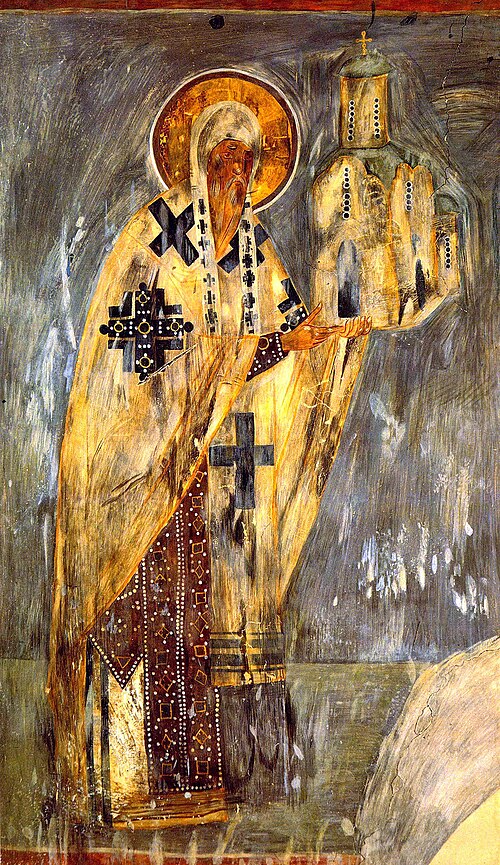
Saint
Moses of Novgorod
Archbishop of Novgorod and Pskov
Archbishop of Novgorod and Pskov, born at Novgorod as Mitrofan, who died in 1362.
- Feast
- January 25old style February 7
- Reposed
- 136214th century
- Order
- Hierarchs
Life
Saint Moses (in the world Mitrofan) was archbishop of Novgorod and Pskov, a gentle hierarch, lover of monasticism, builder of monasteries and churches, who held the see of Novgorod from 1325 to 1330 and again from 1352 to 1359. He died in the Skovorodsky monastery on 25 January 1362. He is commemorated on 25 January (7 February in the new style), on the third Sunday after Pentecost in the synaxes of the saints of Novgorod and Pskov, and on the Sunday after 29 June in the synaxis of the saints of Tver.
Beginnings
He was born in Novgorod, in a rich and pious family, and received a good education. From childhood he was devout and, barely out of adolescence, left his parents in secret for the Otroch monastery of Tver, where he was tonsured a monk. His parents found him there and begged him to move to a Novgorod monastery, nearer to them. Heeding them, he moved to the Kolmov monastery, near Novgorod. After a time the monk Moses was ordained hieromonk by Archbishop David of Novgorod, then raised to archimandrite and appointed abbot of the Saint George (Yuriev) monastery of Novgorod.
First episcopate
In 1325 he was consecrated in Moscow by Metropolitan Peter as bishop of Novgorod and Pskov, with elevation to archbishop. Times were hard: repeated devastation by fires in Novgorod, with its many churches, popular unrest with looting that kept everyone in fear, and the threat of raids by the Tatar-Mongols, who pursued princes not obedient to them. In 1328 he went with the city's chief magistrate, Avram, to Pskov, to Prince Alexander Mikhailovich, who had fled there after the Tver uprising, to ask him to go to the Horde, as Khan Uzbek had ordered. Alexander did not want to go to the khan. The saint's soul sought monastic solitude, and in 1330 he retired to the Kolmov monastery, where he received the schema.
Second episcopate
From 1352, at the urgent request of the Novgorodians, he governed the diocese of Novgorod a second time. He loved building churches and organizing monasteries. During his rule he founded or renewed five monasteries: the Resurrection monastery at Derevyanitsa (1335), the convent of Saint John the Theologian near Novgorod (1354), the monastery of the Archangel Michael at Skovorodka, with a stone church (1355), the convent of the Holy Spirit in Novgorod (renewed in 1357) with a church of the Holy Spirit, and the Dormition monastery at Radogoshchi (1357). He also built several churches: the church of the Tithe in the monastery in Novgorod (1359), the church of Saint Procopius in the prince's court (1359) and the church of the Annunciation on Mikhailovskaya street in Novgorod (1362).
Throughout his ministry he took care of the good of his flock, helping the suffering and the wronged, caring for widows and orphans, protecting the weak from the oppression of the strong. He fought the heresy of the Strigolniki and the pagan customs that had not yet died out at Novgorod. He had a special love for spiritual enlightenment: with his blessing scribes were gathered who copied many books, mainly service books. In 1354 Patriarch Philotheos of Constantinople, as a sign of deep respect, allowed him to use the ancient privilege of the hierarchs of Novgorod, to wear vestments with crosses (the cross-patterned phelonion), which he sent himself, and permitted him to address the Patriarch of Constantinople directly. Emperor John VI Kantakouzenos awarded him a charter with a golden seal.
In 1359, feeling weak and ill, he retired to the Skovorodsky monastery, which he had founded, despite the earnest entreaties of all the people. In the year of his leaving the archbishopric, on the occasion of a change of mayor, an uprising broke out in Novgorod: the rebels killed many boyars, destroyed the Volkhov bridge and for three days the inhabitants of the Trade Side and the Sophia Side stood face to face, ready for a fierce fight. Then Saint Moses came out to the feuding sides and, blessing them, said: "Children, do not stir up war, do not enter battle. Let the holy churches and this place not be left desolate." He died in the Skovorodsky monastery on 25 January 1362 and was buried in the cathedral church of the monastery.
Veneration
The saint's Life was written, with the blessing of Archbishop Jonah of Novgorod, by the hieromonk Pachomius the Logothete. He was numbered among the saints before the seventeenth century. On 19 (29) April 1686, in the time of Metropolitan Cornelius of Novgorod, his incorrupt relics were found. In 1782, through the care of Metropolitan Gabriel (Petrov), a new bronze reliquary was made in the Skovorodsky monastery and the relics were moved into it.
Commemorated the same day January 25
 Gregory the TheologianSaint · Archbishop of ConstantinopleJan 25
 Felicitas of RomeMartyrJan 25
 Vladimir of KyivHieromartyr · Metropolitan of Kyiv and HalychJan 25
- Castinus of ByzantiumSaint · Bishop of ByzantiumJan 25
 Peter ZverevHieromartyr · Archbishop of VoronezhJan 25
 Anatoly of OptinaVenerable · Elder of OptinaJan 25
 Constantine VeretskyHieromartyr · ArchpriestJan 25
 Andrew ArgunovMartyr · Chairman of the parish councilJan 25
- Bretanion of TomisSaint · Bishop of TomisJan 25
 Joasaph of BorovskHieromartyr · Archimandrite of the Trinity LavraJan 25
 Nicholas PopovHieromartyr · ArchpriestJan 25
 Sergius KrestnikovVenerable Martyr · Choir directorJan 25