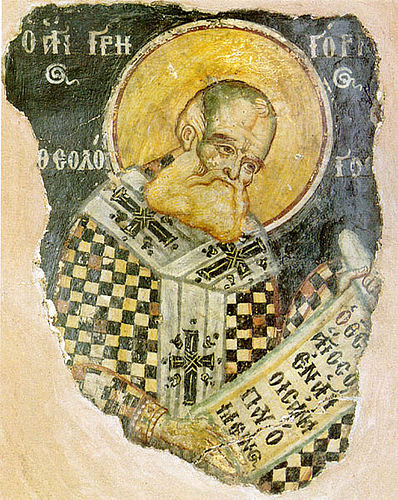
Saint
Gregory the Theologian
Archbishop of Constantinople
Great theologian and poet of Cappadocia who defended the Holy Trinity and led the Church of Constantinople.
- Feast
- January 25old style February 7
- Reposed
- 3894th century
- Place
- Arianzos
- Order
- Hierarchs
Life
Saint Gregory the Theologian, also called Gregory of Nazianzus, is one of the Three Holy Hierarchs and one of the Cappadocian Fathers. He was a great preacher and poet, a defender of the dogma of the Holy Trinity, archbishop of Constantinople and, for a time, president of the Second Ecumenical Council. The Church gives him the title "Theologian", which, besides him, only the holy Apostle John and Saint Symeon the New Theologian bear.
Family and studies
He was born around 329 at Arianzus near Nazianzus in Cappadocia, into a wealthy Christian family. His father, also Gregory, was bishop of Nazianzus, and his mother, Saint Nonna, had asked God for a son and dedicated him to the Lord. When he learned to read, she put the Holy Scripture in his hands. He was first schooled at home with his uncle Amphilochius, then at Nazianzus, Caesarea in Cappadocia and Alexandria.
On the way to Athens a terrible storm raged for many days. Gregory, still a catechumen, lay twenty days in the ship's stern praying not to perish before Baptism; he vowed to devote himself to God and was saved. At Athens he studied rhetoric, poetry, geometry and astronomy for six years. There he met Basil, the future archbishop of Caesarea, and the two became such friends that they seemed one soul in two bodies. Julian, the future apostate emperor, was studying in the city at the same time.
Priest and bishop
In 358 he returned to Nazianzus. At thirty-three he was baptized by his father, now a bishop, and was then ordained priest by him against his will. When his father wanted to make him a bishop, he fled to Basil in Pontus, where Basil had organized a monastery. They lived there together as ascetics. In 362 and 363 Gregory wrote two orations against Julian the Apostate, holding that Christ would overcome by love and patience.
After the death of his brother Caesarius he went home to help his father and strengthened him in the right faith. In 372 Basil ordained him bishop of Sasima, a small town between Caesarea and Tyana that he had created to strengthen his position against Bishop Anthimus of Tyana. Gregory accepted reluctantly, stayed at Nazianzus, where his father was dying, and tended the city after his father's death in 374. He lived austerely, and in 375 withdrew to a monastery at Seleucia, where he stayed three years.
At Constantinople
After the death of Emperor Valens in 378, a council of bishops invited him to help the Church of Constantinople, ravaged by heretics. With Basil's consent he came in 379 and began to serve and preach in a small church named Anastasia, "Resurrection". The heretics were many: Arians, Macedonians, Apollinarians. The more he preached, the fewer they became and the more the Orthodox grew. On the night of Pascha in 379, as he was baptizing catechumens, a mob of armed heretics burst into the church, threw stones, killed a bishop and wounded Gregory. His gentleness and steadfastness protected him, and his words won many to the Church.
In the capital he lived as in the wilderness. His friend, the philosopher Maximus, had himself consecrated bishop in his place, but the people drove him out. On 24 November 380 the Emperor Theodosius arrived and gave the great church to the Orthodox, and Gregory entered it in procession. A man sent to kill him repented and came to him in tears.
The Second Ecumenical Council
At the Council of 381 he was chosen archbishop of Constantinople. After the death of Meletius of Antioch he presided, and to reconcile West and East he proposed that Paulinus be recognized as bishop of Antioch. The Egyptian and Macedonian bishops, who arrived late, would not accept the election. For the peace of the Church Gregory resolved to resign. "Let me be as the Prophet Jonah", he said, "I am the cause of the storm, but I would sacrifice myself for the salvation of the ship." He gave a farewell address to the Council and departed.
Orations, poems and last years
Back in Cappadocia he established the pious Eulalius as bishop of Nazianzus and withdrew into the solitude of Arianzus, which he loved. There he wrote most of his poems, among them an autobiographical poem of nearly two thousand lines. He departed to the Lord on 25 January, in 389 according to the OCA synaxarion and in 390 according to other sources.
The five Theological Orations show who may speak of God: one tried in contemplation, pure in soul and body. Gregory teaches that God has hidden His essence, and that man grasps divine things as far as his mind is purified. He answers the Eunomians, who wished to comprehend God's essence by syllogisms, and defends the divinity of the Son and of the Holy Spirit. He shows the Spirit working hidden in the Old Testament and more clearly after the Ascension and Pentecost. Forty-five orations survive, along with clear letters and many poems. The Council of Chalcedon gave him the title "Theologian". Saint John of Damascus followed his lead in his Exposition of the Orthodox Faith.
Relics and veneration
The saint was buried at Nazianzus. In 950 his relics were moved to Constantinople, to the church of the Holy Apostles. A part was taken to Rome by the crusaders in 1204 and returned to Istanbul in 2004. In Romania, a part of his head is kept at Slatina Monastery in Suceava County, brought from Constantinople in the time of Prince Alexandru Lăpușneanu according to the chronicler Ion Neculce. The reliquary was returned to Slatina in 2001.
The Church celebrates him on 25 January, on 30 January in the Synaxis of the Three Hierarchs with Saints Basil the Great and John Chrysostom, and on 19 January at the translation of his relics.
Commemorated the same day January 25
 Felicitas of RomeMartyrJan 25
 Vladimir of KyivHieromartyr · Metropolitan of Kyiv and HalychJan 25
- Castinus of ByzantiumSaint · Bishop of ByzantiumJan 25
 Peter ZverevHieromartyr · Archbishop of VoronezhJan 25
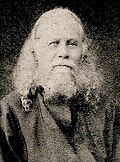 Anatoly of OptinaVenerable · Elder of OptinaJan 25
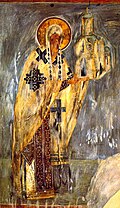 Moses of NovgorodSaint · Archbishop of Novgorod and PskovJan 25
 Constantine VeretskyHieromartyr · ArchpriestJan 25
 Andrew ArgunovMartyr · Chairman of the parish councilJan 25
- Bretanion of TomisSaint · Bishop of TomisJan 25
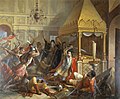 Joasaph of BorovskHieromartyr · Archimandrite of the Trinity LavraJan 25
 Nicholas PopovHieromartyr · ArchpriestJan 25
 Sergius KrestnikovVenerable Martyr · Choir directorJan 25