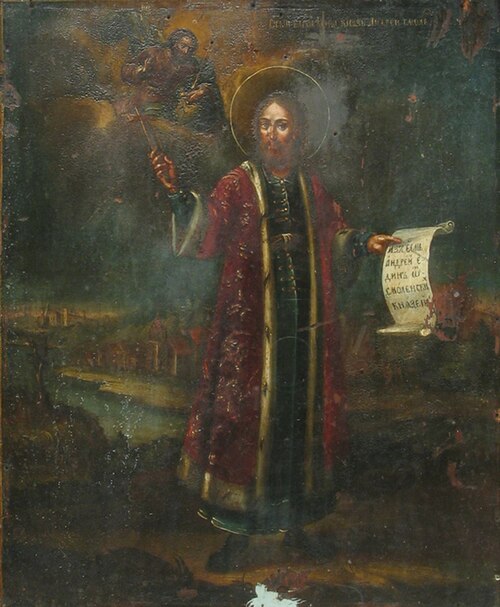
Right-Believing
Andrew of Smolensk
Prince and ascetic
Holy prince who always wore heavy iron chains, enduring insults and want; he died in 1390.
- Feast
- October 27old style November 9
- Reposed
- 139014th century
Life
Saint Andrew of Smolensk (died 1390) was a prince of the line of Rostislav Mstislavich who gave up of his own will rule, property and princely robes so as no longer to be a cause of quarrel among brothers. He lived thirty years, unknown, at Pereslavl-Zalessky, as sexton of the church of Saint Nicholas, in silence, work and prayer, wearing heavy iron chains. His relics, found incorrupt in 1540, worked healings. He is commemorated on 27 October.
Renouncing rule
Andrew descended from the line of Prince Rostislav Mstislavich and had his homeland and rule in the city of Smolensk. The year of his birth and the time of his rule are not known, but the date of death is placed in 1390. His father is called Prince Feodor the Blind of Fomino, contemporary of Grand Prince Simeon the Proud. The principality of Smolensk, with the multiplying of the princes of Smolensk (who at one time numbered up to 17), had been broken into small parts, and in the division of inheritances quarrels arose among relatives. It was grievous to Prince Andrew to be the object of his brothers' envy and to see their enmity over earthly possessions. He wished to keep the peace of his soul and the calm of his blameless conscience and, after his parents' death, gave up his rule of his own will, divided all his property, stripped himself of bright princely robes, put on a beggar's rags and, in the guise of a beggar, secretly from relatives and acquaintances, left Smolensk, leaving the principality, and directed his way toward the northern lands.
He had not chosen beforehand a place to settle, to perform the labours of piety in obscurity, but gave himself wholly to God's guidance, saying on the way the prayer: "Look upon me, Lord, and have mercy on me; direct my steps according to Thy word and let no iniquity have dominion over me; deliver me from the slander of men and I will keep Thy commandments". Going through many cities and lands, he stopped at last at Pereslavl-Zalessky and found here a place suitable for his labours, beside the town gate called Nikolskaya, at the church of the Holy Hierarch and Wonderworker Nicholas.
Thirty years of struggle
To be able always to see the beauty of the church and learn in it the Lord's commandments, the blessed prince took on the sexton's service in this church. He strictly kept the church clean and served with all obedience the priest serving in it. After the end of services he remained in unceasing labours and efforts of piety: by day he did manual work, and the nights he spent in prayer and prostrations. In all the time of his service at the church he kept strict silence, bearing without murmur hunger, thirst and nakedness and depriving himself even of what was needed. To mortify his flesh he constantly wore heavy iron chains, enduring at the same time all insult and want. The blessed one remained in these severe labours of self-denial, from the time of his coming from Smolensk, for thirty years, no one knowing who he was and where he had come from.
When he had thus prepared his righteous soul, the blessed one passed to the Lord. When his death became known, the priest came with several citizens to bury his body as that of one of the poor, with the usual burial. Then they saw in his right hand a paper in which was written: "I am Andrew, one of the princes of Smolensk; from envy and strife of my brothers I left my rule and my house and all the rest". At the same time they took from the holy body his princely chain, the grivna, the gold ring and the iron chains. Then, singing funeral hymns over him, they buried him beside the same church of Saint Nicholas, at which he had performed his service with such zeal.
Finding of the relics
In 1540, in the reign of Ivan the Terrible, Venerable Daniel, founder of the Daniel monastery at Pereslavl, was at Moscow. Explaining to the tsar and the metropolitan the decay of the churches of Pereslavl of Saint John the Forerunner and of Saint Nicholas, he told them that beside the old church of Saint Nicholas lay in the earth the relics of the holy Prince Andrew of Smolensk, to whom, in former time, as he knew for sure, a service with stichera and canon was sung and whose image was painted on icons, but why now no commemoration was held was not known. Venerable Daniel asked permission to examine Prince Andrew's tomb with the local clergy. The tsar and the metropolitan permitted it. He returned at once to Pereslavl and announced to the local clergy the tsar's command and the metropolitan's blessing, and all rejoiced. They wanted to ring the bells to gather the people, but one priest said that if it pleased God to reveal the relics of His servant, they should first serve a service of supplication and then go out to the work, so as to understand clearly whether it was pleasing to God. The wise counsel was accepted by all. After the service they took apart the monument over the tomb and began to dig. The people gathered in great number, and some of the clergy came with candles. All begged the Lord to reveal His good will.
At last they found the holy relics whole and incorrupt, laid not in a coffin but wrapped in birch bark, and giving off a sweet fragrance. The hair on his head was long and fair, like a flower in bloom, his clothing, with copper buttons, was fastened to one side and appeared whole from head to foot. The crumbs of bark that fell away when the earth was cleared were taken in faith by many sick people, who were healed. Venerable Daniel at once sent the priest Constantine to announce the finding of the relics to the metropolitan and the grand prince. From Moscow were sent Archimandrite Jonah of the Chudov monastery, later bishop of Suzdal, and Archpriest Gury of the Dormition Cathedral, to verify the report and move the relics into the church. As at first, the clergy first served a service of supplication in the Transfiguration cathedral and then in procession, with a multitude of people, went to the church of Saint Nicholas. They examined the relics of the holy right-believing prince and sang a memorial service over them. Probably at that time the gold chain, grivna and ring of Prince Andrew were taken to Tsar Ivan Vasilievich the Terrible for the blessing of the tsar's house, and the tsar ordered that for this the church of Saint Nicholas receive a grant.
Miracles
After the memorial service, Archimandrite Jonah began to ask Venerable Daniel in the church for what reason and with whose permission and blessing he had sought the relics. The venerable elder answered: "Holy father, I informed beforehand the most pious sovereign and the most holy metropolitan and with their permission uncovered the relics of the holy prince. Now God has been pleased that your priesthood too should see the incorrupt relics of this holy prince. Here is his image painted on an icon, here is his service, the stichera and canon, written long ago. It was not I who wrote it, the book, as you see, is old. Ask the people also how the sick received healings by the prayers of this venerable one". At the demand of Archimandrite Jonah and Archpriest Gury those healed were called, who told before all.
An overseer of the tsar's villages, Ivan Oklyacha, declared that for many years he had suffered from headache so great that he could not bow, but as soon as he touched the holy relics the pain stopped and now he is quite well. A woman of Pereslavl said that for three years her throat had hurt so that she could not speak and she constantly awaited death. When these holy relics were found she came to venerate them and, finding some crumbs of the bark in which the holy relics were wrapped, rubbed her sore throat with them, and suddenly the pain ceased and she began to speak, which her husband and neighbours can testify. Another woman said she had been blind for many years. At the finding of the relics her relatives brought her, gave her some crumbs from the holy relics, she rubbed her eyes and face with them and began to see. After these unshakeable proofs of the incorruption and miracle-working of the relics of the right-believing prince, they were placed in a new coffin, wrapped in a shroud and the service was served. From then on the church of Saint Nicholas began to be called also the church of Holy Prince Andrew of Pereslavl, the wonderworker. It was 1540, the year of Venerable Daniel's repose. Many years after the finding of the holy relics a fire broke out at Pereslavl that set alight also the wooden church of Saint Nicholas. While the church was in flames, round the saint's coffin such a strong whirlwind arose that all were terrified and amazed. When the fire was over and the church had burned to its foundations, the coffin of Prince Andrew, his icon on it, the pall covering the coffin and the icon of the Most Holy Mother of God Hodegetria on it remained whole and unharmed. All the citizens present who saw this miracle glorified God and His Most Pure Mother and God's servant, the right-believing Prince Andrew.
Veneration
Prince Andrew's memory is kept by the Church on 27 October. By decree of the Holy Synod in 1749 it was ordered that at all services in Pereslavl the venerable fathers Daniel the Abbot, Nikita the Stylite and the right-believing Prince Andrew, wonderworkers of Pereslavl, be commemorated. In 1825 the service to the holy right-believing Prince Andrew was printed, with two troparia. His relics are kept at Pereslavl, in the church dedicated to him.
Commemorated the same day October 27
 EvaristusSaint · Bishop of RomeOct 27
 Nestor the ChroniclerVenerable · Monk of the Kiev Caves LavraOct 27
 Claudia ProculaMartyr · Wife of PilateOct 27
 Gaudiosus of AbitinaSaint · Bishop of AbitinaOct 27
 Nestor of ThessalonicaMartyr · Companion of Saint DemetriusOct 27
 Oran of IonaVenerable · Companion of Saint ColumbaOct 27
 Demetrius of BasarabovVenerable · Patron of BucharestOct 27
 Olga of AlaskaRighteous · Priest's wife of AlaskaOct 27
 Capitolina and ErotiidaHoly Martyrs · Martyrs of CappadociaOct 27
 Alexander OkropiridzeSaint · Bishop of Guria and SamegreloOct 27
- Abraham the SimpleVenerableOct 27
- Protus of Porto TorresHieromartyr · Priest of Porto TorresOct 27