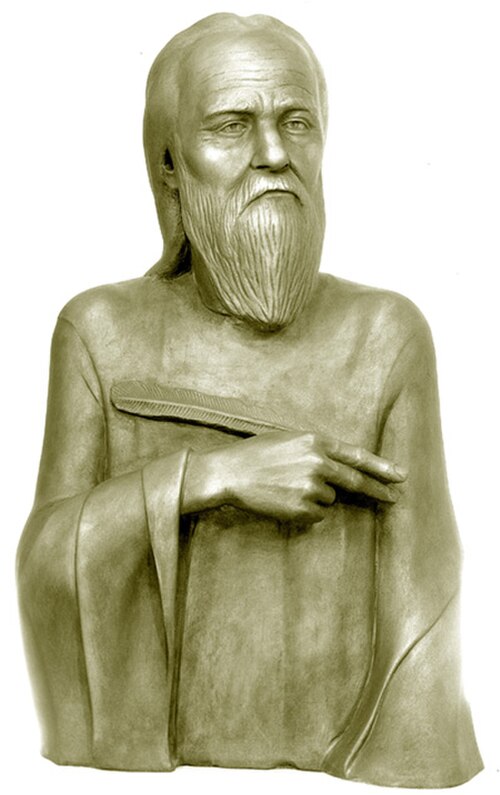
Venerable
Nestor the Chronicler
Monk of the Kiev Caves Lavra
Monk of the Kiev Caves Lavra, author of saints' lives and of the Primary Chronicle.
- Feast
- October 27old style November 9
- Reposed
- 111412th century
- Place
- Kyiv
- Order
- Venerables
Life
Venerable Nestor the Chronicler was a monk of the Kiev Caves Lavra, a disciple of Saint Theodosius, and one of the most notable writers of Kievan Rus'. Two lives of saints certainly came from his hand, the Life of Venerable Theodosius of the Caves and the Account of the Life and Martyrdom of the Holy Passion-Bearers Boris and Gleb. Tradition also credited him with the Tale of Bygone Years, the oldest surviving chronicle of the Eastern Slavs, which gave him the name Chronicler, though scholars today doubt it. His memory is kept on 27 October (9 November on the new style). In Ukraine, since 1997, 9 November has been the Day of Writing and Language, in his memory.
The beginnings
Nestor was born at Kiev, around 1050 or 1056 according to the sources. At seventeen, around 1073, he entered the Monastery of the Caves, where he was a disciple of Venerable Theodosius. He received the monastic tonsure from Abbot Stephen, the successor of Theodosius, and was then ordained hierodeacon. It is said that he soon surpassed the well known elders of the Caves in purity of life, prayer and obedience.
A mark of his spiritual life is that he took part, with other holy Fathers, in casting out a devil from the hermit Nikita, who had been led astray by Jewish wisdom. Nikita later became a bishop at Novgorod and is remembered on 31 January. Of books Nestor said that their benefit is great: they show the way of repentance, give wisdom and temperance and comfort those in sorrow, and whoever reads books converses with God or with the saints.
The writings
In the 1080s Nestor wrote the Account of Boris and Gleb, in connection with the transfer of the relics of the two brothers to Vyshhorod. It tells of their murder by Sviatopolk, in which the two young men appear as an example of humility and of renouncing revenge. It is a basic text for their veneration, though its dating is much debated. In the same years he composed the Life of Venerable Theodosius of the Caves.
In 1091, on the eve of the patronal feast of the monastery, Abbot John charged Nestor, together with two other monks, to dig up the relics of Saint Theodosius so that they might be moved into the church. His part in this has remained in the hymns: the kontakion calls Nestor a disciple and imitator of Saint Theodosius and the first eyewitness of his honoured relics.
The chronicle
The Tale of Bygone Years begins with the question "whence came the Russian land, and who first began to rule in Kiev". Church tradition, followed by Orthodox sources, counts Nestor as its compiler, around 1112 and 1113. He drew on earlier chronicles and monastic records, on the Byzantine chronicles of John Malalas and George Hamartolos, and on the accounts of witnesses such as the elder Ivan Vyshatich, and joined it all under a firm ecclesiastical view, as part of the history of the salvation of the human race.
The chronicle records the first mention of the Rus' in the sources, in 866, in the time of Saint Photius, the Slavic alphabet made by Saints Cyril and Methodius, the baptism of Saint Olga at Constantinople, the testing of the faiths by Saint Vladimir and the baptism of Rus' in 988. It then tells of the beginnings of the Caves and of their founders. Nestor lived in hard times, with quarrels among the princes and raids by the Polovtsians, and he witnessed the devastation of the Caves monastery in 1096.
The author, an open question
Most historians today doubt that Nestor wrote the Tale of Bygone Years. They hold that it is a compilation of several fragments and redactions, revised later by Abbot Sylvester of the Vydubychi monastery and by others, and some therefore call him Nestor the Hagiographer instead. The oldest surviving manuscript is the copy of Abbot Laurence from 1377, called the Laurentian chronicle. Believers and older historians, however, called him the Chronicler, and we keep the name under which he is known and honoured.
Repose and veneration
Nestor fell asleep around 1114, leaving his work to be continued by the monk chroniclers of the Caves. He was buried in the Near Caves of Saint Anthony, and his holy relics are kept in the Caves Lavra, where the faithful may venerate them. He was glorified by the inclusion of his name in the synaxis of the Venerable Fathers of the Near Caves, kept on 28 September, and in that of all the Venerable Fathers of the Caves on the second Sunday of Great Lent. His troparion praises him who wrote the deeds of the great princes and the lives and miracles of the Fathers of the Caves, and whose own name is written in heaven.
On 27 October another Nestor is also remembered, an ascetic of the Far Caves, who must not be confused with the Chronicler.
Commemorated the same day October 27
 EvaristusSaint · Bishop of RomeOct 27
 Claudia ProculaMartyr · Wife of PilateOct 27
 Gaudiosus of AbitinaSaint · Bishop of AbitinaOct 27
 Nestor of ThessalonicaMartyr · Companion of Saint DemetriusOct 27
 Oran of IonaVenerable · Companion of Saint ColumbaOct 27
 Demetrius of BasarabovVenerable · Patron of BucharestOct 27
 Olga of AlaskaRighteous · Priest's wife of AlaskaOct 27
 Capitolina and ErotiidaHoly Martyrs · Martyrs of CappadociaOct 27
 Alexander OkropiridzeSaint · Bishop of Guria and SamegreloOct 27
- Abraham the SimpleVenerableOct 27
 Andrew of SmolenskRight-Believing · Prince and asceticOct 27
- Protus of Porto TorresHieromartyr · Priest of Porto TorresOct 27