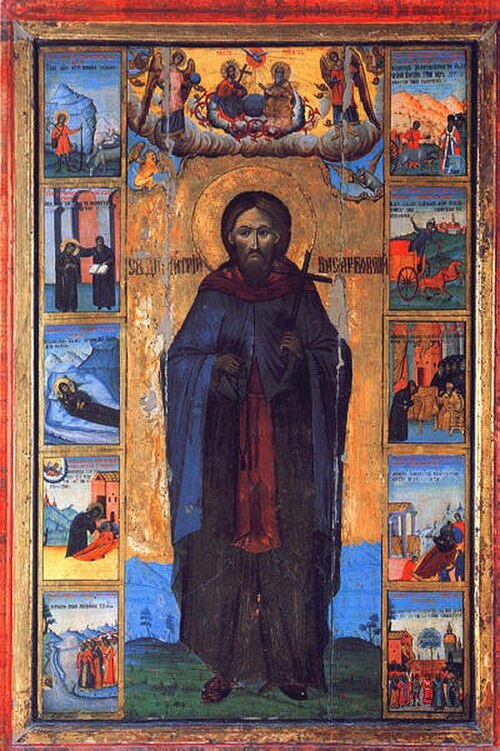
Venerable
Demetrius of Basarabov
Patron of Bucharest
Venerable of Basarbovo whose relics rest in Bucharest, patron of the city; canonized in 1955.
- Feast
- October 27old style November 9
- Reposed
- 170017th century
- Place
- Basarbovo
- Order
- Venerables
Life
Saint Demetrius the New of Basarbovo, the Venerable, is the patron of the city of Bucharest, where his holy relics have rested since 1774. He was born in the village of Basarbovo, in the valley of the river Rusenski Lom near Ruse, in present-day Bulgaria. He was a shepherd, then a monk and hermit, and few sure things are known of his years: sources give different centuries, from the thirteenth to 1685. He was canonized by the Romanian Orthodox Church on 27 October 1955. He is commemorated on 27 October, and the Russian Church commemorates him on 26 October and on 8 July, at the translation of the relics.
Life
According to the Romanian Lives of the Saints, Demetrius was born in the time of the Vlach-Bulgarian tsars Peter and Asen, in the thirteenth century, in the village of Basarabi (Basarbovo) in Bulgaria, and was a cattle herder. Not many details are known, but a story is told that stood at the beginning of his ascetic life: one day, walking through the tall hay after the village's cattle, he carelessly crushed the naked chicks in a bird's nest. He felt so guilty in his heart that he punished the offending foot, no longer putting a shoe on it for three years, neither in summer nor in winter.
Later he received the monastic habit at a monastery in a cave, not far from his village (according to a Bulgarian tradition he was married but childless and became a monk after his wife's death, at the rock monastery near his native village, where he became known for zeal and all the virtues of a true monk). In the cave he spent his time in fasting and prayer, in struggles known only to God. Knowing his end beforehand, he closed the mouth of the cave with stones and gave up his soul into God's hands; according to the Bulgarian tradition, feeling the end, he left the monastery, lay down between two stones on the bank of the river Rusenski Lom and there fell asleep. For a long time the body could not be found: a flood came, and the two stones fell into the river together with the relics. God wished to reveal him: the angel of the Lord appeared in a dream to a girl possessed by an unclean spirit, showed her the place and said: "If your parents take me out of the water, I will heal you." So the relics were found, taken from the water and placed in the village church, where they began to work healings.
According to another version, that of Paisius of Hilandar, Demetrius was a layman, living alone on the bank of a river, with a small vineyard and a few sheep, and died there; Paisius gives as the year of death 1685. The relics were moved to Basarbovo, where healings took place. Two sisters from the village of Cherveni Voda wished to take secretly a particle of the relics for their church, but their cart could not start until they repented and gave back what they had taken; Metropolitan Nicephorus of Tarnovo, coming to venerate with a group of clergy, among them the monk Laurence, tried to bite off a particle, but his mouth stayed open until he repented with tears. A Catholic bishop, Nicolò Pulieși, who visited Basarbovo around 1764 and 1765, testifies that he saw the relics in a church bearing the saint's name, devoutly venerated by the villagers for three centuries, with animal sacrifices in his honour, at which Bulgarians and Armenians from Ruse also were present. Todor Mollov thinks that the saint lived three centuries before the date given by Paisius.
The relics at Bucharest
In the Russo-Turkish war of 1768 to 1774 the Russian armies crossed the Danube and occupied Basarbovo. General Ivan Saltykov, hearing of the relics, ordered them taken to Russia, but a Romanian merchant, Hagi Dimitrie, the general's interpreter, and Metropolitan Gregory II of Ungro-Wallachia asked him not to carry them off but to leave them to Wallachia as a consolation for the sufferings of the war. The request was granted and the relics were placed in the church of the Metropolitanate at Bucharest on 13 July 1774. The general nevertheless took the saint's right hand and sent it to Kyiv, where it is still kept in the Caves Lavra.
In the night of 17 February 1918, during the occupation of the capital in the First World War, the bells rang, announcing the disappearance of the relics from the Metropolitanate church: some Bulgarian soldiers had stolen the shrine, wishing to take it across the Danube. Their plan was soon discovered and the saint returned to Bucharest, and the faithful gathered in tens of thousands, since the saint was regarded as the protector of the city and was greatly loved for his many miracles and for having saved the city from many calamities. Among them the plague of 1813 and 1814 is recalled, which broke out on the second day of Caragea's reign and is said to have destroyed half the inhabitants of Bucharest and some seventy thousand people in the whole country: the people of Bucharest cried to the protector, and after the procession with the relics and prayers the plague ceased. Lieutenant-Colonel Dimitrie Papazoglu testifies that he saw the saint's miracles with his own eyes: in 1815, when the epidemic was great, the relics were carried through the city, prayers were read in the middle of the market, and the epidemic began to decline. In 1827, in a terrible drought, the metropolitan with a council of priests carried the relics in procession and on the same day a torrential rain began, which lasted three days and saved the city from famine. The saint also interceded in the cholera of 1831, when General Pavel Kiselyov was governor: after the great blessing in the field of Filaret, the number of the dead, which had risen to a hundred to a hundred and sixty a day, fell rapidly.
Veneration
He was proclaimed protector of Bucharest in 1792, in the time of Metropolitan Philaret II. Because of his veneration, Patriarch Justinian Marina proposed to the Holy Synod that his cult be generalized in the Romanian Orthodox Church and proclaimed his canonization in 1955. The Romanian and Bulgarian Churches commemorate him on 27 October, the day on which the shrine with the relics is placed for veneration on Metropolitanate Hill, under a canopy adorned with flowers. In 2005, at the request of Patriarch Maxim of Bulgaria, Patriarch Teoctist gave the Basarbovo monastery an icon with a particle of the saint's relics. In Bulgaria three churches are dedicated to him: the rock monastery at Basarbovo, the only active cave monastery in the country, the parish church in the village of Basarbovo and a new church at Ihtiman, consecrated in 2020.
Commemorated the same day October 27
 EvaristusSaint · Bishop of RomeOct 27
 Nestor the ChroniclerVenerable · Monk of the Kiev Caves LavraOct 27
 Claudia ProculaMartyr · Wife of PilateOct 27
 Gaudiosus of AbitinaSaint · Bishop of AbitinaOct 27
 Nestor of ThessalonicaMartyr · Companion of Saint DemetriusOct 27
 Oran of IonaVenerable · Companion of Saint ColumbaOct 27
 Olga of AlaskaRighteous · Priest's wife of AlaskaOct 27
 Capitolina and ErotiidaHoly Martyrs · Martyrs of CappadociaOct 27
 Alexander OkropiridzeSaint · Bishop of Guria and SamegreloOct 27
- Abraham the SimpleVenerableOct 27
 Andrew of SmolenskRight-Believing · Prince and asceticOct 27
- Protus of Porto TorresHieromartyr · Priest of Porto TorresOct 27