Right-Believing
Andrew of Suzdal
Prince of Suzdal and Nizhny Novgorod
A right-believing prince of Suzdal and Nizhny Novgorod, honored as a saint in the Russian Church.
- Feast
- June 23old style July 6
- Reposed
- 136514th century
Life
Holy Right-believing Prince Andrew of Suzdal and Nizhny Novgorod (Andrew Konstantinovich, not later than 1323 to 2 June 1365) was prince of Nizhny Novgorod. He is commemorated on 6 July, in the Synaxis of the Saints of Vladimir.
He was the eldest son of the prince of Suzdal (later of Nizhny Novgorod) Konstantin Vasilievich, after whose death (21 November 1354) he inherited the throne of Nizhny Novgorod. At first Andrew did not continue the struggle of the princes of Nizhny Novgorod and Suzdal with those of Moscow for the grand principality of Vladimir, begun in Konstantin's time. After the death of John II he left the leading role in this struggle to his younger brother, Dmitry-Thomas, renouncing in his favour the charter for the grand principality offered him in 1360 by the khan of the Golden Horde, Navruz, and in 1360 to 1362, in alliance with Novgorod, supported Dmitry against the young Muscovite prince Saint Dmitry Ivanovich. Andrew's lack of interest in politics meant that even in his lifetime, not later than autumn 1363, the throne of Nizhny Novgorod was taken by another younger brother, Boris Konstantinovich, prince of Gorodets.
Judging by some chronicle reports, Andrew, like his wife, Vassa (Vasilisa), was "very spiritual and of many virtues"; in 1363 the cross with which the newly installed Bishop Alexis of Suzdal blessed him after the Liturgy exuded myrrh. In 1359 the cathedral of Saint Michael the Archangel in Nizhny Novgorod was built at his expense and, if one may trust a report of a late (sixteenth-century) life of Venerable Euthymius of Suzdal, also the monastery of the Protection of the Mother of God in Suzdal, in thanks to God for a miraculous escape during a journey on the Volga (1364). In 1364 Andrew received the monastic tonsure and, about a year later, died; the chronicler recorded the event thus: "There passed away the meek, quiet and humble and many-virtued grand prince Andrew Konstantinovich, among monks and in the schema." He was buried in the cathedral of the Transfiguration in Nizhny Novgorod, beside his father. The commemoration of him and his wife Vasilisa (without day given) is found in the Menologion of Simon Azarin of the mid-seventeenth century; he is also mentioned under 25 August in an icon-painters' manual of the 1820s.
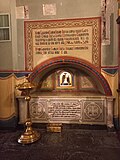
In 1829 the ancient Transfiguration cathedral was taken down and built anew; on 17 September 1834 the church was consecrated, and the graves of the princes of Nizhny Novgorod, among them Andrew's, remained in a separate crypt in the underground part of the church, to which the gravestones that had been in the church were also moved. Later in that crypt a church in honour of the Kazan Icon was made from voluntary gifts, with a north side chapel of the Holy Unmercenaries Cosmas and Damian and a south one of the Holy Great Martyr Demetrius. The grave of Andrew and his wife came to be in the south chapel of the crypt church; services were held there daily. In 1929 the cathedral was destroyed.
Commemorated the same day June 23
 Sviatoslav-Gabriel of VladimirRight-Believing · Grand Prince of VladimirJun 23
 Agrippina of RomeMartyr · Virgin and martyrJun 23
 Artemius of VerkolaRighteous · Child saintJun 23
 George YaroslavichRight-Believing · Prince of MuromJun 23
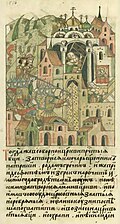 Patricius of VladimirHieromartyr · Sacristan in VladimirJun 23
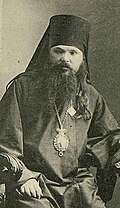 Mitrofan of AstrakhanHieromartyr · Archbishop of Astrakhan and TsarevJun 23
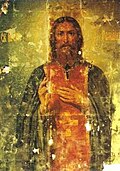 Roman of KirzhachVenerable · Disciple of Saint SergiusJun 23
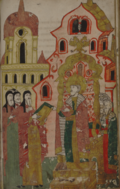 Barlaam of SuzdalSaint · Bishop of SuzdalJun 23
- Paraskeva of PirinemRighteousJun 23
 Christina of VladimirRight-Believing · Princess of VladimirJun 23
- Eudokia AlexandrovnaRight-Believing · Daughter of Alexander NevskyJun 23
 Hilarion of SuzdalSaint · Metropolitan of SuzdalJun 23