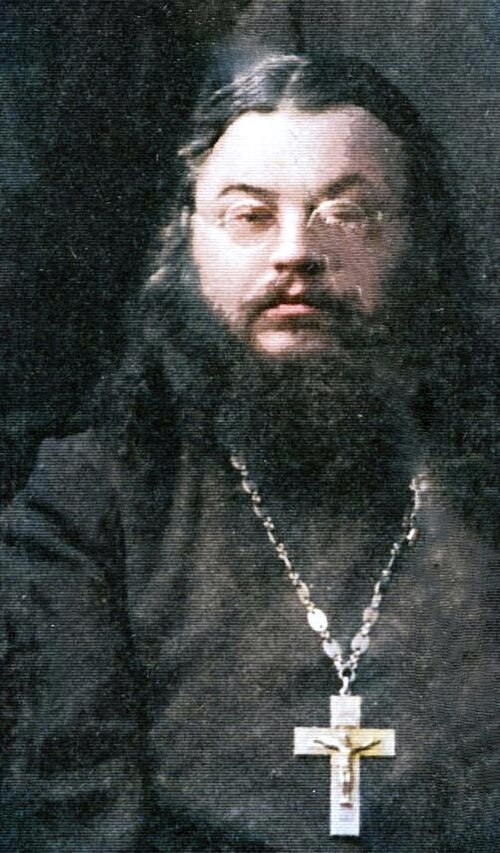
Hieromartyr
Andrew Zimin
Archpriest
Archpriest born into a Transbaikal Cossack family, a graduate of the Blagoveshchensk seminary, who died in 1920.
Life
The Holy Hieromartyr Andrew Zimin was an archpriest in the Russian Far East, for twenty years rector of the village of Chernigovka in the Ussuri region, a builder of churches and schools and a pastor loved by his people. In January 1920, on the eve of Theophany, he was cruelly killed by Bolshevik partisans together with his wife, his mother-in-law and his four daughters. In 2019 he was numbered among the New Martyrs of Russia.
Childhood and first years of priesthood
Andrew Simeonovich Zimin was born on 14 (27) August 1872 into a Transbaikal Cossack family. In 1894 he graduated from the Blagoveshchensk Theological Seminary. His wife, Lydia Alexandrovna, born in 1876, was the daughter of the Blagoveshchensk merchant Alexander Shumarov.
After seminary he served for a time as a reader, and in mid-September 1894 Bishop Macarius (Darsky) of Kamchatka, the Kurils and Blagoveshchensk ordained him priest. He served at the cathedral in Blagoveshchensk, where he soon became catechist and preached many sermons and instructions. His gift as a teacher was quickly evident, and he was appointed religion teacher at the cathedral's parish school; he also taught at the First People's School and at the town school of Blagoveshchensk.
In 1895 he received a letter of commendation from the archbishop for arranging the cathedral library. From September 1896 he was secretary and treasurer of the Blagoveshchensk section of the parish schools council and a member of the city's Brotherhood of the Most Holy Mother of God, and from 18 September 1899 an alternate member of the seminary board. He was rewarded with a violet skufia (1898), a Bible presented by the Holy Synod (1900) and the silver medal in memory of the reign of Tsar Alexander III.
Rector of Chernigovka
In 1899 the diocese of Vladivostok was founded, and many churches were being built and new parishes opened in the Ussuri region. In 1900 Father Andrew was appointed rector of the church of the Nativity of the Mother of God in Chernigovka, one of the most important parishes in the region, a large village with a mild climate and fertile land.
Immediately after his arrival he set about improving the church, calling the parishioners to share the work. Within a few months he opened a parish school in the old church building, and then worked on building a new state school. By 1917, under his guidance, the village community had raised a four-grade stone school and a brick building for a one-grade school. Diocesan inspectors repeatedly noted in their reports that teaching in Chernigovka was exemplary.
His care was not limited to his own parish. Bishop Eusebius (Nikolsky) of Vladivostok appointed him dean of the sixth district, and his chief concern was the building of churches and schools in that area. When he arrived in 1900 there were churches in five villages: Voznesenka, Dmitrievka, Monastyrishche, Chernigovka and Khalkidon. In his time their number doubled, with new churches at Altynovka (1904), Vasyanovka, Melkushevka and Sivakovka (1909) and Vadimovka (1910). On 19 December 1902 he blessed the parish school in the village of Pavlovka.
Pastor and teacher
To strengthen the children's Christian spirit he regularly took the pupils of the parish school on pilgrimage to the Holy Trinity and Saint Nicholas Monastery, 120 kilometres from Chernigovka. He wrote with enthusiasm about the life of the parish and school in the Vladivostok diocesan gazette, where he also published his sermons: he explained the Gospel readings of Sundays and feasts, told the lives of saints dear to the Russian people and reflected on the spiritual condition of his time.
He urged the faithful to live in piety and prayer according to Orthodox custom and not to lose heart in sickness or misfortune, but to endure firmly. He did not shrink from rebuking drunkenness, abortion and neglect of the spiritual life, calling his parishioners to repentance and amendment of life so that they might attain holiness and, in the end, eternal life.
In 1913, as vice-chairman of the eighth diocesan congress of clergy, he called for greater religious zeal among the faithful and opposed the use of prayers in modern Russian at services. He was a member of the Ussuri Orthodox Brotherhood and of the Vladivostok section of the Orthodox Missionary Society, and in 1914 he founded temperance brotherhoods in Chernigovka and Altynovka.
The old people of the village remembered him as very compassionate and generous, helping not only his own parishioners but anyone in need. As patron of the Chernigovka agricultural association, which united seventy peasants, he supported the creation of a library and courses in farming, orcharding, gardening and beekeeping, with new methods of work.
For his service he received the kamilavka (1902), a letter of blessing from the Holy Synod (1904), the pectoral cross (1907), the silver medal for twenty-five years of parish schools, and the Order of Saint Anna, third class (1913) and second class (1916), for his zeal and his labours during the war. On 23 May 1913 he was raised to the rank of archpriest.
The years of revolution
After the October Revolution of 1917, the decree of 23 January 1918 on the separation of Church and state and of school and Church opened the way to persecution. In the Primorye region, after Soviet power was overthrown in 1918, church life revived in the towns along the railway, but Bolshevik partisan bands operated in the taiga. Village priests were threatened if they served and taught religion; some were arrested or taken hostage and pressed for ransom or for renunciation of their orders.
So it happened to Father Andrew. In June 1919 partisans took flour, horses and other goods from the people of Chernigovka and carried the rector off with them into the taiga, apparently as a hostage. After nearly a month, in July, they let him go home, having humiliated and insulted him. The diocesan council investigated the incident and found nothing unworthy in his conduct, so he continued to serve and to teach the children.
Martyrdom
Father Andrew was preparing for death. According to his relative, the priest John Konoplev, shortly before it he had a dream in which the end of his coming sufferings was shown to him. He described it in a letter which he gave to Father John, asking him to open it only after his death.
On 18 January 1920, on the eve of Theophany, armed men burst into his house in the church grounds. They tortured his family cruelly and then shot his wife and his four daughters. They threw the beaten priest to the floor, laid on his chest a door taken from its hinges, stood on it and crushed him.
The bodies of Father Andrew, his wife Lydia, his mother-in-law Domnika and his four daughters were buried according to the rite of the Church in the cemetery beside the church in Chernigovka. On 25 February 1920, after the Liturgy in the Dormition Cathedral in Vladivostok, a solemn memorial service was celebrated for the martyred priest and his family.
Glorification
The exact place of the grave is no longer known, but the parishioners have set up a memorial cross beside the church, where pilgrims hold services of prayer. On 4 April 2019 the Holy Synod of the Russian Orthodox Church entered Archpriest Andrew Zimin in the Synaxis of the New Martyrs and Confessors of Russia and blessed the painting of his icon. His solemn glorification took place on 14 September 2019, after a festal Liturgy in the church of the Nativity of the Mother of God in Chernigovka, where he had served.
Commemorated the same day January 5
 Edward the ConfessorRight-Believing · King of EnglandJan 5
 Syncletica of AlexandriaVenerableJan 5
 Apollinaria SyncleticaVenerable · Hermit of EgyptJan 5
 Theopemptus and TheonasHoly Martyrs · Martyrs of NicomediaJan 5
 Rusticianus of BresciaSaint · Bishop of BresciaJan 5
 Theopemptus of NicomediaHieromartyr · Bishop of NicomediaJan 5
- Acutus of AfricaSaintJan 5
- Amelia of GironaMartyrJan 5
- Astolfus of MainzSaint · Archbishop of MainzJan 5
- CiaraSaintJan 5
- Ciaran son of AedhSaintJan 5
 ConwoionVenerable · Abbot of RedonJan 5