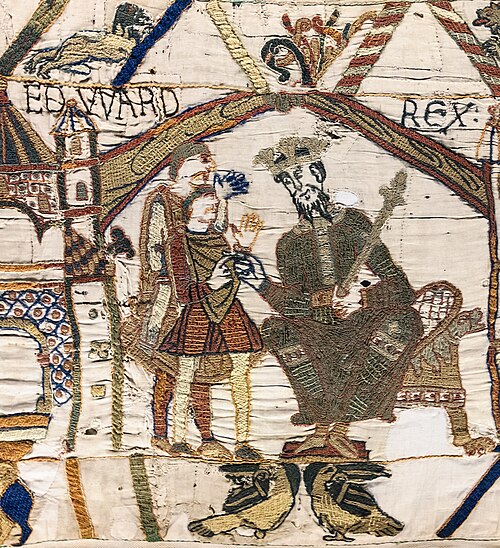
Right-Believing
Edward the Confessor
King of England
King of England from 1042 to 1066, known for his piety and the last king of the House of Wessex.
- Feast
- January 5old style January 18
- Reposed
- 106611th century
- Place
- Westminster
Life
Edward the Confessor was king of England from 1042 to 1066, the last king of the house of Wessex. The epithet Confessor marks a man who lived as a saint without being a martyr. He was canonized in 1161 by Pope Alexander III and is honoured in the Roman Catholic Church and the Church of England, and a Russian encyclopedia says that he is also venerated in the Orthodox Church. The Western Rite of the Orthodox Church keeps his memory on 13 October. He lived before the separation of the Churches, but the sources consulted give no day of commemoration in the Byzantine calendars.
Exile
He was born between 1003 and 1005 at Islip in Oxfordshire, the seventh son of King Aethelred the Unready and the first by Emma of Normandy, sister of Duke Richard II. When the Danes under Sweyn Forkbeard conquered England in 1013, his mother fled to Normandy, taking him and his brother Alfred with her. After Sweyn's death Edward was sent back for a time, but when Cnut the Great became master of the country in 1016, he went into exile again. He spent almost a quarter of a century abroad, mostly in Normandy, where he made friends among the rulers of that land.
In 1036 he and Alfred came separately to England. Alfred was seized by Earl Godwin and handed over to Harold Harefoot, who had him blinded, and he died of his wounds. The memory of this deed is thought to have fed Edward's hatred of Godwin. Edward returned to Normandy.
His reign
In 1041 his half-brother Harthacnut, son of Cnut, called him back, as heir. After Harthacnut died on 8 June 1042, Edward was acknowledged king, and on Easter Sunday, 3 April 1043, he was crowned at Winchester. His position was weak at first, and he had to reckon with the great earls Godwin, Leofric and Siward. On 23 January 1045 he married Edith, daughter of Godwin.
The stories of his deep piety in Normandy are regarded by historians as largely the product of later propaganda for his canonization. They show a king with the habits of a country noble, fond of hunting and quick to anger. The biographer Frank Barlow describes the early years as those of an energetic and ambitious man, while Richard Mortimer shows that after the return of the Godwin family from exile in 1052 Edward lost much of his power. In 1051 he had named the Norman Robert of Jumieges archbishop of Canterbury, which led to the break with Godwin.
Edward had no children. The story that the marriage remained chaste, like that of monks, comes from the life of the saint rewritten later by Osbert of Clare. Historians have long debated who was meant to follow him on the throne. William the Conqueror claimed that Edward had promised it to him, and Harold Godwinson, the king's brother-in-law, claimed to have been chosen on the deathbed.
Westminster
The greatest work of the reign was Westminster Abbey, the first Norman Romanesque church in England, raised as a royal burial church. Work began between 1042 and 1052, and the church was consecrated on 28 December 1065. The king, who was ill, could not be present. He fell asleep on 5 January 1066 and was buried there. His building was pulled down in 1245 and replaced by King Henry III with the church that stands today.
Veneration
After 1066 there was a quiet cult of Edward, which grew in the twelfth century. Prior Osbert of Clare began a campaign for canonization, for the benefit of Westminster Abbey. A first petition at Rome in 1139 was put off by Pope Innocent II. With the support of King Henry II and the bishops, Pope Alexander III issued the bull of canonization on 7 February 1161. Historians note that Edward did not have in the eleventh century the fame of holiness he gained afterward, largely through the labour of the monks of Westminster.
His relics were moved on 13 October 1163 and again on 13 October 1269, when King Henry III raised a great tomb for him in Westminster, where the shrine stands today. 13 October is his commemoration in England for the Roman Catholic Church and the Church of England. The Roman Martyrology also lists him on 5 January, the day of his death. Until about 1350 he was one of the patron saints of England, with Edmund the Martyr and Pope Gregory the Great, and then King Edward III chose Saint George. Edward the Confessor is regarded as a patron of difficult marriages, and each October Westminster Abbey honours him with a week of services and prayer.
Commemorated the same day January 5
 Syncletica of AlexandriaVenerableJan 5
 Apollinaria SyncleticaVenerable · Hermit of EgyptJan 5
 Theopemptus and TheonasHoly Martyrs · Martyrs of NicomediaJan 5
 Rusticianus of BresciaSaint · Bishop of BresciaJan 5
 Theopemptus of NicomediaHieromartyr · Bishop of NicomediaJan 5
 Andrew ZiminHieromartyr · ArchpriestJan 5
- Acutus of AfricaSaintJan 5
- Amelia of GironaMartyrJan 5
- Astolfus of MainzSaint · Archbishop of MainzJan 5
- CiaraSaintJan 5
- Ciaran son of AedhSaintJan 5
 ConwoionVenerable · Abbot of RedonJan 5