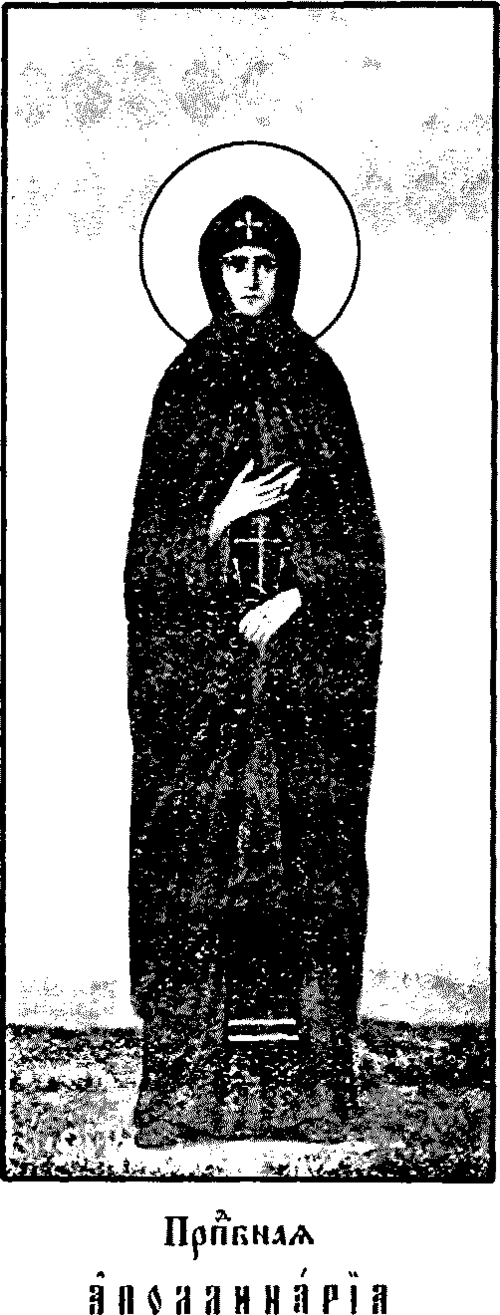
Venerable
Apollinaria Syncletica
Hermit of Egypt
Hermit of the 5th century, also known as Apollinaria of Egypt, venerated in the Orthodox and Catholic Churches.
- Feast
- January 5old style January 18
- Reposed
- 4705th century
- Place
- Egypt
- Order
- Venerables
Life
Venerable Apollinaria of Egypt (also called Syncletica, dead in 470 according to some sources) is a hermit saint of the fifth century, venerated in the Orthodox and Catholic Churches. Her story, scholars say, is very probably apocryphal. She is commemorated on 5 January (18 January by the new calendar), according to the Serbian source, and on the day of the synaxis of the saints who shone in the land of Egypt. The Catholic Church commemorated her on 4 January, and her name was removed from the Roman calendar in 2001.
Life according to tradition
According to the life, she was the daughter of Flavius Anthemius, prefect and de facto ruler of the Eastern Roman Empire in the years of the childhood of Theodosius II. Symeon the Metaphrast, in the tenth century, said she was the daughter of the emperor Anthemius, but more likely her father was a consular prefect in Constantinople; the association with the emperor of the West and the link with Macarius were, according to the English source, probably added to enhance her spiritual authority. Her parents wanted to marry her young to a rich man, but she refused and persuaded them to let her remain unmarried. She wanted to retire wholly from the world, like the Egyptian recluses she admired. The Serbian source says she was Anthemius' elder daughter, while the younger was out of her mind; she did not want to marry, but betrothed herself in heart to Christ and went away into the Egyptian desert.
Her parents allowed her a pilgrimage to the Holy Places, to Jerusalem, where she freed and dismissed the slaves who accompanied her, except an old man and a eunuch to prepare her tent, and paid an old woman to bring her a monastic habit. On the way back, on the Egyptian coast, she escaped her companions, put on the garb of a monk, casting aside worldly dress with all its adornments, and fled to a marshy place, where she struggled in fasting and prayer. Her companions could not find her, even with the help of a local governor. Her parents, hearing, assumed that she had entered a community of devout women.
She made her way to Wadi Natrun, the desert valley in the Nitrian Desert west of the Nile Delta, to the skete of Saint Macarius, a large community of recluses living in caves and cells. She passed for a monk and took the name Dorotheus. Meanwhile her sister was possessed by a demon, and her parents sent her to Macarius, famed for healings. Macarius, moved by an inner prompting, insisted that Dorotheus heal the girl. The girl was restored and taken back to her parents, but fell ill again and her parents assumed she was pregnant; according to the Russian source, the demon, to take revenge on Apollinaria, made her sister appear pregnant. The girl accused Dorotheus of seducing her, the emperor accused Abba Dorotheus of seducing the younger daughter, and they demanded that he be brought to answer the charge. Apollinaria was sent in chains to Rome, where she revealed herself to her parents as their daughter. After spending a few days with them, she returned to the desert and remained there all her life. At the trial, Abba Dorotheus was found innocent and returned to the Skete.
Her secret was not discovered by her fellow hermits until after death, say the sources: only after she had passed away did Macarius the Great and the Fathers of the Skete learn that under that name Apollinaria had been hidden. Her death is placed in 470 by the Russian and Serbian sources, while the English source says 420 or 470. She was buried in a cave on the grounds of the monastery of Saint Macarius.
Value of the sources
The English source notes that the story is probably apocryphal and turns on the familiar theme of a girl who puts on male attire and lives many years undiscovered. It has been called "a pious fiction" and "a religious romance". The legend seems to rest on those of Syncletica of Alexandria and Theodora of Alexandria, two Desert Mothers; the Life of Syncletica, attributed to Athanasius, was not written before 450, and her sayings are in the Apophthegmata Patrum, compiled around 480-500. Macarius of Alexandria died in 390, and the link with him, like that with the emperor, was most probably added later. Yet the Church has kept her story as an example of spiritual courage, and the Serbian source says that the maiden's manly bravery remained for centuries an example and encouragement for those who think of their salvation.
Commemorated the same day January 5
 Edward the ConfessorRight-Believing · King of EnglandJan 5
 Syncletica of AlexandriaVenerableJan 5
 Theopemptus and TheonasHoly Martyrs · Martyrs of NicomediaJan 5
 Rusticianus of BresciaSaint · Bishop of BresciaJan 5
 Theopemptus of NicomediaHieromartyr · Bishop of NicomediaJan 5
 Andrew ZiminHieromartyr · ArchpriestJan 5
- Acutus of AfricaSaintJan 5
- Amelia of GironaMartyrJan 5
- Astolfus of MainzSaint · Archbishop of MainzJan 5
- CiaraSaintJan 5
- Ciaran son of AedhSaintJan 5
 ConwoionVenerable · Abbot of RedonJan 5