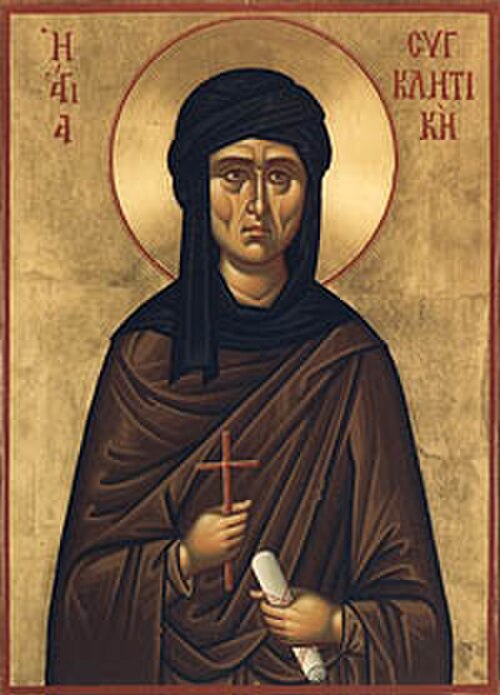
Venerable
Syncletica of Alexandria
Ascetic of Roman Egypt in the fourth century, known from her Life written in Greek.
- Feast
- January 5old style January 18
- Reposed
- 4605th century
- Place
- Macedonia
- Order
- Venerables
Life
Saint Syncletica of Alexandria, venerable, was an ascetic and Desert Mother of Roman Egypt, in the fourth century. The Church keeps her Life, attributed to Saint Athanasius the Great, and her sayings, gathered in the Apophthegmata. She lived in labour, fasting and prayer and was the spiritual mother of many virgins. She is commemorated on 5 January.
Family and her choice
According to the Life, she was born in a noble and wealthy family from Macedonia, which moved to Alexandria. She had a blind sister and two brothers, one of whom died young, while the other, according to one source, went into the desert. Beautiful and well provided for, she was sought in marriage by many, but refused them all, loving the purity of virginity, though her parents, who hoped to preserve their line through her marriage, opposed it. She cut her hair as a sign that she had become another creature. The years of her birth and death are not known, and the sources give the fourth century, with various reckonings.
After her parents' death she gave her wealth to the poor and withdrew with her blind sister to a cell, according to one source in a tomb belonging to relatives, outside the city. The fame of her struggles spread quickly, and many virgins and pious women came to live under her guidance, though she resisted. She became a teacher of nuns, instructing them by word and by example.
Her teaching
The Apophthegmata preserve twenty-eight of her sayings. Her teaching is full of quotations from Scripture and images from everyday life, especially sailing, the sea, household tasks and women's work. Unlike some ascetics of the time, she connected domestic life with spiritual life. She is said to have said: if it is a time of fasting, do not excuse yourself because of illness, for even those who do not fast fall into the same illnesses. And: as a treasure that is uncovered is quickly plundered, so virtue, when made known, grows dim and is lost. One source says that her wisdom came not from books but from suffering and from prayer by day and night.
Illness and death
Syncletica died on 5 January, at the age of eighty, according to one source eighty-three or eighty-four, after an illness of three years, a cancer of the mouth. She refused treatment, though the illness had disfigured her face, but in the end accepted it, so as not to infect her caregivers. No miracles are attributed to her, not even after her death. One Serbian source gives the year 350 for her death.
Her Life and veneration
She is the only anchorite, apart from Saint Anthony, about whom a life was written. Her Life, attributed to Saint Athanasius, was published about 450, probably written in Palestine, though some believe it anonymous. Scholars note that the only details about her person are found in this Life, which may be mainly monastic instruction in the guise of a saint's life. The Orthodox Church commemorates her on 5 January, on the eve of the Baptism of the Lord, together with the commemoration of the martyrs Theopemptus and Theonas. Her service is in the Menaion and includes three stichera and a canon.
Commemorated the same day January 5
 Edward the ConfessorRight-Believing · King of EnglandJan 5
 Apollinaria SyncleticaVenerable · Hermit of EgyptJan 5
 Theopemptus and TheonasHoly Martyrs · Martyrs of NicomediaJan 5
 Rusticianus of BresciaSaint · Bishop of BresciaJan 5
 Theopemptus of NicomediaHieromartyr · Bishop of NicomediaJan 5
 Andrew ZiminHieromartyr · ArchpriestJan 5
- Acutus of AfricaSaintJan 5
- Amelia of GironaMartyrJan 5
- Astolfus of MainzSaint · Archbishop of MainzJan 5
- CiaraSaintJan 5
- Ciaran son of AedhSaintJan 5
 ConwoionVenerable · Abbot of RedonJan 5