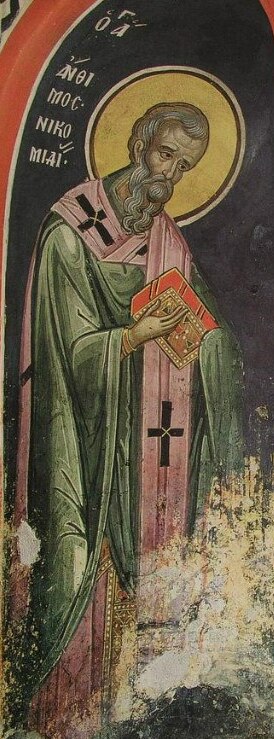
Hieromartyr
Anthimus of Nicomedia
Bishop of Nicomedia
Bishop of Nicomedia in Bithynia, beheaded during a persecution of Christians.
- Feast
- September 3old style September 16
- Reposed
- 3024th century
- Place
- Nicomedia
- Order
- Martyrs
Life
The Holy Hieromartyr Anthimus of Nicomedia was bishop of Nicomedia in Bithynia, beheaded during a persecution of Christians, traditionally placed under Diocletian (around 303, though some historians say 311-312). His feast is on 3 September (and 28 December).
Beginnings
He was born at Nicomedia, it seems, and from his youth was distinguished by virtue. He received the priesthood and, after the death of Cyril, head of the Church of Nicomedia, was chosen bishop (according to one source, ordained in 293). Not many details of his life are known. Nicomedia was Diocletian's chief residence and was half Christian, the palace itself being full of Christians; Christian sources memorialize the "20,000 martyrs of Nicomedia."
The persecution
The main church of Nicomedia was destroyed on 23 February 303, and on the following day the first edict was published. Shortly after, a fire broke out in the imperial palace, for which the Christians were blamed. The Orthodox account says that on the feast of the Nativity of Christ in 302, when some twenty thousand Christians had gathered in the cathedral church of Nicomedia, the emperor sent a herald who ordered them all to come out and sacrifice to the idols, or else he would burn the church with them in it. None would bow to the idols. While the tormentors prepared to set fire, Bishop Anthimus, who was serving, baptized all the catechumens and communed them all with the Holy Mysteries; all the twenty thousand died in the flames, but Bishop Anthimus managed to hide in a village near Nicomedia (Omana or Semana, according to sources). From hiding he sent letters to the Christians, exhorting them to hold firmly to the faith and not fear torments. One letter, sent by the deacon Theophilus, was intercepted and given to the emperor; Theophilus was interrogated and died under torture without revealing where the bishop was. In other sources, the massacres took place in the Christian communities of Bithynia after altars were set up in the marketplaces, where no transaction was permitted until a token sacrifice to the gods and the genius of the Augustus had been performed, and Anthimus took refuge, at the request of his flock, in the village of Omana, where he helped survivors.
Arrest and martyrdom
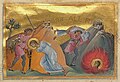
In the end the emperor learned the place and sent a band of soldiers. On the way they met the bishop himself; the soldiers did not recognize him, but he called them to him, fed them, and then told them he was the one they sought. The soldiers did not know what to do, wanted to leave him and tell the emperor they had not found him; but the bishop could not bear a lie and would not agree. The soldiers believed in Christ and received Holy Baptism, and the saint nevertheless made them carry out the ruler's command. (The detail with Maximinus suggests, in some views, that two persecutions have been conflated.) When Bishop Anthimus came before the emperor, he ordered instruments of torture brought and laid before him. "Do you think, O king, to frighten me with instruments of torture?" the saint asked. "No, you will not frighten one who himself desires to die for Christ. Torture frightens only the fainthearted, for whom temporal life is dearest of all." Then the emperor ordered him cruelly tortured: first they struck him with stones on the neck and pierced his feet with red-hot stakes, laid him on sharp potsherds and beat him with rods, then put red-hot bronze boots on his feet, but Anthimus received the torments with joy for Christ. Maximian ordered him tied to a wheel and turned over a fire, but the fire struck the executioners. Then Anthimus was thrown into prison with robbers, whom he brought to Christ. Learning of this, Maximian offered him to become first among the pagan priests; Anthimus rejected this offer too, and by the emperor's order his head was cut off.
The year of martyrdom and writings
The Orthodox place him in the Great Persecution under Diocletian and Maximian. Others, on the basis of a fragmentary letter preserved in the Chronicon Paschale, written in prison by the presbyter Lucian of Antioch awaiting death, which mentions Anthimus, bishop of Nicomedia, as if he had just suffered martyrdom, hold that he suffered not under Diocletian but under Maximinus Daia (311 or 312), if the fragment is genuine. A letter to his flock from hiding is attributed to him, now lost, and a fragment of a letter to a Theodore on the Holy Church, preserved in two manuscripts (Ambrosian Library, thirteenth century, and Escorial, fourteenth century), which sets out the marks of the true Church (unity, catholicity, apostolicity) against the heretical one (multiplicity of origins, philosophical teachings, limited spread); it seems the text was composed by Anthimus and then reworked in the fourth century by an unknown writer.
Troparion, Tone 4: Sharing in the ways and a successor on the throne of the apostles, you found, inspired by God, the ascent through visions; therefore, rightly teaching the word of truth, you suffered for the faith even to blood, O Hieromartyr Anthimus; entreat Christ God that our souls be saved.
In iconography he is shown as an old man with a white beard divided into two or three locks, in hierarchal vestments, with the Gospel in his hand. His martyrdom is painted, among other places, at Visoki Decani monastery, of the fourteenth century.
Commemorated the same day September 3
 PhoebeApostle · Deaconess of CenchreaeSep 3
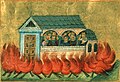 The 20,000 Martyrs of NicomediaHoly MartyrsSep 3
 Vasilissa of NicomediaMartyr · Child martyr of NicomediaSep 3
 Auxanius of MilanSaint · Archbishop of MilanSep 3
 Chrodegang of SéesSaint · Bishop of SéesSep 3
 John the Hairy of RostovFool-for-Christ · Fool for Christ of RostovSep 3
 Joanikije LipovacHieromartyr · Metropolitan of Montenegro and the LittoralSep 3
 Thaddeus of PetrozavodskFool-for-Christ · Fool for ChristSep 3
 AristionHieromartyr · Bishop of Little AlexandriaSep 3
 Rieul of ReimsSaint · Bishop of ReimsSep 3
 Joanikije IISaint · Patriarch of PećSep 3
 IndesMartyr · Eunuch of NicomediaSep 3