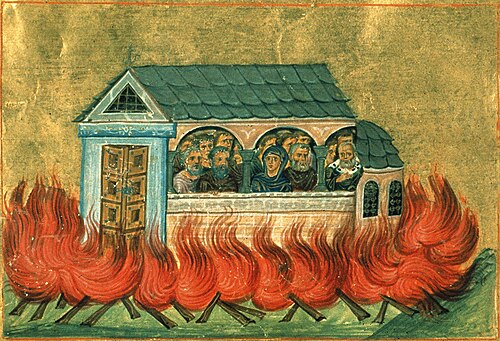
Holy Martyrs
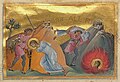
The 20,000 Martyrs of Nicomedia
Christians put to death at Nicomedia for their faith in the Diocletian persecution; tradition speaks of twenty thousand.
- Feast
- September 3old style September 16
- Era
- unknown
- Place
- Nicomedia
- Order
- Martyrs
Life
The Twenty Thousand Martyrs of Nicomedia were Christians put to death at Nicomedia in Bithynia for their faith in Christ, in the persecution of Diocletian, at the start of the fourth century. The Orthodox Church remembers them on 28 December, and the Roman Catholic Church on 23 June.
Nicomedia was one of the principal residences of the emperors and an administrative centre of the eastern provinces under Diocletian. For this reason it was one of the first places where the laws against Christians were enforced. According to Eusebius of Caesarea and Lactantius, the persecution began at Nicomedia in 303, when the authorities ordered the destruction of the great church of the Christians and the burning of the Holy Scriptures. The edicts required Christians to sacrifice to the Roman gods, and those who refused were imprisoned, tortured or killed.
The Byzantine tradition, preserved in the synaxaria, tells that on the day of the Nativity of the Lord, in 302 according to some sources, 304 according to others, many Christians gathered in the church at Nicomedia. The emperor Maximian, angered by the spread of the faith in the city, ordered the church surrounded by soldiers and burned with all inside it, unless they would sacrifice to idols. An envoy of the emperor entered the church and read the command. The assembled faithful refused. It is said that Bishop Anthimus of Nicomedia, before the soldiers came, baptized those who were not yet baptized and gave all the Holy Mysteries. Then the soldiers set fire to the church, and all inside were burned. Other accounts also speak of those killed by drowning and beheading.
The figure of twenty thousand, as given in the later liturgical texts, is regarded by modern historians as rather symbolic; the sources speak of several thousand victims. Nicomedia was, however, beyond doubt a great centre of persecution. Many links bind it to names: Saint Anthimus, the city's bishop, was later seized and beheaded; Saint Gorgonius, a high official in the emperor's household, suffered as well; the Eastern tradition also remembers Domna of Nicomedia, a young woman who renounced paganism and was killed, and Vasilissa, a child martyr. Dimitry of Rostov, in his Menaion, ties the drama of the community to the story of the young Domna, the emperor's foster-child: her renunciation of paganism was, he says, the occasion of the persecution, and her death its climax. Together with many nameless believers, all are remembered together as the twenty thousand martyrs of Nicomedia.
Commemorated the same day September 3
 PhoebeApostle · Deaconess of CenchreaeSep 3
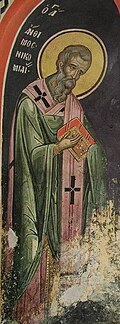 Anthimus of NicomediaHieromartyr · Bishop of NicomediaSep 3
 Vasilissa of NicomediaMartyr · Child martyr of NicomediaSep 3
 Auxanius of MilanSaint · Archbishop of MilanSep 3
 Chrodegang of SéesSaint · Bishop of SéesSep 3
 John the Hairy of RostovFool-for-Christ · Fool for Christ of RostovSep 3
 Joanikije LipovacHieromartyr · Metropolitan of Montenegro and the LittoralSep 3
 Thaddeus of PetrozavodskFool-for-Christ · Fool for ChristSep 3
 AristionHieromartyr · Bishop of Little AlexandriaSep 3
 Rieul of ReimsSaint · Bishop of ReimsSep 3
 Joanikije IISaint · Patriarch of PećSep 3
 IndesMartyr · Eunuch of NicomediaSep 3