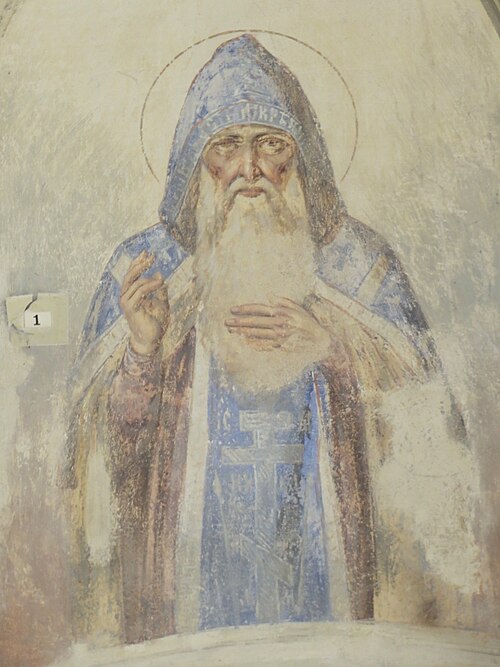
Venerable
Anthony of Krasny Kholm
Founder of Antoniev Monastery
Founder of the Nicholas-Antoniev Monastery at Krasny Kholm, who died in 1481.
- Feast
- January 17old style January 30
- Reposed
- 148115th century
- Place
- Antoniev Krasnokholmsky Monastery
- Order
- Venerables
Life
Venerable Anthony of Krasny Kholm was a hermit and hieromonk, founder of the Nicholas-Anthony (Nikolaevsky-Antoniev) monastery near Krasny Kholm, in the Bezhetsk diocese of the Tver metropolis, venerated as a local saint. He came to the Bezhetsk land in 1461 from the Beloozero region and died in 1481, the year in which he laid the foundation of the monastery's stone cathedral. The place of burial is not known with certainty; the relics are thought to rest underground beside the cathedral of Saint Nicholas. He is commemorated on 17 (30) January and on the first Sunday after 29 June (12 July), in the Synaxis of the Saints of Tver.
Life, according to the monastery chronicle
The only historical source about him is the monastery chronicle, compiled in 1687, which contains not a detailed life but few general data. According to it, Anthony came to the neighbourhood of the town of Goroditsk in Bezhetsky Verkh (today Bezhetsk, Tver region) from "the land called by men Belozersk", as a hermit, hieromonk and elder; the chronicle gives the year of his arrival, 1461 (6969). Passing through the lands of the Nelediny boyars, the elder fell ill and, soon receiving by God's mercy a miraculous healing, he resolved to spend his life in solitude and prayer in those places, choosing a beautiful and deserted corner at the confluence of the river Neledina and the Mogocha. He asked for a plot from the boyar Athanasy Vasilievich Nelediny (a historical figure, who however lived a hundred years later) and made himself a cell and a chapel for prayer. His pious life drew people, some of whom stayed with him. The chronicle says that soon he began a monastery: he began "to build a wooden church in honour of the great hierarch and wonderworker Nicholas of Myra, and, building it, adorned it beautifully with holy icons, supplied it with divine books and, not long after, fenced it with a wall and began to gather brethren". The chronicle gives no date for the building of the wooden church and the founding of the community, so one can say only conventionally that it was in 1461; officially this is the year of the monastery's founding. Nowhere is he called hegumen, only "guide" and "builder", nor is he called venerable, only the "God-struggling" character of his life is noted.
The last work of his life, according to the chronicle, was the laying of the foundation of the monastery's stone cathedral, the church of Saint Nicholas, in 1481 (6989). He did not live to see the end of the building: he died and was buried by the brethren on the monastery grounds (the place is not stated). A later monastic tradition, probably from the second half of the seventeenth century, at the time of the monastery's restoration and flourishing, places the grave beside the cathedral of Saint Nicholas, underground. In 1690 a chapel dedicated to All Saints was built over the place.
More recent data
It seems that Anthony was never officially canonized (historians have found no such decision), but was venerated as a "departed ascetic", most likely only in his own monastery. Manuscript and printed calendars up to the end of the eighteenth century do not mention him. The researcher A. A. Romanova found his commemoration in three Old Believer calendars, of the early nineteenth century, with two days, 17 (30) January and 7 (20) May. From the early nineteenth century too is an addition about him in the monastery's synodikon of 1681. Today Anthony of Krasny Kholm belongs to the Synaxis of the Saints of Tver and is a locally venerated saint in the Bezhetsk diocese; his commemoration is held on the day of Saint Anthony the Great, probably by likeness of name and struggle, on 17 (30) January, and on the first Sunday after 29 June. In the 1990s and in 2008 archaeological digs at the monastery showed a monastic settlement of the fifteenth century, wooden buildings on the site of the cathedral of Saint Nicholas and nine monastic graves of the fifteenth century, but among them the relics of Anthony were not found.
The nickname and veneration
The nickname "of Krasny Kholm" shows the place of his struggle, the town of Krasny Kholm, a kilometre from which the monastery lies; until 1776 the town was a village and was called Spas na Kholmu. He could receive the nickname only after 1776, the year in which the village was made a town and the monastery included in its limits; it appears in the calendar of F. P. Babushkin. The historian M. P. Pogodin noted in 1841 that the monastery is called Antoniev, but it is not known who the founder Anthony was, where he lived, when he died and where he is buried; the people keep only the memory of his virtues and go to serve memorial services. A record of 1545 and 1546 already mentions "Anthony's monastery", showing that the monastery bore the founder's name already in the sixteenth century; his veneration as a pious ascetic begins at the end of the seventeenth century, in the monastery, and veneration as a venerable only from the end of the eighteenth century or, according to Romanova, from the last quarter of the nineteenth. His icons are all late, from the second half of the nineteenth century and the twentieth; the earliest is a fresco in a medallion on the vault of the church of Saint John the Theologian at Bezhetsk, of the 1860s.
Commemorated the same day January 17
 Theodosius the GreatRight-Believing · Roman EmperorJan 17
 Anthony the GreatVenerable · Father of MonasticismJan 17
 Sulpicius the PiousSaint · Bishop of BourgesJan 17
 Sabinus of PiacenzaSaint · Bishop of PiacenzaJan 17
 Speusippus, Eleusippus and MelapsippusHoly MartyrsJan 17
 George of IoanninaNew MartyrJan 17
- Julian SabaVenerable · Hermit of SyriaJan 17
- Anthony of DymskyVenerable · Founder of Dymsky MonasteryJan 17
 John I of RostovSaint · Bishop of RostovJan 17
- Anthony of ChernoezerskVenerableJan 17
- Achilas the Hermit of EgyptVenerable · Hermit of EgyptJan 17
- AmoesSaintJan 17