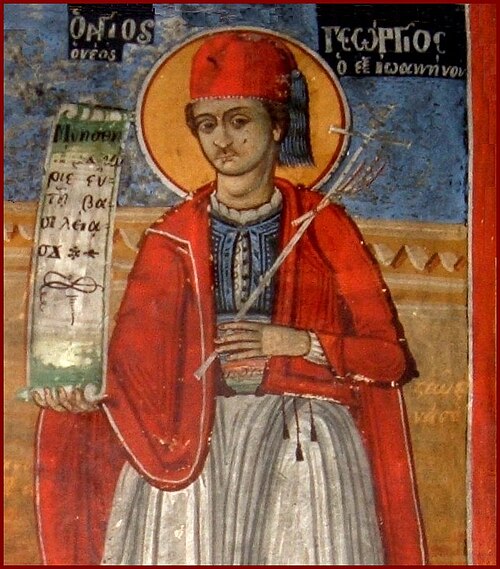
New Martyr
George of Ioannina
Born in 1808 near Grevena, orphaned at twelve or thirteen, a servant at Ioannina, where he was martyred in 1838.
- Feast
- January 17old style January 30
- Reposed
- 183819th century
- Place
- Ioannina
- Order
- Martyrs
Life
The holy new martyr George of Ioannina (George of Grevena) was born in 1808 and was hanged at Ioannina on 17 January 1838 for refusing to deny Christ. He is the patron of the city of Ioannina and of his native village. He is commemorated on 17 January.
Childhood and years as a servant
He was born in 1808 in the village of Tsourchli (now Agios Georgios, near Grevena), to Constantine and Vasiliki, poor farmers. According to the Greek sources he was orphaned at eight and grew up in the village beside his older brothers; according to others he was orphaned at twelve or thirteen. At sixteen he went down to Ioannina to earn his living. At twenty-two he was hired there as a groom by Hadji Abdullah Effendi, a trusted officer of Imin Pasha, who had succeeded his father as vali of Ioannina in 1830 when the latter became Grand Vizier in Constantinople. The Turks gave him the name "Giaour Hasan", that is, Hasan the infidel. A Bulgarian source says he was abducted by Ottoman soldiers and taken for a Muslim.
The confession
In 1836 he became engaged to a pious young woman of Ioannina, Eleni. On the day of the betrothal an Ottoman hodja slandered him, saying that in earlier years he had become a Muslim and had returned to the Orthodox faith. Asked in court, George confessed without fear that he was born of Christian parents and had remained a Christian all his life. The truth of his words was proved also by the fact that he was not circumcised, and so he was set free. He married on the feast of Saint Demetrius of that year, 26 October 1836. In 1837 he was hired as a groom by the musselim of Filiates, from where he returned to Ioannina in December for the birth and baptism of his son. On 7 January 1838, the feast of Saint John the Forerunner, he baptized his son and gave him the name John.
On 12 January 1838 the same hodja slandered him again, saying that he insulted the Muslim faith, because he had been an Ottoman and was now a Christian, married to a Christian and had baptized his child a Christian. He was arrested and imprisoned and pressed to change his faith, but he remained unmoved, constantly confessing his Christian faith. The clergy and people of Ioannina tried in vain to prevent the unjust decision of the Turkish judge. The Metropolitan of Ioannina, Joachim of Chios (Kokkodis), went to the court to defend him, but none of his arguments was accepted. The next day, 13 January, in court, they tried to persuade him to renounce, offering him posts and dignities. He said again: "I am a Christian." So the martyrdom began.
The martyrdom
They flogged him without mercy, burned him with boiling oil and wax, drove needles under his nails and laid on his chest a heavy stone that twenty men could barely lift. George endured bravely, saying simply: "I am a Christian and a Christian I shall die." On Monday 17 January 1838, the feast of Saint Anthony, he was hanged. His body stayed hanging until 19 January, during which time many wonderful signs of his holiness were seen. Already from Monday evening a light came down from heaven and crowned the head of the new martyr, and it appeared every evening during the three days. He healed even a Muslim woman, along with many Christians.
Then his body was bought for 300 piastres from Mustafa Pasha, and Metropolitan Joachim, assisted by the metropolitans of Grevena and Arta, buried him with honour at the west side of the sanctuary of the cathedral of Saint Athanasius. His martyrdom and burial were followed by many miracles, unmistakable proofs of his holiness. A chapel was later built over his grave.
Relics and veneration
On 25 October 1971 Metropolitan Seraphim of Ioannina, later Archbishop of Athens, with his then protosyncellus and successor Theoklitos, took up his relics and placed them in the church of his name in Ioannina, on Pargis Square. A church dedicated to him stands also in his native village, where part of the relics is kept. Other parts of the relics are in the church of Saint Demetrius in Thessalonica, in the monastery of Dionysiou on Athos and in Saint Nicholas Monastery in Fort Myers, Florida. His veneration spread in the nineteenth century in western Macedonia and Epirus. The first church built in his honour, in 1847, only nine years after the martyrdom, is the five-domed church at Argyro Pigadi in Aetolia-Acarnania. His native village was renamed Agios Georgios in 1927.
Commemorated the same day January 17
 Theodosius the GreatRight-Believing · Roman EmperorJan 17
 Anthony the GreatVenerable · Father of MonasticismJan 17
 Sulpicius the PiousSaint · Bishop of BourgesJan 17
 Sabinus of PiacenzaSaint · Bishop of PiacenzaJan 17
 Speusippus, Eleusippus and MelapsippusHoly MartyrsJan 17
 Anthony of Krasny KholmVenerable · Founder of Antoniev MonasteryJan 17
- Julian SabaVenerable · Hermit of SyriaJan 17
- Anthony of DymskyVenerable · Founder of Dymsky MonasteryJan 17
 John I of RostovSaint · Bishop of RostovJan 17
- Anthony of ChernoezerskVenerableJan 17
- Achilas the Hermit of EgyptVenerable · Hermit of EgyptJan 17
- AmoesSaintJan 17