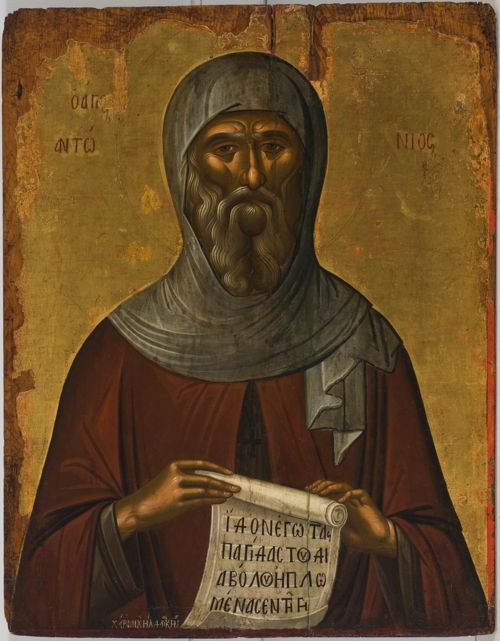
Venerable
Anthony the Great
Father of Monasticism
Hermit of Egypt, regarded as the father of monasticism, who died at over a hundred years of age.
- Feast
- January 17old style January 30
- Reposed
- 3574th century
- Place
- Thebes
- Order
- Venerables
Life
Saint Anthony the Great was a hermit of Egypt who lived in the third and fourth centuries. The Church calls him the father of monks, since his life and teaching in the desert guided countless disciples and gave form to monastic life throughout the Christian world. His feast is on 17 January.
The call
He was born in 251 in the village of Koma in Egypt, to a well-off Christian family. At about twenty he lost his parents and was left to care for a younger sister. Entering church one day, he heard the Gospel read: "If you would be perfect, go, sell what you possess and give to the poor, and you will have treasure in heaven; and come follow Me." Anthony took the word as spoken to him. He sold his lands, gave the money to the poor, entrusted his sister to a community of virgins, and began the ascetic life.
Struggle in the desert
At first he lived in a hut near the village as the disciple of an elderly ascetic, working with his hands to earn his living and give alms. In this time he met hard temptations from the devil, thoughts of his former life, doubts and anxiety for his sister, which he overcame by prayer and the thought of Christ. He then shut himself in a tomb, where the demons beat him terribly; the friend who brought him bread found him as if dead and carried him to the village. Anthony asked to be taken back, and, as the Life written by Athanasius records, at the end of the torment the light of Christ appeared to him.
At thirty-five he crossed the Nile and shut himself in an abandoned Roman fort at Pispir, blocking the entrance with stones. A friend brought him bread twice a year. He stayed almost twenty years, until about 305, when his disciples broke down the door. They found him not wasted but healthy in body and clear in mind. Monasteries multiplied around his cell, and for five or six years Anthony instructed and ordered the monks.
The confessor
In the persecution under Emperor Maximian, in 311, he went to Alexandria to strengthen the martyrs, served those in prison, and accompanied the confessors to the place of execution, desiring to suffer for Christ himself, though the Lord kept him for the benefit of Christians. Later he withdrew to the inner desert, to a mountain between the Nile and the Red Sea, where the monastery bearing his name still stands. There he spent the last forty-five years of his life, receiving those who came for counsel. In 338 he returned for a time to Alexandria to support the right teaching against the Arians. Emperor Constantine the Great and his sons wrote to him asking for his prayers; Anthony answered urging them not to prize this world but to remember the judgment to come. According to Saint Jerome he also visited Saint Paul of Thebes, the first hermit, and buried him; scholars treat this episode as legend.
Repose and veneration
Sensing his end, he urged the brethren to keep the Orthodox faith pure and to avoid heretics. He left one mantle to Saint Athanasius of Alexandria and another to Saint Serapion of Thmuis, and his staff to Saint Macarius. He reposed in peace in 356, at the age of 105, and was buried in the desert by his disciples, in a place he wished to remain hidden.
His Life, written by Saint Athanasius the Great, the first biography of a saint who was not a martyr, was translated into Latin before 374 and spread the monastic ideal in East and West. Saint John Chrysostom advised every Christian to read it. Seven letters to monasteries of Egypt survive among the writings attributed to him; other works are not considered certain. According to tradition his relics were taken to Alexandria in 544 (or 561), then to Constantinople, and later reached Arles in France. His sayings are preserved in the Paterikon.
Commemorated the same day January 17
 Theodosius the GreatRight-Believing · Roman EmperorJan 17
 Sulpicius the PiousSaint · Bishop of BourgesJan 17
 Sabinus of PiacenzaSaint · Bishop of PiacenzaJan 17
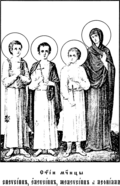 Speusippus, Eleusippus and MelapsippusHoly MartyrsJan 17
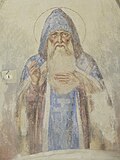 Anthony of Krasny KholmVenerable · Founder of Antoniev MonasteryJan 17
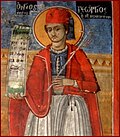 George of IoanninaNew MartyrJan 17
- Julian SabaVenerable · Hermit of SyriaJan 17
- Anthony of DymskyVenerable · Founder of Dymsky MonasteryJan 17
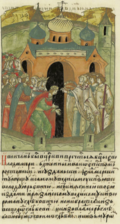 John I of RostovSaint · Bishop of RostovJan 17
- Anthony of ChernoezerskVenerableJan 17
- Achilas the Hermit of EgyptVenerable · Hermit of EgyptJan 17
- AmoesSaintJan 17