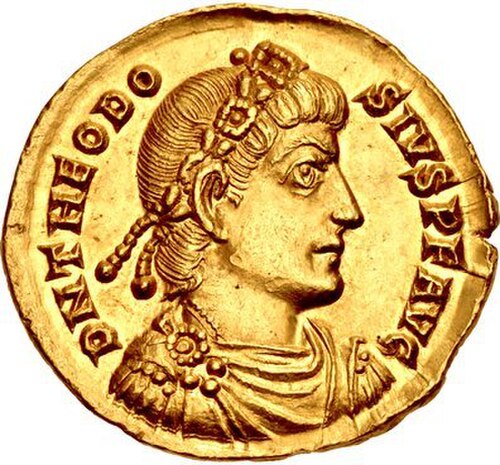
Right-Believing
Theodosius the Great
Roman Emperor
Emperor from 379 to 395, who upheld the Nicene faith and convened the Second Ecumenical Council.
- Feast
- January 17old style January 30
- Reposed
- 3954th century
- Place
- Milan
Life
The holy Emperor Theodosius the Great ruled the Roman Empire between 379 and 395. The Church honours him as a right-believing emperor who supported the faith of Nicaea, convened the Second Ecumenical Council, and bowed in repentance before the rebuke of Saint Ambrose. He is commemorated on 17 January. According to the Synaxarion he often said that he counted himself more fortunate to be a member of Christ's holy Church than to be an emperor.
Beginnings
He was born on 11 January, in 346 or 347, in Hispania, at Cauca, the son of a general of the same name who rose to be count of Africa. His father was unjustly put to death in 376, and the son withdrew to the family estates in Spain. Because of his military gifts the Emperor Gratian called him after the death of Valens at the battle of Adrianople in 378. Theodosius won a victory over the Sarmatians, and on 19 January 379, at Sirmium, Gratian crowned him emperor of the East, when Theodosius was thirty-three years old.
For the faith of Nicaea
In the autumn of 380, at Thessalonica, Theodosius fell gravely ill and asked for Baptism, which he received from Bishop Ascholius of Thessalonica. An edict issued that same year, at the end of February 380, laid down that only those who confess the faith of the council of Nicaea may call themselves Christians. It was the first step in a policy of strengthening Orthodoxy. The Synaxarion says that heretics were no longer allowed to claim the name of the Church, and that the churches were given back to the faithful.
At Constantinople the Arians, who had seized all the churches in the time of Valens except the little chapel of Saint Anastasia, wished to drive out Saint Gregory the Theologian, whom the Orthodox had called there. Theodosius entered the city in November 380, expelled the Arian bishop Demophilus and set Gregory on the throne.
In 381 Theodosius convened the second ecumenical council at Constantinople. It confirmed the faith of Nicaea, completed the Creed with the article on the Holy Spirit against Macedonius, who denied Him, and settled the order of the episcopal sees disturbed under the Arians. Further synods followed in 382 and 383. The emperor issued laws against heretics, upheld Sunday rest, forbade circus spectacles on Sundays, and prohibited sacrifices and the worship of idols. Historians today note, however, that he was rather cautious toward the old cults, and that the anti-pagan laws of 391 and 392 had limited effect.
Mercy and repentance
The Synaxarion keeps two events that show his humility. In 387 the people of Antioch rose in revolt and pulled down the statues of the emperor and his wife. Theodosius meant to punish them harshly, but the empress, the patriarch Flavian and the monks of the region pleaded, and at Pascha he granted pardon.
The second event is from 390, when at Milan he ordered a terrible punishment for the riot at Thessalonica, in which the garrison commander, Butheric, had been killed. Thousands of people were slain, seven thousand according to the Synaxarion. Theodosius repented, but the countermand arrived too late. Saint Ambrose, bishop of Milan, asked him to do public penance and would not allow him the Holy Mysteries until it was done. The emperor submitted, came to church without his imperial robes, and after eight months, at Christmas, was received again to communion. Modern historians think that the scene at the cathedral door, where Ambrose is said to have barred his way, is a later embellishment, but the emperor's penance itself is not in doubt.
Repose
After defeating the usurper Eugenius at the Frigidus in September 394, Theodosius ruled the whole Empire alone, for the last time. He died at Milan on 17 January 395, of an illness with swelling of the body, at almost fifty years of age. His body lay in the palace for forty days, and on 25 February Saint Ambrose delivered the funeral oration in the cathedral. On 8 November 395 the body was carried to Constantinople and laid in the church of the Holy Apostles. After him the Empire was divided between his sons, Arcadius in the East and Honorius in the West.
The title "the Great" was first given to distinguish him from his grandson Theodosius II, and at Chalcedon in 451 it was judged deserved for his support of Nicene faith. Bishop Paulinus of Nola wrote that in him he praised not so much the emperor as the servant of Christ. The Orthodox Church commemorates him on 17 January.
Commemorated the same day January 17
 Anthony the GreatVenerable · Father of MonasticismJan 17
 Sulpicius the PiousSaint · Bishop of BourgesJan 17
 Sabinus of PiacenzaSaint · Bishop of PiacenzaJan 17
 Speusippus, Eleusippus and MelapsippusHoly MartyrsJan 17
 Anthony of Krasny KholmVenerable · Founder of Antoniev MonasteryJan 17
 George of IoanninaNew MartyrJan 17
- Julian SabaVenerable · Hermit of SyriaJan 17
- Anthony of DymskyVenerable · Founder of Dymsky MonasteryJan 17
 John I of RostovSaint · Bishop of RostovJan 17
- Anthony of ChernoezerskVenerableJan 17
- Achilas the Hermit of EgyptVenerable · Hermit of EgyptJan 17
- AmoesSaintJan 17