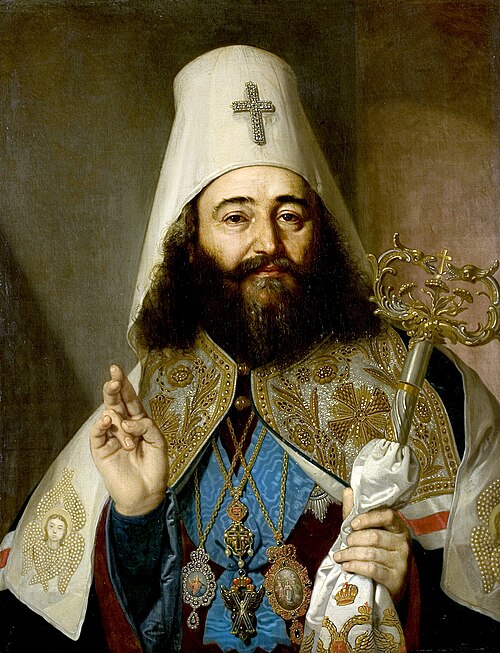
Saint
Anton II of Georgia
Catholicos-Patriarch of Georgia
Son of King Heraclius II, Catholicos-Patriarch of Georgia, who died in exile at Nizhny Novgorod.
- Feast
- December 21old style January 3
- Reposed
- 182719th century
- Place
- Nizhny Novgorod
- Order
- Hierarchs
Life
Saint Anton II was a king's son, the last Catholicos-Patriarch of Georgia before the abolition of the autocephaly of the Georgian Church, and a defender of the ancient traditions of his Church in the face of Russian rule. He led the Georgian Church from 1788 to 1811 and spent his last years in exile at Nizhny Novgorod, where he departed to the Lord in 1827. The Georgian Orthodox Church canonized him in 2011. He is commemorated on 21 December by the Julian calendar.
Youth
He was born in Tbilisi on 8 January 1762 or 1763 as Prince Royal Teimuraz, named after his grandfather King Teimuraz II. He was a son of King Heraclius II of Kartli and Kakheti by his third marriage, to Darejan Dadiani, and a brother of the last king, George XII. He was educated at the royal court in Tbilisi and then at the Tbilisi theological seminary, under the guidance of his relative and predecessor, Catholicos Anton I. In 1782 he became a monk and took the name Anton, and was then ordained hierodeacon.
In 1783, at the conclusion of the Treaty of Georgievsk between Heraclius II and Empress Catherine II, he travelled to Saint Petersburg with the Georgian embassy and his brother Mirian, and was received at the imperial court. Mirian entered the Russian army, while Anton was consecrated bishop of Ninotsminda in the presence of the empress, at the church of the palace at Tsarskoye Selo, in 1784 by some sources and 1787 by others, and raised to the rank of metropolitan. On this occasion Catherine gave him a richly adorned panagia, which the Russian Synod took after his death in 1827. He was among the company that accompanied the empress on her journey through the territory of the former Crimean Khanate. He was transferred to Alaverdi, both sees lying in his native Kakheti, but he stayed another year in Russia.
Catholicos-Patriarch
In 1788 his father, displeased that Russia had not kept its troops in defence of Georgia as the treaty provided, ordered him to return home. That year, on 29 October, at the death of Catholicos Anton I, he was elected his successor at the age of 25, remaining also administrator of the diocese of Alaverdi. His zeal for building churches and for education, together with his birth, added to his prestige. In 1791 he helped bring about a temporary reconciliation in western Georgia between his nephew King Solomon II of Imereti and Solomon's rival David II. The Georgian Church was then divided into two patriarchates, and when Maxim II of Imereti retired to Kiev in 1795 and no successor was chosen, Anton remained the sole primate of Georgia.
Russian rule
After the Russian Empire annexed Georgia in 1801 and began deporting the royal family to Russia, Anton came under growing pressure. He never openly withdrew his loyalty to the tsar, but the Russian administration was uneasy at his refusal to give up any of his privileges and his zealous defence of the old Georgian church traditions and laws. He answered that the laws and customs of Georgia were hundreds of years old, older than the Russian models, and that the decrees of Alexander I had confirmed the independence of the Georgian Church. Questions were also raised about his links with anti-Russian members of the royal family. The Church was also shaken by an internal division, through the intrigues of Metropolitan Arsen of Tbilisi.
Anton was forced to leave Georgia for Saint Petersburg in 1810. On 30 January 1811 Emperor Alexander I confirmed the report of the Russian Holy Synod abolishing the autocephaly and patriarchal dignity of the Georgian Church, which became an exarchate of the Russian Church under Metropolitan Varlaam Eristavi. On 21 June 1811 the Synod removed Anton from the rank of Catholicos-Patriarch. He was summoned to take permanent part in the work of the Synod in Saint Petersburg and never returned to Georgia.
Last years and veneration
He retired to Nizhny Novgorod, where he was granted a green velvet mantle, the Order of Saint Andrew, a carriage, an annual pension of 54,000 paper rubles and the household of a metropolitan of the first rank. He departed to the Lord on 21 December 1827 and was buried in the Annunciation monastery of Nizhny Novgorod, and in 1841 was moved to the Transfiguration cathedral in the city's kremlin. After the Bolsheviks blew up the cathedral in 1929 his remains were lost, and attempts by Georgian students of the Moscow Theological Academy to find them have failed.
In July 2011 the Holy Synod of the Georgian Orthodox Church canonized him. A street in Tbilisi bears his name. He is commemorated on 21 December by the Julian calendar.
Commemorated the same day December 21
 Juliana of NicomediaMartyrDec 21
 Philaret of KievSaint · Metropolitan of Kiev and GaliciaDec 21
 Juliania of VyazmaRight-Believing · Princess of VyazmaDec 21
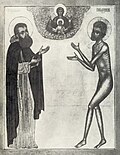 Procopius of VyatkaFool-for-Christ · Fool for ChristDec 21
 Siméon MstislavitchRight-BelievingDec 21
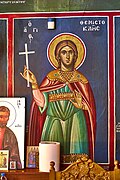 Themistocles of MyraMartyrDec 21
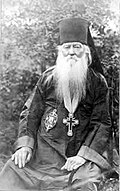 Nikita PribytkovHieromartyr · Bishop of BelevDec 21
- 130 Holy WomenSaintsDec 21
- 500 MartyrsHoly MartyrsDec 21
- BaudacariusVenerableDec 21
- BeornwaldHieromartyr · Priest of BamptonDec 21
- Flann son of FoircheallachSaintDec 21