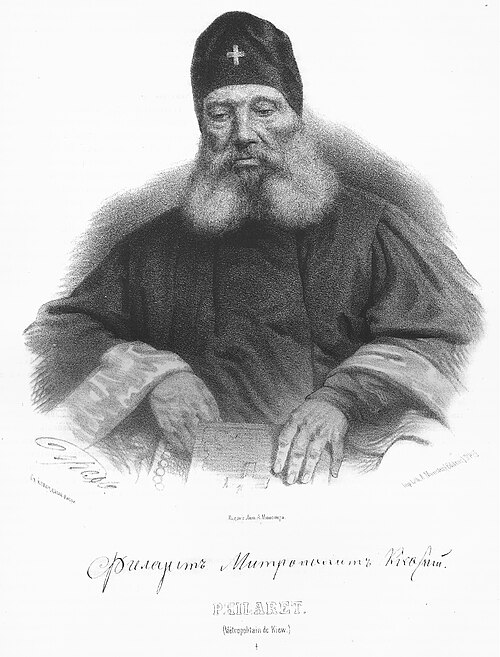
Saint
Philaret of Kiev
Metropolitan of Kiev and Galicia
Metropolitan of Kiev and Galicia from 1837 to 1857, died at Kiev in 1857.
- Feast
- December 21old style January 3
- Reposed
- 185719th century
- Place
- Kyiv
- Order
- Hierarchs
Life
Saint Philaret (Amfiteatrov), in the schema Theodosius, was Metropolitan of Kiev and Galicia for twenty years, from 1837 to 1857. Rector of seminaries and of an academy, archbishop of Kaluga, Ryazan, Kazan and Yaroslavl, he was an ascetic strict with himself and merciful to the poor, a spiritual father of the Kiev Caves Lavra and a defender of the peasants and the clergy. The Russian Orthodox Church has numbered him among the saints.
Childhood
In the world he was Fyodor Georgievich Amfiteatrov, born on 17 April 1779 in the village of Vysokoye in the Kromy district of the Oryol province, into the family of the priest George Nikitich Amfiteatrov and his wife Anastasia. He was born almost blind and was raised by his grandfather. When at the age of six the boy began to see well, his grandfather taught him to read and write. His brother was the writer and teacher Semyon Raich, and among his nephews were Archbishop Anthony (Amfiteatrov) and the jurist Pyotr Alexandrov.
In 1789 he was admitted directly into the second class of the Oryol theological school, and in 1795 he entered the seminary of the Oryol diocese, then located at Sevsk, from which he graduated in 1797.
Monk, teacher and rector
In November 1798 he was tonsured a monk with the name Philaret, and shortly afterwards ordained hierodeacon and, on 13 January 1799, hieromonk. He taught poetry, rhetoric and philosophy at the seminary, and from 1802 he was its rector and professor of theology, as well as abbot of the Svensky Monastery (1802-1804). At the request of Bishop Dositheus of Oryol he was transferred to Ufa, where in October 1804 he was raised to archimandrite of the Dormition Monastery and headed the Orenburg Seminary.
In 1810 he was appointed rector and professor of theology of the Tobolsk Seminary. On 2 December 1813 he was summoned to Saint Petersburg to serve and preach and was made abbot of the Joseph-Volokolamsk Monastery. On the proposal of Philaret (Drozdov), the future Metropolitan of Moscow, he became inspector of the Saint Petersburg Theological Academy on 15 February 1814, where in August 1814 he received the degree of doctor of theology, not for scholarly works but for his service and blameless life.
That same year he was transferred as inspector to the new Moscow Theological Academy, and from March 1816 he was its rector and professor of theology. His lectures followed, in abridged form, the theology of Theophan Prokopovich, but he avoided borrowing from Western theologians, lest something murky enter his teaching. His theology was a positive exposition of the faith, without polemics. From 1817 he also governed the Resurrection Monastery of New Jerusalem.
Bishop
On 1 June 1819 he was consecrated Bishop of Kaluga and Borovsk. On 12 January 1825 he was transferred to Ryazan, on 22 August 1826 raised to archbishop and appointed a member of the Commission of Theological Schools, and on 25 February 1828 he was appointed Archbishop of Kazan, where he brought more than 5,000 people of other faiths to Orthodoxy. In 1836-1837 he governed the diocese of Yaroslavl and Rostov. He was a member of the Holy Synod (1836-1842) and, from 1837, of the Russian Academy.
In 1820, when work began on translating Holy Scripture into Russian, he opposed it, believing that the Slavonic translation conveyed Scripture more fully and faithfully, and that Slavonic should rather be diligently taught in all schools. Metropolitan Philaret of Moscow on the contrary supported the translation, and the Synod adopted his view. Each of the two hierarchs kept his conviction to the end of his life.
Metropolitan of Kiev
On 18 April 1837 he was appointed Metropolitan of Kiev and Galicia. In his twenty years as pastor he showed himself a good shepherd who united all the Christian virtues and kept the monastic rule strictly. On 13 August 1841 he secretly received the great schema with the name Theodosius.
In the 1840s peasant unrest broke out in the Kiev province because of the tense relations between the landowners, mostly Polish Catholics, and their Orthodox serfs. The landowners suspected the village priests of involvement, but the metropolitan firmly defended his clergy, pointing out that the true cause of the uprisings was the heavy and unbearable condition of the peasants.
He loved the peasants and the poor greatly. Following the example of his patron, Saint Philaret the Merciful, he would go out into the city at night to leave alms secretly at the homes of the neediest families. He gave nearly 43,000 roubles for orphans and distributed to the poor all the income he received from the Lavra. A priest who oppressed widows and orphans was suspended by him from serving until he asked forgiveness and compensated those he had wronged.
Father of the Lavra
He forbade sending the brethren of the Lavra to field work, watched strictly over their life and constantly instructed them with good and wise words; soon the brethren came to revere and love him. His contemporaries said that he was a valiant ascetic who knew how to raise other ascetics. He wrote “Nine Rules” for the monks of the Lavra, reminding them among other things that they must live according to the requirements of monastic life and worthily of the holiness of the place, or else be expelled.
He held that before building stone churches one must build the inner churches in the hearts of monks and abbots. He restored the Holosiiv and Kitaev hermitages and founded the theological school at Saint Sophia in Kiev. New cells were built for the growing number of brethren and the sacristy was enlarged. He rebuilt the Lavra printing house, the only church press in Kiev, opened a bookshop, built a book warehouse in 1851, and in 1856 ordered eight printing presses from Berlin. The Horologia and Psalters printed then, 42,000 copies, sold out at once, and a whole generation in Ukraine and the neighbouring provinces learned to read from them.
Under his care the Monastery of Saint Michael of the Golden Domes was also renewed, and, not without his influence, the benefactress Anna Orlova gave 40,000 roubles for a silver shrine for the relics of the Holy Great Martyr Barbara.
He is said to have had the gift of spiritual healing, of working miracles, a remarkable memory and bold prayer, and to have been granted many revelations. He used to say that his constant rule had been always to walk the straight path, even when hard pressed on every side, confident that however people scheme, God surpasses them all in wisdom and strength.
The writer Nikolai Leskov devoted to him a chapter of his “Trifles of a Bishop's Life” and the story “The Bishop's Judgement”, calling him the kindest hierarch of the Russian Church. He received the Order of Saint Andrew (1839) and, in 1856, its diamond insignia, and was an honorary member of the theological academies and of the universities of Kiev and Kazan.
Repose
In December 1855 he fell gravely ill. From then on he suffered frequent illnesses, which he bore with wonderful patience and gentleness, knowing that they brought him closer to eternal life. On the eve of his death he called to him all the clergy of the Lavra and the Academy, blessed them with an icon and took leave of them until their meeting in the heavenly life. He reposed on 21 December 1857 (2 January 1858), in the seventy-ninth year of his life, and was buried in the Kiev Caves Lavra.
Glorification
He was first venerated as a local saint. On 8 December 2005, with the blessing of Patriarch Alexis II, his name was entered in the calendar of the Russian Church, and the Council of Bishops of 3 February 2016 established his veneration throughout the Church. He is commemorated on 21 December, the day of his repose, and in the Synaxes of the Saints of Rostov and Yaroslavl (23 May), of the Saints of Siberia and of Ryazan (10 June) and of the Venerable Fathers of the Far Caves of the Lavra (28 August).
Commemorated the same day December 21
 Juliana of NicomediaMartyrDec 21
 Anton II of GeorgiaSaint · Catholicos-Patriarch of GeorgiaDec 21
 Juliania of VyazmaRight-Believing · Princess of VyazmaDec 21
 Procopius of VyatkaFool-for-Christ · Fool for ChristDec 21
 Siméon MstislavitchRight-BelievingDec 21
 Themistocles of MyraMartyrDec 21
 Nikita PribytkovHieromartyr · Bishop of BelevDec 21
- 130 Holy WomenSaintsDec 21
- 500 MartyrsHoly MartyrsDec 21
- BaudacariusVenerableDec 21
- BeornwaldHieromartyr · Priest of BamptonDec 21
- Flann son of FoircheallachSaintDec 21