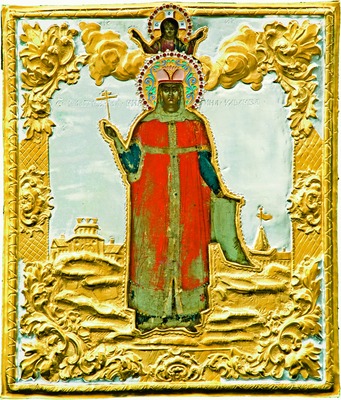
Right-Believing
Juliania of Vyazma
Princess of Vyazma
Wife of Prince Simeon Mstislavich of Vyazma, daughter of the boyar Maxim Danilov, martyred in 1406.
- Feast
- December 21old style January 3
- Reposed
- 140615th century
Life
The right-believing princess and martyr Juliania of Vyazma (also called of Novotorzhsk) was the wife of Prince Simeon Mstislavich of Vyazma, the daughter of the boyar Maxim Danilov, and was killed on 21 December 1406. She is honoured in the Russian Church as a saint. She is remembered on 21 December (3 January on the new calendar) and on 2 June (15 June), the day of the finding of her relics.
Martyrdom
According to her life, Prince Yury Svyatoslavich of Smolensk, enticed by her beauty, killed her husband at a feast and made an attempt on her chastity. Defending herself, Juliania struck him with a knife, and Yury, enraged, cut off her hands and feet with a sword and ordered her body to be thrown into the river Tvertsa. This took place on 21 December 1406. The Serbian and Ukrainian sources give a more detailed story: Simeon was at the court of Yury, and both lived in exile at Torzhok, after the invasion of Lithuania at Vyazma and Smolensk. Yury had fallen in love with Juliania and tried to entice her. One day he invited the couple to a feast and killed Simeon, to force Juliania to marry him. Since she rejected him again, he cut her down with the sword.
Relics
In the spring of 1407 her body was found floating against the current on the river Tvertsa and, by tradition, a sick peasant heard a voice from heaven commanding him to gather the clergy and bury the body at the south doors of the Transfiguration cathedral of Torzhok. The peasant was healed, according to a Ukrainian source, and, as the Church testifies, in the following centuries a number of healings occurred from her relics. In 1815, during repairs, the tomb of Saint Juliania was opened. Her relics were placed in a shrine in the side chapel built in her honour (consecrated on 2 June 1819). In 1918, after the closing of the cathedral by the Bolsheviks, the relics were moved to the church of the Archangel Michael and stayed there until 1930. After that their fate is not known. On 19 February 1919 the shrine with the relics was opened by representatives of Soviet power and, according to the report, in it were found, among other bones, the bones of the hands, which contradicts the life of the saint.
Commemorated the same day December 21
 Juliana of NicomediaMartyrDec 21
 Anton II of GeorgiaSaint · Catholicos-Patriarch of GeorgiaDec 21
 Philaret of KievSaint · Metropolitan of Kiev and GaliciaDec 21
 Procopius of VyatkaFool-for-Christ · Fool for ChristDec 21
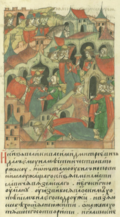 Siméon MstislavitchRight-BelievingDec 21
 Themistocles of MyraMartyrDec 21
 Nikita PribytkovHieromartyr · Bishop of BelevDec 21
- 130 Holy WomenSaintsDec 21
- 500 MartyrsHoly MartyrsDec 21
- BaudacariusVenerableDec 21
- BeornwaldHieromartyr · Priest of BamptonDec 21
- Flann son of FoircheallachSaintDec 21