Apostle
Archippus
Apostle of the Seventy
Christian of Colossae, mentioned in the epistles to the Colossians and Philemon, honored as one of the Seventy.
- Feast
- February 19old style March 4
- Reposed
- 1001st century
- Place
- Colossae
- Order
- Apostles
Life
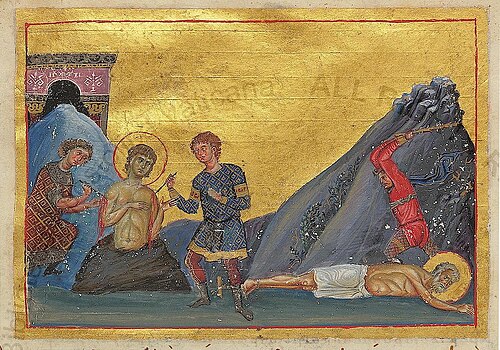
The holy Apostle Archippus, one of the seventy, was a Christian of Colossae whom Saint Paul calls his fellow soldier. He is named in the Letter to Philemon and the Letter to the Colossians. According to tradition he was bishop of Laodicea and died for Christ. The Orthodox Church keeps his memory on 19 February, with Philemon and Apphia on 22 November, and in the synaxis of the seventy apostles on 4 January.
In the New Testament
The name Archippus means "master of the horse" in Greek. In the Letter to Philemon (verse 2) Paul writes to Philemon, to Apphia and to "Archippus our fellow soldier," and to the church that met in their house. In the Letter to the Colossians (4:17) Paul sends this word to him through the church: "See that you fulfil the ministry that you have received in the Lord." So Archippus had a task in the Church, probably at Colossae, which Paul urged him to complete. The New Testament says no more of him.
According to tradition
The Apostolic Constitutions of the fourth century name Archippus as the first bishop of Laodicea in Phrygia. Another tradition counts him among the seventy disciples whom the Lord sent out in Luke 10. The Greek synaxarion says that Paul brought him to the faith at Colossae and that his zeal soon made him a fellow soldier of his master.
The accounts of his death differ. In the synaxarion of 19 February, he was arrested on the order of a governor, Androcles, and refused to sacrifice to idols. He was stripped and buried to the waist in a pit, pricked with needles, and, as he went on confessing Christ aloud, stoned to death. The synaxarion of 22 November, which is shared with Philemon and Apphia, tells that during a pagan festival, in the persecution of Nero, a crowd burst into the Christian assembly. Archippus was beaten and stabbed with knives, and died on the way to the trial, while Philemon and Apphia were stoned by order of the governor. These are traditions, and historians cannot confirm them.
Veneration
The Church remembers him on 19 February with Philemon and Apphia, and again on 22 November with them and Onesimus. The Catholic Church honours him on 20 March.
Commemorated the same day February 19
 PhilemonApostle · Apostle of the SeventyFeb 19
 Beatus of LiébanaConfessor · Spanish monk and theologianFeb 19
 Quodvultdeus of CarthageConfessor · Bishop of CarthageFeb 19
 Philothei of AthensVenerable Martyr · Nun of AthensFeb 19
 Dositheus of GazaVenerable · Disciple of Dorotheus of GazaFeb 19
 Mansuetus of MilanSaint · Archbishop of MilanFeb 19
 Barbatus of BeneventoSaint · Bishop of BeneventoFeb 19
- Conon of PentuclaVenerable · Abbot of PentuclaFeb 19
- Sylvester of AlexandriaSaint · Patriarch of AlexandriaFeb 19
- Baoithin son of GuanaSaintFeb 19
- Daigh son of NenuaillSaintFeb 19
- Dionysios of SiatistaVenerable · of St Demetrius Skete (Vatopedi)Feb 19