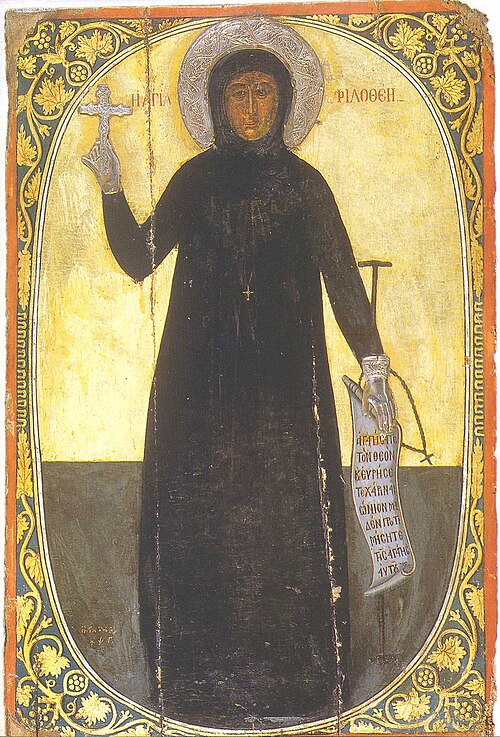
Venerable Martyr
Philothei of Athens
Nun of Athens
Greek nun of Athens under Ottoman rule, martyred in 1589.
- Feast
- February 19old style March 4
- Reposed
- 158916th century
- Place
- Kalogreza
- Order
- Martyrs
Life
Saint Philothei of Athens, venerable martyr, was a Greek nun of Athens under Ottoman rule, known for her great almsgiving, and she died of beatings received from the Turks on 19 February 1589. The Church commemorates her on 19 February and regards her as protector of Athens.
She was born on 21 November 1522 at Athens, with the name Revoula (Rigoula) Benizelos, into the wealthy and renowned Benizelos family, the daughter of Angelos Benizelos and Syrigi Palaiologina, both from old Byzantine families. Her parents had no children and, after fervent prayer, her mother bore a girl. She grew up in the faith and with a fine mind. At fourteen she was married, against her will, to the noble Andrea Chila, much older, who mistreated her. She was widowed at seventeen, beautiful and rich, and her parents urged her to marry again; she said she wished to follow the ascetic life and stayed at home, in prayer. The family wealth let her do works of charity and, while still young, she enjoyed the love and respect of the community. After her parents' death, in 1549, she was left owner of extensive holdings. She received tonsure with the name Philothei and, around 1551, founded a women's monastery, dedicated to the holy Apostle Andrew, in the courtyard of her parents' house; she entered first among the nuns as abbess, with other girls of renowned families of Athens, about a hundred and fifty. There the nuns taught girls handiwork, weaving, housekeeping and cooking; Philothei also built a school for girls and boys. She founded a second, more secluded monastery at Patisia.
Remembered above all for her great almsgiving, she built hospices, homes for the elderly and schools, and worked at Athens and on the Aegean islands. She did one thing that sometimes stirred opposition: she bought the freedom of Greeks taken as slaves by the Turks, especially women taken to harems. She sheltered young women, some pregnant, and, although hunted by the Turks, helped them escape in secret to Tzia, Andros, Aegina and Salamis. In a letter of 22 February 1583 to the Venetian Senate she asked for financial help for debts she owed the Turks, from ransoms, duties, bribes and taxes. Her monasteries were often plundered. Four women enslaved in harems fled to her; they were traced, and Philothei was beaten and brought before the magistrate, who put her in prison. Friends intervened and paid the governor for her release. As her fame grew, so did the hatred against her. On 3 October 1588, during the evening vigil (the feast of Saint Dionysius the Areopagite), four Ottoman mercenaries broke into the monastery at Patisia and beat her severely. She stayed in bed and died of her wounds, at Kalogreza, on 19 February 1589. Shortly after her death she was enrolled among the saints, in the time of Patriarch Matthew II. Her relics are kept in the sanctuary of the metropolitan cathedral of Athens. Her parents' house in the Plaka district of Athens is probably the oldest house in the city.
Commemorated the same day February 19
 ArchippusApostle · Apostle of the SeventyFeb 19
 PhilemonApostle · Apostle of the SeventyFeb 19
 Beatus of LiébanaConfessor · Spanish monk and theologianFeb 19
 Quodvultdeus of CarthageConfessor · Bishop of CarthageFeb 19
 Dositheus of GazaVenerable · Disciple of Dorotheus of GazaFeb 19
 Mansuetus of MilanSaint · Archbishop of MilanFeb 19
 Barbatus of BeneventoSaint · Bishop of BeneventoFeb 19
- Conon of PentuclaVenerable · Abbot of PentuclaFeb 19
- Sylvester of AlexandriaSaint · Patriarch of AlexandriaFeb 19
- Baoithin son of GuanaSaintFeb 19
- Daigh son of NenuaillSaintFeb 19
- Dionysios of SiatistaVenerable · of St Demetrius Skete (Vatopedi)Feb 19